
Plastic is rarely just plastic. Behind a water bottle, a cable or a food container there’s usually a recipe: a base polymer plus additives that make it flexible, tough, colorful or fire-resistant. Many of those ingredients are fine under normal use. A few carry real health concerns. And the label almost never tells you which is which.
This guide sorts it out. You’ll see what’s in plastic, which chemicals deserve your attention, how they reach you, and which habits make a difference. It also covers recent rule changes, including the EU’s BPA ban and the FDA’s phthalates review.
Key takeaways
- Plastics are polymers plus additives. What’s inside depends on the plastic type and what it’s designed to do.
- The chemical groups that get the most scrutiny are bisphenols (like BPA), some phthalates, some PFAS and certain flame retardants.
- “BPA-free” labels and recycling numbers don’t tell you a product is free of chemicals of concern.
- The habits that matter most: heat food only in containers labeled for it, replace scratched or warped containers, choose glass or stainless steel for hot food and drinks, and keep household dust down.
- A chemical being present isn’t the same as harm. Dose, timing and exposure route decide the risk.
What’s actually in plastic
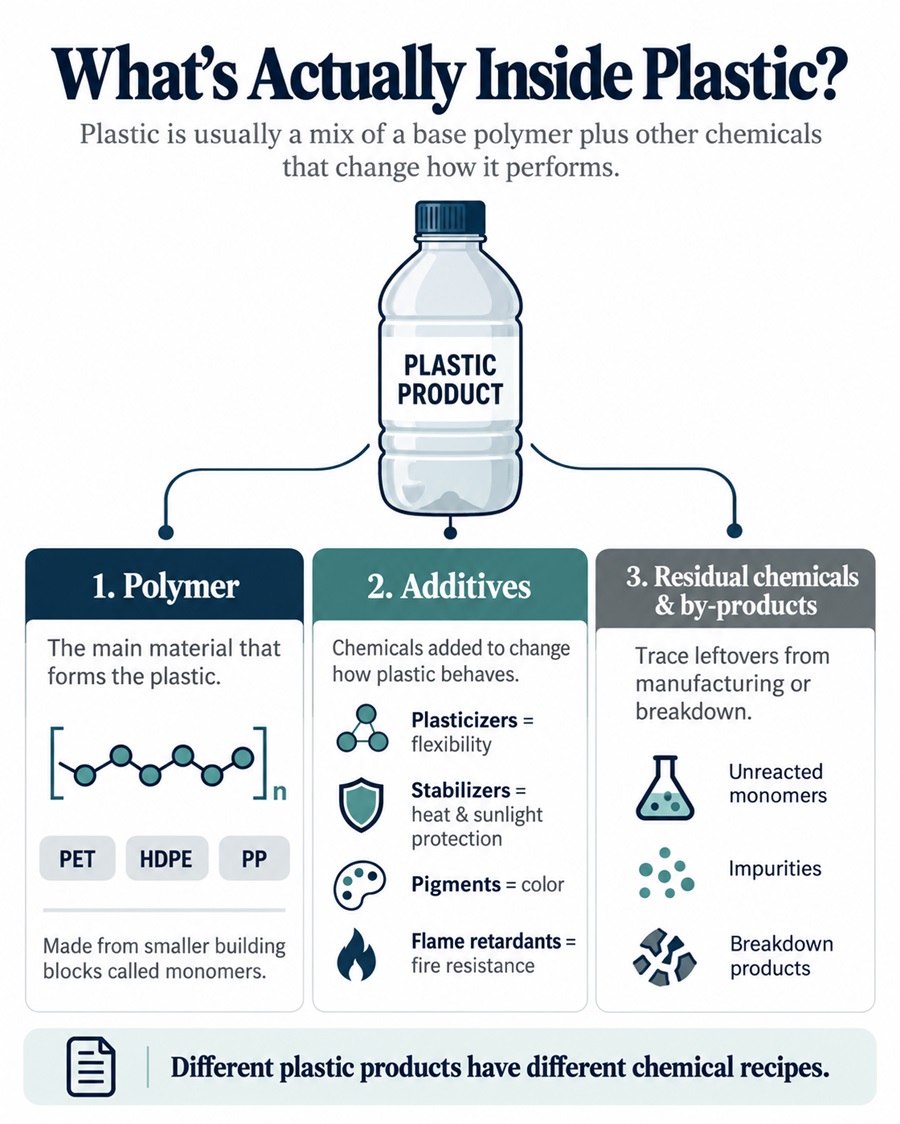
Three terms cover most of it:
- Polymers are the backbone: long chains of repeating units, like polyethylene, polypropylene and PET.
- Monomers are the small building blocks that get linked into polymers. Traces of unreacted monomer sometimes remain.
- Additives change how the plastic behaves. Plasticizers soften it, stabilizers protect it from heat and sunlight, flame retardants slow burning and pigments add color.
Take PVC. Rigid, it becomes pipes and window frames. Soft and flexible, it becomes cable insulation and flooring, and plasticizers are usually what make the difference.
The scale of plastic chemistry is large. The UN Environment Programme’s 2023 assessment linked more than 13,000 chemicals to plastics and flagged over 3,200 with hazardous properties. A 2025 paper in Cambridge Prisms: Plastics puts the figure above 16,000 across the plastics life cycle. Those numbers cover everything used in making, using and disposing of plastics. They don’t mean your lunch box contains thousands of substances.
The main chemical groups
| Group | What it does | Where you might find it | Main concern | Where the evidence stands |
| Bisphenols (BPA, BPS, BPF) | Building blocks for polycarbonate and epoxy resins | Some reusable bottles, can linings, jar lids | Hormone disruption, immune effects | Well-established concern for BPA, restricted in the EU. Replacements still being studied |
| Phthalates | Plasticizers that soften PVC | Some vinyl flooring, cables, hoses, older toys | Reproductive and developmental effects (certain phthalates) | Several restricted. Others under review |
| PFAS | Water-, grease- and stick-resistance, processing aids | Some coatings, fluoropolymers, treated packaging | Persistence in the environment and body, some linked to health effects | Active regulatory attention, varies by substance |
| Flame retardants | Slow ignition | Some electronics and building materials | Persistence and toxicity of certain types | Some legacy types restricted internationally |
| Stabilizers, antioxidants, colorants | Protect the plastic, set color | Almost everything | Depends entirely on the substance | Mostly low concern. Some older metal-based types restricted |
| Residues and by-products | Left over from manufacturing | Varies | Depends on identity and how much migrates | Assessed case by case, especially for food contact |
The table shows possible associations, not ingredients every product contains.
BPA and its replacements
BPA goes into polycarbonate plastic and epoxy coatings, including some can linings. It can interfere with hormone signaling, and in 2023 the European Food Safety Authority (EFSA) concluded that dietary BPA exposure is a health concern across all age groups, with immune effects at the center of its assessment.
Many manufacturers switched to BPS or BPF. The catch: some of those have shown hormone-related activity in lab studies too. So “BPA-free” tells you one chemical was left out. It doesn’t tell you what went in instead.
Phthalates
These are a big family, and not every member is a problem. Some, including DEHP, DBP and BBP, have raised reproductive and developmental concerns and face restrictions, especially in toys and childcare products. Plenty of flexible plastics, like polyethylene film, don’t need phthalates at all. Judge individual substances, not the whole family.
PFAS
PFAS aren’t standard ingredients in plastic. They show up in specific cases: some fluoropolymers, certain coatings, some historic grease-proof packaging. What worries scientists is that many don’t break down and can build up in people and wildlife. The US EPA also found PFAS leaching from certain fluorinated HDPE containers. That traced back to a particular surface treatment, not ordinary HDPE.
Flame retardants
They’re mostly relevant to electronics and building materials. Some older brominated types are persistent pollutants and have been restricted internationally. Newer formulations and design changes mean a modern device isn’t automatically loaded with them.
Everything else worth knowing
Some substances aren’t added on purpose. Leftover monomers, impurities and breakdown products are called non-intentionally added substances (NIAS), and food-contact safety assessments have to consider them. Specific ones people ask about include styrene in polystyrene, vinyl chloride in PVC production, and lead or cadmium in older pigments and stabilizers (now restricted in many uses).
Where you’ll run into them
| Product | What to know |
| Disposable PET water bottles | PET doesn’t normally use BPA. Trace residues are possible but generally assessed as low |
| Reusable plastic bottles and containers | Check the material and intended use. Some polycarbonate products use bisphenol chemistry |
| Plastic wrap and bags | Different products use different polymers and additives |
| Flexible PVC (flooring, cables, hoses) | Plasticizers and stabilizers vary by product and market |
| Electronics | Flame retardants and pigments depend on safety and performance needs |
| Baby bottles, teethers and toys | Among the most regulated products. Look for compliance with your region’s standards |
| Recycled plastic goods | Can carry original additives and contamination from earlier use |
The recycling number on the bottom of a product identifies the main resin. #2 HDPE, for example, tells you it’s high-density polyethylene. It doesn’t reveal the pigments, stabilizers or processing aids, and it isn’t a safety certification.
How exposure happens
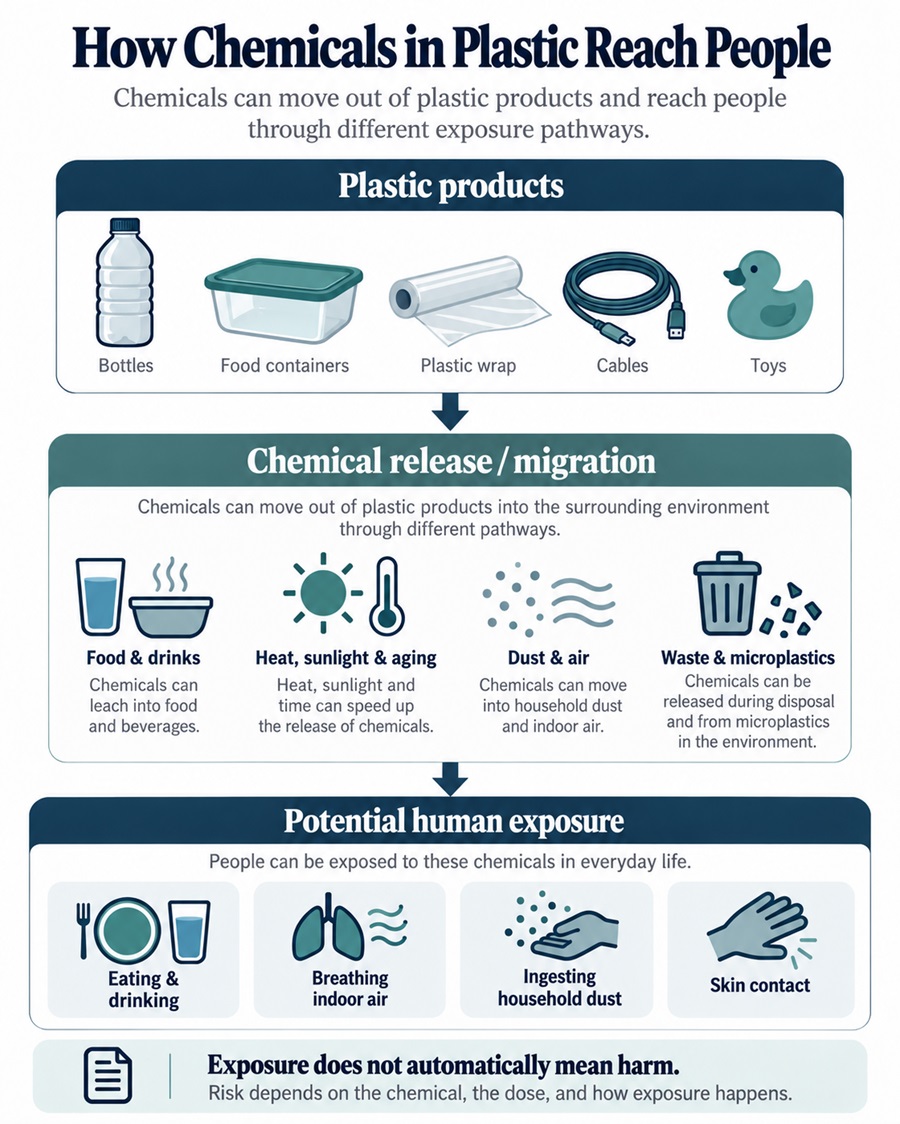
Food and drinks
Chemicals can move from packaging into what it touches. This is called migration, and it depends on:
- the chemical and the type of plastic
- temperature and how long the contact lasts
- the food itself (fatty, acidic and hot foods tend to increase migration)
- whether the product is being used as designed
Migration alone doesn’t make a product unsafe. Regulators evaluate food-contact plastics for intended temperatures, contact times and food types. Problems arise mostly when people go beyond those conditions, like reheating takeaway containers that were never meant for it. Some lab studies also suggest that steeping plastic-based tea bags or pouring boiling water into plastic-lined cups can release microplastic particles, which is one more reason to match the container to the job.
Dust, air and skin
Some plastic-related chemicals drift into indoor air and settle in household dust. You pick them up by breathing or by touching dusty surfaces and then your mouth. Skin contact can matter for some substances, though how much gets absorbed varies a lot. Small children spend more time near the floor and put things in their mouths, so their exposure pattern differs.
Waste and microplastics
Sunlight, abrasion and weathering break plastic into smaller pieces and can release associated chemicals. Microplastics can carry additives from their original manufacture. Researchers are still working out how much this contributes to human exposure compared with food, dust and air, so treat it as an open question, not a settled risk. Our guide to microplastics covers that side in depth.
What this means for your health
Start with two words that get mixed up. Hazard is what a chemical can do. Risk is the chance it actually does, given how much of it reaches you, how often, by which route and at what stage of life.
What the research has linked to certain plastic chemicals:
- Endocrine disruption: BPA and some phthalates can interfere with hormone signaling, which matters because hormones act at very low concentrations.
- Reproductive and developmental effects: shown for certain phthalates, which is why pregnancy and childhood get extra attention.
- Immune effects: the central finding in EFSA’s BPA assessment.
- Metabolic and neurological outcomes: under investigation, with evidence still incomplete, particularly for long-term exposure to mixtures.
Pregnancy, infancy and early childhood are the most sensitive windows, so that’s where precaution pays off most.
One reassurance: finding a chemical in a blood or urine test doesn’t mean you’re ill or that a specific product caused it. If you’re pregnant, planning a pregnancy or worried about a particular exposure, a doctor can help you weigh it.
Are some plastics safer than others?
Not in a way a single number can tell you. Each resin has different uses and additive needs, and the same resin can have very different formulations.
| Resin | Common uses | Chemical angle |
| PET (#1) | Beverage bottles, food trays | Trace residues, migration under intended use |
| HDPE (#2) | Milk jugs, containers, pipes | Additives and, rarely, surface treatments |
| PVC (#3) | Pipes, flooring, cables | Flexible versions need plasticizers |
| LDPE (#4) | Films, bags | Antioxidants and processing additives |
| PP (#5) | Food containers, caps | Heat tolerance varies by product |
| PS (#6) | Disposable food service items | Residual styrene |
| Other (#7) | Mixed resins | Wide variation. Some polycarbonates use bisphenols |
Two more things people often assume:
- Recycled isn’t automatically cleaner. Recycling doesn’t strip out additives. Older products may contain substances now restricted, and mixed waste streams can bring in contamination. That’s why recycled plastic for food contact needs strict controls. The fix is better sorting and traceability, not abandoning recycling.
- Biodegradable or bio-based isn’t automatically safer. Those terms describe what a material is made from or how it breaks down, not its chemical safety.
How to reduce your exposure
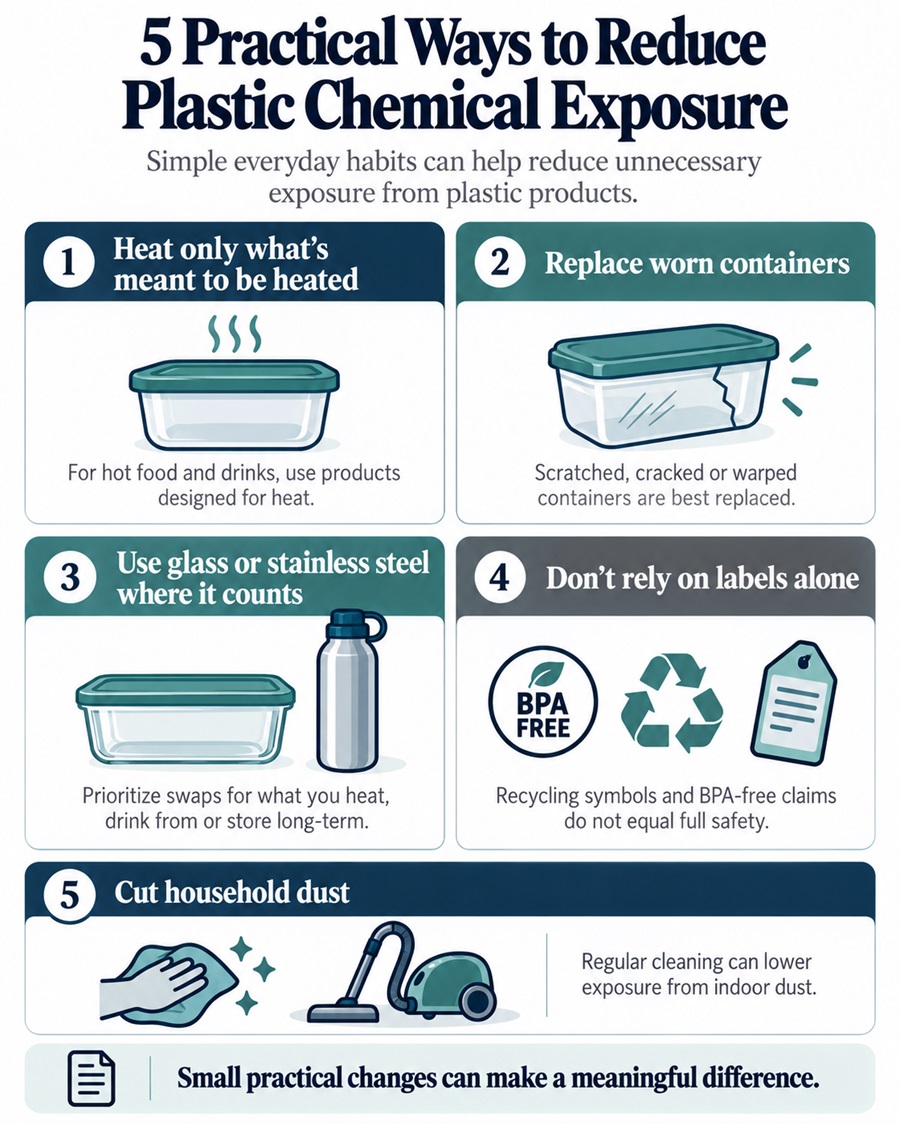
You don’t need to purge every plastic item in your home. These five changes cover most of the practical gain:
- Heat only what’s meant to be heated. Use containers labeled microwave-safe. If you’re unsure, move food to glass or ceramic, especially for hot, fatty or acidic dishes. Don’t assume takeaway tubs or thin wrappers can take heat.
- Replace worn containers. Scratched, cracked, cloudy or warped food containers no longer perform as designed, and they’re harder to clean.
- Use glass or stainless steel where it counts. Prioritize what you heat, drink from daily or store long-term. Check lids, seals and coatings too.
- Don’t lean on labels. “BPA-free” covers one chemical. A recycling symbol says nothing about food or heat safety. Terms like “natural” or “eco-friendly” aren’t safety claims either.
- Cut household dust. Wet-dust, vacuum with a good filter if you can, and wash hands before eating.
How to check a product: look for the manufacturer’s intended-use instructions (microwave, dishwasher, hot liquids), the food-contact symbol (the glass-and-fork mark in the EU), and independent testing marks such as NSF in the US or LFGB in Germany. When there’s no clear guidance, treat the product as room-temperature use only.
Rules and latest developments
Regulation is moving fast, so here’s where things stand as of October 2026.
| European Union | United States | |
| BPA | Banned in food-contact materials, with narrow exceptions. The main transition period ended on July 20, 2026 | Not banned in general food-contact use. The FDA has barred it from baby bottles, sippy cups and infant formula packaging |
| Phthalates | Restricted for certain substances and uses | The FDA released a scientific evaluation of the phthalates still authorized for food contact in May 2026. No new restrictions yet |
| Other bisphenols | Covered by the same regulation, with requirements for hazardous bisphenols | Not specifically banned |
EU BPA ban, the details. The Commission adopted it in December 2024 after EFSA’s updated assessment, and a corrective revision published on February 3, 2026 clarified definitions and transition rules. Products first placed on the market before the July 2026 deadline can still be filled and sold for a further period. Longer deadlines, running to 2028–2029, apply to some metal coatings and professional food-production equipment. Two narrow uses stay permitted: very large tanks and polysulfone filtration membranes.
US phthalates review. The FDA is weighing whether to assess the remaining authorized phthalates together as a group. Its testing found that much of the industry has already moved to alternative plasticizers, and in 2022 it revoked authorizations for 23 phthalates that manufacturers had largely abandoned. A final safety assessment hasn’t been issued.
Global plastics treaty. Chemicals of concern are one of the contested topics in the UN negotiations. As of October 2026 the talks are described as stalled, while scientists advising governments are pushing for mandatory disclosure of the chemicals in plastics. Until something binding exists, product rules will keep depending on where you live.
Frequently asked questions
Is it safe to microwave plastic containers? If the container is labeled microwave-safe, yes, when used as directed. If it isn’t, or the label’s worn off, switch to glass or ceramic. Heat and fatty food speed up migration.
Is BPA-free plastic safe? It’s a reasonable start, not a guarantee. Some BPA substitutes have shown hormone-related activity in studies. Check intended use and the product’s overall quality, not just the label.
Are baby bottles and kids’ toys a concern? They’re among the most tightly regulated plastic products, and BPA and several phthalates are restricted in them. Buy from reputable sellers, follow cleaning and heating instructions, and retire damaged items.
Do plastic water bottles release chemicals in a hot car? Heat can increase the release of trace substances from some plastics, though studies of single-use PET bottles generally find levels within safety limits. Still, don’t leave bottles baking in the sun, and don’t reuse single-use bottles for months.
Do I need to throw out all my plastic containers? No. Replace damaged ones and any you heat regularly, and move your most-used heating and long-term storage to glass or steel over time.
The bottom line
Plastic chemistry is complicated, but your response doesn’t have to be. Use products the way they were designed, retire the worn-out ones and be skeptical of one-word labels. The bigger changes, like disclosure and safer design, have to come from manufacturers and regulators.
Leave a Reply