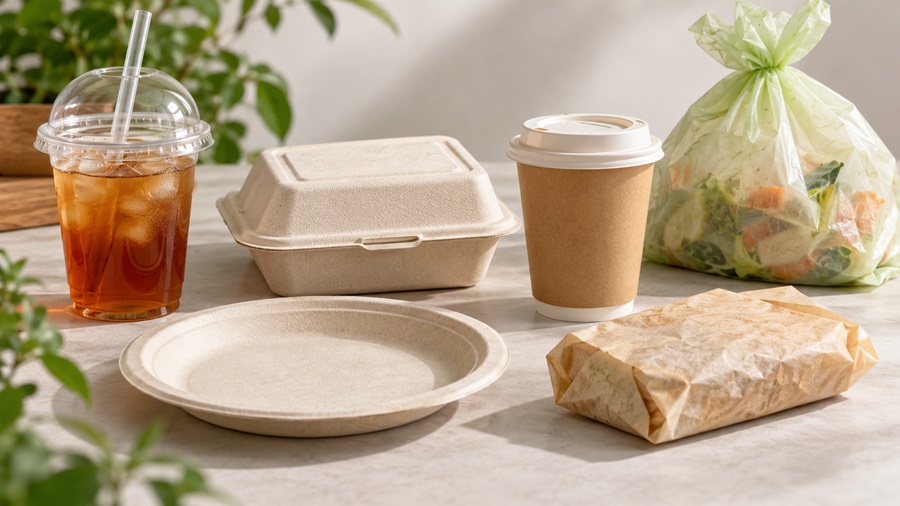
A takeaway box stamped “compostable” feels like a clean ending: eat, toss, done. Whether that’s true depends on three things most labels don’t tell you: what the box is actually made of, what’s been added to it, and whether anyone nearby will compost it.
This guide is the practical side of the topic. If you want the science and the big-picture rules (industrial vs home composting, landfill behavior, litter), start with our guide to compostable plastics. Here we focus on the packaging itself: the materials, the hidden coatings, what to look for when buying, and how to dispose of it.
Quick answer
- Compostable packaging is designed to biodegrade in a defined composting system and leave usable compost behind. Most of it needs a commercial facility, not a backyard bin.
- The label isn’t the test. Third-party certification of the whole product (coatings and inks included) is.
- It only helps if a facility accepts it. No collection route, no benefit.
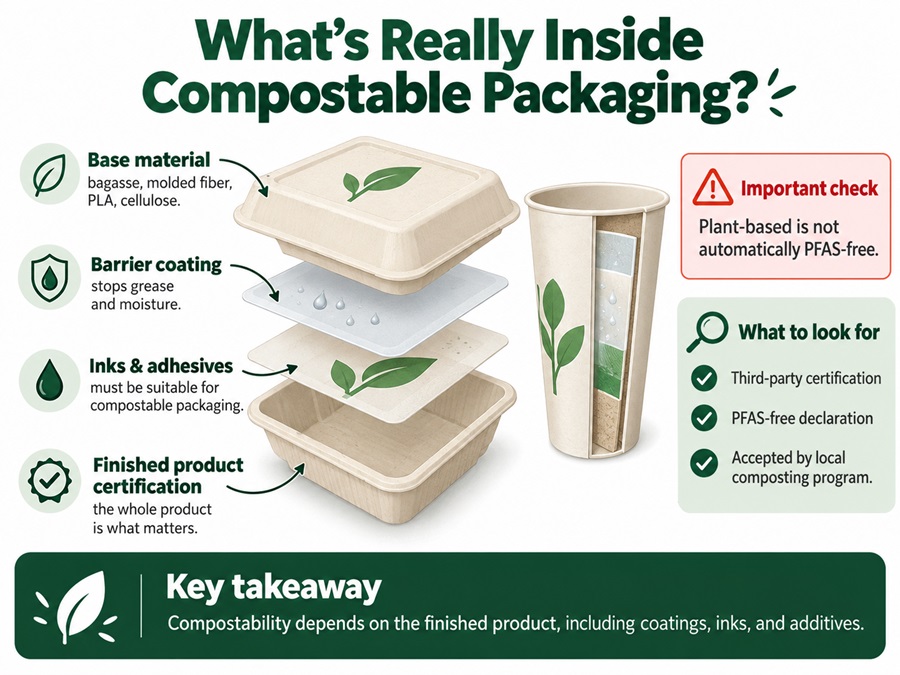
- Fiber is not automatically clean. Some “plant-based” containers have relied on PFAS for grease resistance.
Materials and formats at a glance
It’s easier to think in formats than in materials, because the same material behaves differently as a film than as a molded bowl.
| Format | Typical materials | What to look for | The catch |
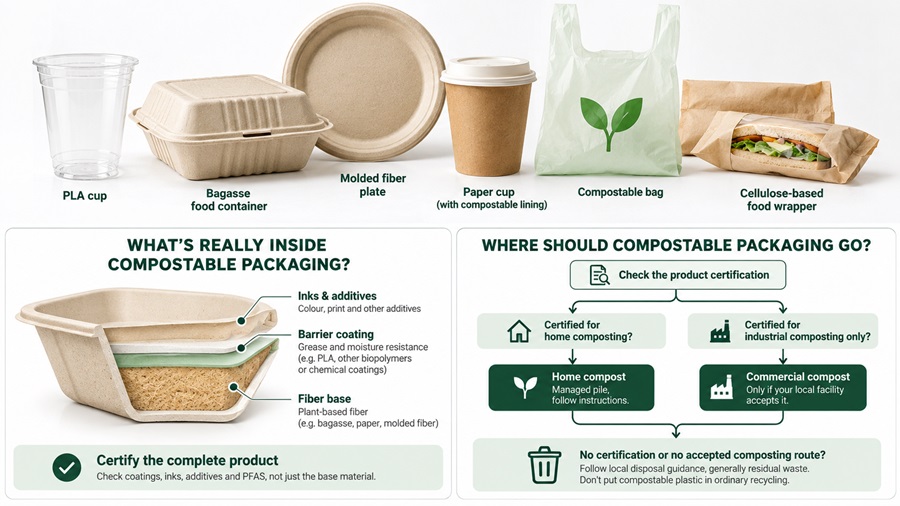
| Clear cold cups, deli containers | PLA | Commercial certification (ASTM D6400 / EN 13432) | Softens around 50–60°C; looks like PET and can contaminate recycling |
| Takeaway boxes, plates, bowls | Bagasse (sugarcane fiber), molded fiber | Certification covering coatings (ASTM D6868 for coated fiber); PFAS-free declaration | Grease-proofing coatings are where problems hide |
| Hot-drink cups | Paper with a compostable lining (often PLA) | Certified as a complete cup, lid included | A paper cup isn’t compostable just because the outside is paper |
| Food-scrap bags, produce bags | Starch blends, compostable polyesters | Certified bag, accepted by your local program | Some programs take bags but reject other packaging |
| Wrappers, flexible films | Cellulose films, PLA or PHA films | Certification for the specific film | Limited moisture and oxygen barrier, so shorter shelf life |
| Protective inserts | Molded pulp | Uncoated, no plastic layers | Usually fine, but check any waterproofing |
A few materials worth knowing:
PLA comes from fermented plant sugar (usually corn or sugarcane). It’s clear and rigid, which is why it’s everywhere in cold-drink cups. Most PLA packaging is built for industrial composting. In a cool backyard pile it can sit around for a very long time.
PHA is made by microorganisms and can biodegrade in a wider range of conditions than PLA. It’s still a niche, pricier material, and “PHA” on a spec sheet doesn’t guarantee a certified product. Ask for the certificate.
Bagasse is what’s left after sugarcane is pressed. It makes sturdy, microwave-friendly plates and boxes, and it’s one of the better-known fiber options. Its compostability depends on the finished product, not the raw fiber.
Starch blends and cellulose films show up in bags and wrappers. Many starch-based bags are blended with other polymers, so “made from corn” tells you little. Only certification of the final bag does.
The PFAS problem nobody puts on the label
Fiber containers need something to stop grease and liquid soaking through. For years, one common answer was PFAS, the “forever chemicals.” That’s a real problem for compostable packaging, because the whole point is that the finished compost goes back to soil.
Regulators have noticed:
- California prohibits products containing PFAS from being labeled “compostable.”
- A growing number of US states restrict PFAS in food packaging, and more are following.
- The EU’s Packaging and Packaging Waste Regulation (PPWR) restricts PFAS in food-contact packaging from 12 August 2026.
- BPI, the main US certifier, now restricts intentionally added PFAS as part of its certification, as we covered in the compostable plastics guide.
What this means in practice: “plant-based fiber” is not a PFAS-free claim. If you’re buying for a business, ask suppliers for a written PFAS-free declaration and a current certificate. If you’re a consumer, look for a certification mark rather than a leaf icon. Also keep in mind that PFAS rules differ by country and state, and are changing fast, so confirm what applies where you operate.
Certifications that actually mean something
A leaf logo, a green color, or the words “eco-friendly” prove nothing. These marks do, because they involve independent testing:
| Mark / standard | Region | Covers |
| ASTM D6400 | US | Plastics for industrial composting |
| ASTM D6868 | US | Paper or fiber with plastic coatings or additives |
| BPI | US / Canada | Third-party certification; separate commercial and home tiers (home launched 2025) |
| EN 13432 | EU | Packaging recoverable through industrial composting |
| OK compost INDUSTRIAL / HOME (TÜV Austria) | Global | Distinguishes industrial from home conditions |
| AS 4736 / AS 5810 | Australia | Industrial / home composting |
Two rules of thumb. First, industrial and home certifications are different claims, so don’t treat them as interchangeable. Our compostable plastics guide explains the difference. Second, check that the certificate covers the exact product you’re holding, not just one component. For industrial standards, the benchmark is roughly 90% biodegradation within about six months, plus tests for disintegration and compost quality. That’s a lab benchmark, not a promise about what happens in a landfill or on a beach.
Separate point: a certificate shows compostability, not food-contact safety. Those are approved separately.
When compostable packaging makes sense (and when it doesn’t)
It’s a good fit when:
- Food scraps and packaging leave together, such as at events, stadiums, campuses, and restaurants with an organics hauler.
- The packaging is food-soiled, the kind that’s hard to recycle.
- Your local composter has confirmed it accepts the specific items.
- Hard-to-separate items are involved: tea bags, produce stickers, food-scrap liners. This is exactly where the EU is applying its rules, with certain tea, coffee, and beverage bags and sticky fruit labels required to meet industrial composting standards by 12 February 2028.
It’s the wrong pick when:
- There’s no commercial composting nearby. A compostable cup in a landfill bin gets you the cost without the benefit.
- The product needs high heat or long shelf life. PLA struggles with hot liquids, hot cars, and dishwashers, and compostable films usually offer weaker barriers than conventional ones.
- A reusable option is realistic. A durable container used many times will usually beat any single-use item. See our reusable packaging guide.
- Good recycling already exists locally. Here, switching to compostable can make things worse, since look-alike PLA contaminates PET streams.
On cost: compostable items typically cost more than conventional plastic, and the premium varies a lot by product and volume, so get quotes. Factor in the bill beyond unit price: separate bins, staff training, and hauling fees for organics.
On lifecycle: a plant-based material isn’t automatically lower-carbon. Farming, pulping, molding, and transport all count. Compostable packaging is best judged by whether it helps capture food waste, not by its feedstock.
What’s changing in 2026 to 2028
- EU PPWR applies from 12 August 2026. It brings PFAS limits for food-contact packaging, and compostability requirements for a few specific items by February 2028. The EU’s approach is to target compostability at items that are genuinely hard to separate, rather than pushing everything that way.
- US extended producer responsibility (EPR) programs are rolling out state by state. Fees and rules for compostable packaging differ, so check how your state treats it before you commit to a supplier.
- Labeling rules are tightening. California has also seen further compostable-labeling bills proposed in 2026. Bill status changes often, so check the state legislature’s site before relying on any one proposal.
- A federal bill to restrict PFAS in food packaging was introduced in the US Congress in June 2026. Introduced isn’t enacted, so treat it as a signal rather than a rule.
- Home certification is maturing. BPI’s home program (2025) gives consumers a clearer signal, though results still vary with climate and pile management.
Where to put it after use
Work down this list in order:
- Look for a certification mark. No mark, no composting. Treat it as trash or follow local guidance.
- Is it home-certified? If yes, and you keep a well-managed compost pile, it can go in. Cutting it into smaller pieces helps. It may take longer in cold weather.
- Is it industrial-only? Check with your local organics program whether it accepts that specific item. Some facilities take bags but not cups or cutlery, and some take only food scraps. Also note that many anaerobic digesters (biogas plants) don’t accept compostable packaging either.
- No facility available? Use the general waste bin. Don’t put it in the recycling bin unless your recycler explicitly says it takes it, and never leave it outdoors, since “compostable” is not “litter-safe.”
For why each of these rules exists, see our compostable plastics guide. Packaging sold as “degradable” or “oxo-degradable” is a different story entirely, covered in our oxo-degradable plastics article.
Buyer’s checklist for businesses
Before you switch a product line, confirm:
- ☐ The finished product (not just the material) has a current third-party certificate
- ☐ The certificate type matches your disposal route (industrial vs home)
- ☐ You hold a written PFAS-free declaration from the supplier
- ☐ Your local composter or hauler has confirmed in writing that it accepts these items
- ☐ The product is approved for food contact and tolerates your temperatures and shelf-life needs
- ☐ Customers can tell where to put it (clear labeling, bin signage)
- ☐ You’ve compared it with reusable and locally recyclable options
FAQ
Is compostable packaging the same as biodegradable? No. Compostable means it passed defined tests in a composting system. “Biodegradable” alone has no set timeframe or conditions. The compostable plastics guide breaks down the differences.
Can I put it in my recycling bin? Usually not. Compostable plastics can look like conventional plastic and contaminate recycling. Only do it if your local program says so.
How long does it take to break down? In an industrial facility, certification tests look for about 90% biodegradation within roughly six months. At home it’s less predictable and often slower, especially in cold weather.
Will it break down in a landfill or the ocean? Don’t count on it. Landfills have little oxygen, and certification doesn’t cover marine or open-air conditions. Discarding it outdoors is still littering.
Is it safe for food? Compostability and food-contact safety are separate approvals. Buy items designed and approved for food use, and ask about PFAS.
The bottom line
Compostable packaging works when three things line up: a certified product, a clean ingredient list (PFAS included), and a facility that really takes it. If any link is missing, a reusable or locally recyclable option is usually the better call. Explore the wider options in our plastic alternatives guide, or compare materials in paper vs plastic.
Leave a Reply