
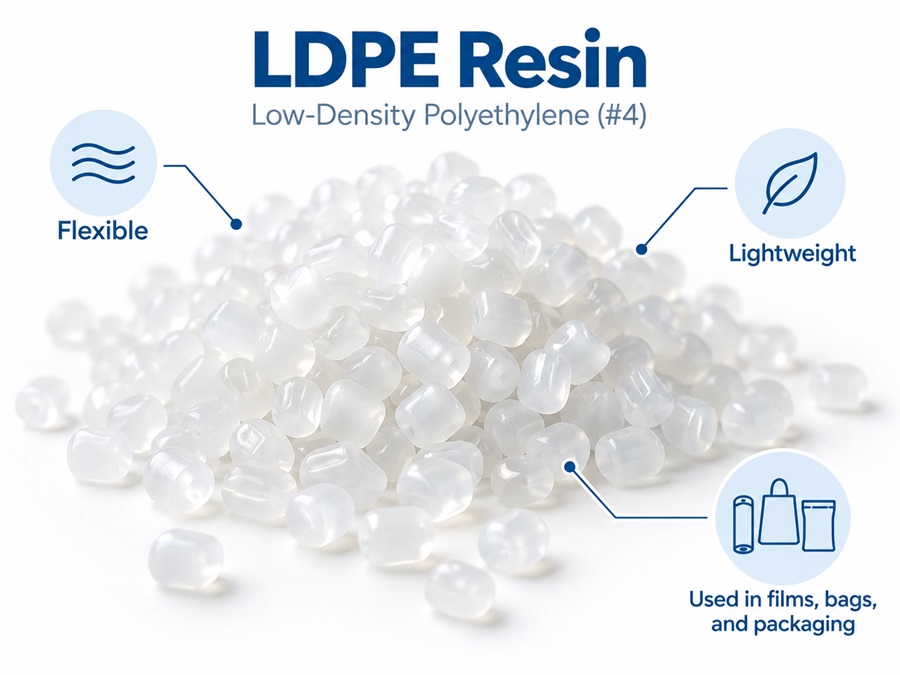
If you’ve ever squeezed a ketchup bottle, torn open a bread bag, or pulled plastic wrap tight over a bowl, you’ve handled LDPE. It’s one of the most common plastics in daily life, yet most people have never heard its full name: Low Density Polyethylene, or resin code #4 if you’ve ever flipped over a container to check the little triangle stamped on the bottom.
Here’s what actually matters about this material — what it is, why it behaves the way it does, and why that little #4 symbol doesn’t mean what most people assume it means.
The Short Version: What Is Low Density Polyethylene
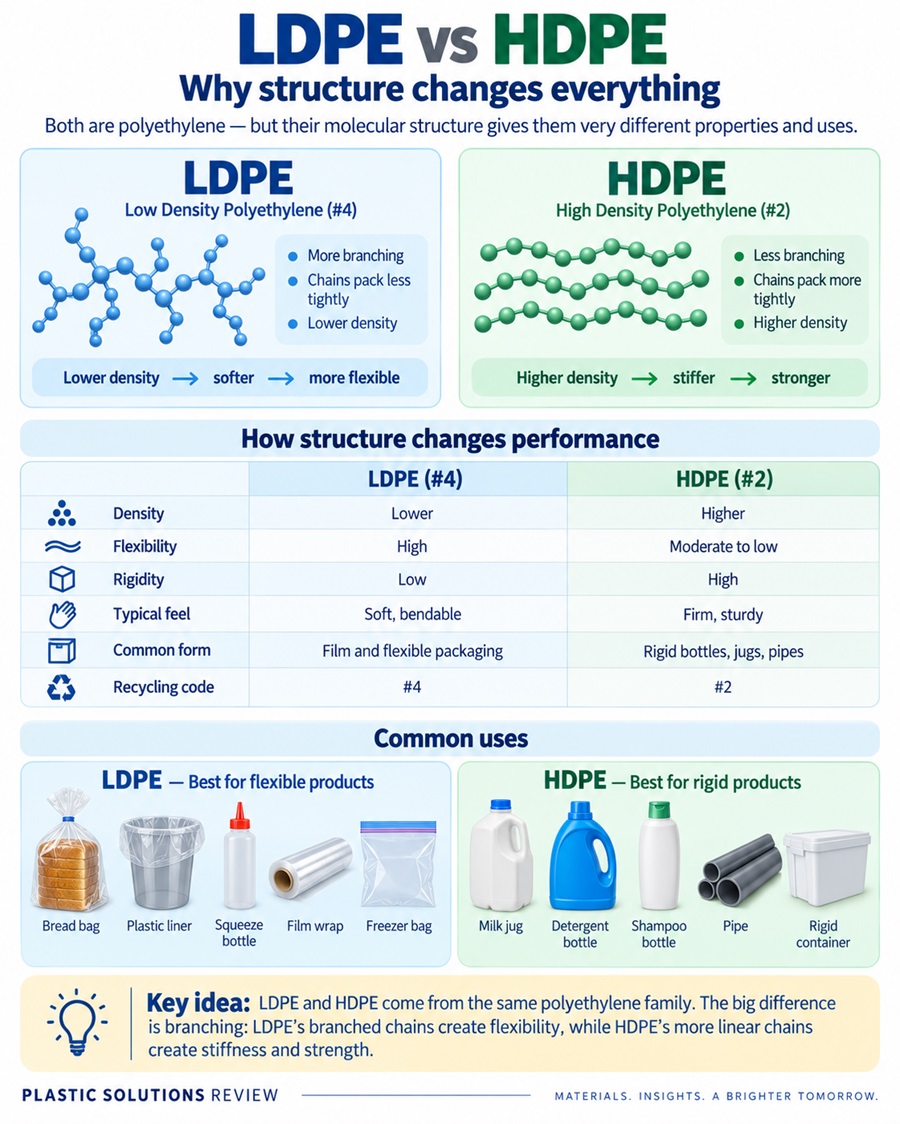
LDPE is a soft, bendy plastic built from ethylene molecules. What separates it from its stiffer cousin HDPE isn’t the ingredients — it’s how the molecular chains are arranged. LDPE’s chains are branched, kind of like a tree with lots of side twigs, which stops them from packing together tightly. Loosely packed chains mean lower density, and lower density means a material that flexes instead of cracks. That’s why it ends up in bags, films, squeeze bottles, and cable coatings instead of rigid jugs.
The catch is what happens after you’re done with it. LDPE can technically be recycled, but the thin, floppy products made from it — bags, wraps, film — are a nightmare for standard recycling equipment. So while the material itself isn’t the problem, the form it usually takes often is.
Where LDPE Came From
LDPE isn’t a modern invention. Two chemists, Eric Fawcett and Reginald Gibson, stumbled onto it in 1933 while experimenting with ethylene gas under intense pressure at Imperial Chemical Industries in England. The result was a waxy white solid nobody was specifically trying to make. ICI patented the process a few years later, and by 1939 commercial production was underway — right as World War II created massive demand for the material’s excellent electrical insulation, which made it ideal for radar cable.
That original high-pressure process is, remarkably, still the backbone of how LDPE gets made today. Everything else in the polyethylene family — HDPE in the 1950s, LLDPE in the 1970s — came later. LDPE was first.
What Does LDPE Mean?
LDPE stands for Low Density Polyethylene, identified by resin code #4 in the Resin Identification Code system:
| Code | Plastic |
| #1 | PET — Polyethylene Terephthalate |
| #2 | HDPE — High Density Polyethylene |
| #3 | PVC — Polyvinyl Chloride |
| #4 | LDPE — Low Density Polyethylene |
| #5 | PP — Polypropylene |
| #6 | PS — Polystyrene |
| #7 | Other |
One point is easy to misunderstand: the #4 symbol identifies the resin — it does not guarantee that the product belongs in your local recycling bin. The EPA specifically notes that resin identification numbers help identify plastic type but don’t necessarily mean a community recycling program accepts that item. This distinction matters more for LDPE than for most plastics, because flexible film is handled so differently from rigid containers in most recycling systems.
What Is LDPE Made Of?
The basic building block of LDPE is ethylene, a small hydrocarbon molecule. Conventional ethylene is usually produced from fossil-based feedstocks (natural gas or naphtha from crude oil). During polymerization, thousands of ethylene molecules join into long polymer chains.
A simplified pathway:
Feedstocks → ethylene → polymerization → LDPE resin → extrusion or molding → finished product
Chemically, LDPE and HDPE are both forms of polyethylene. The major difference lies in how their molecular chains are arranged, not in the base monomer itself.
Why “Low Density”?
Think of the polymer chains like strands of spaghetti. If you lay straight strands next to each other, they pack in tight. Now imagine each strand has little branches sticking off it at random points — you can’t pack those nearly as closely. That’s the structural story of LDPE versus HDPE.
More branching means the chains can’t crystallize into a dense structure. Less density means more room for the material to flex and bend without snapping. It’s a direct trade: LDPE gives up stiffness and gets flexibility in return. HDPE goes the other way — fewer branches, tighter packing, more rigidity, less give.
What It’s Actually Used For
LDPE shows up anywhere flexibility matters more than structural strength:
- Film and bags — bread bags, produce bags, freezer bags, shrink wrap, dry cleaning bags
- Squeeze bottles — condiments, lotions, anything you need to compress
- Coatings — the thin plastic layer inside paper cups and milk cartons that keeps them from getting soggy
- Cable insulation — a role it’s held since its radar-cable days in the 1940s
- Agricultural film — greenhouse covers, mulch film, silage wrap (though LLDPE has taken over a lot of this territory)
Not everything soft and bendy is LDPE, though. Plenty of thin grocery bags are actually HDPE, and modern flexible packaging often blends LDPE with LLDPE to get better puncture resistance. The resin code stamped on the product is a far more reliable guide than how something looks or feels.
LDPE vs. HDPE vs. LLDPE — What’s the Real Difference?
People mix these up constantly, so here’s the quick version:
LDPE has heavy branching from high-pressure production, giving it softness, good clarity, and easy heat-sealing — but low strength.
HDPE has minimal branching, so it packs tightly and comes out dense, stiff, and strong. Think detergent bottles and pipe.
LLDPE is a different beast entirely — a more linear backbone with short, controlled branches added deliberately using catalysts. It trades some of LDPE’s clarity for serious gains in tensile strength and puncture resistance, which is why it dominates stretch wrap and heavy-duty shipping film.
Manufacturers frequently blend LDPE and LLDPE in the same product to balance processing ease against durability, so a single package might legitimately be “made of both.”
The Recycling Problem, Explained Properly
Here’s the part that trips people up: being recyclable and being recycled are two different things.
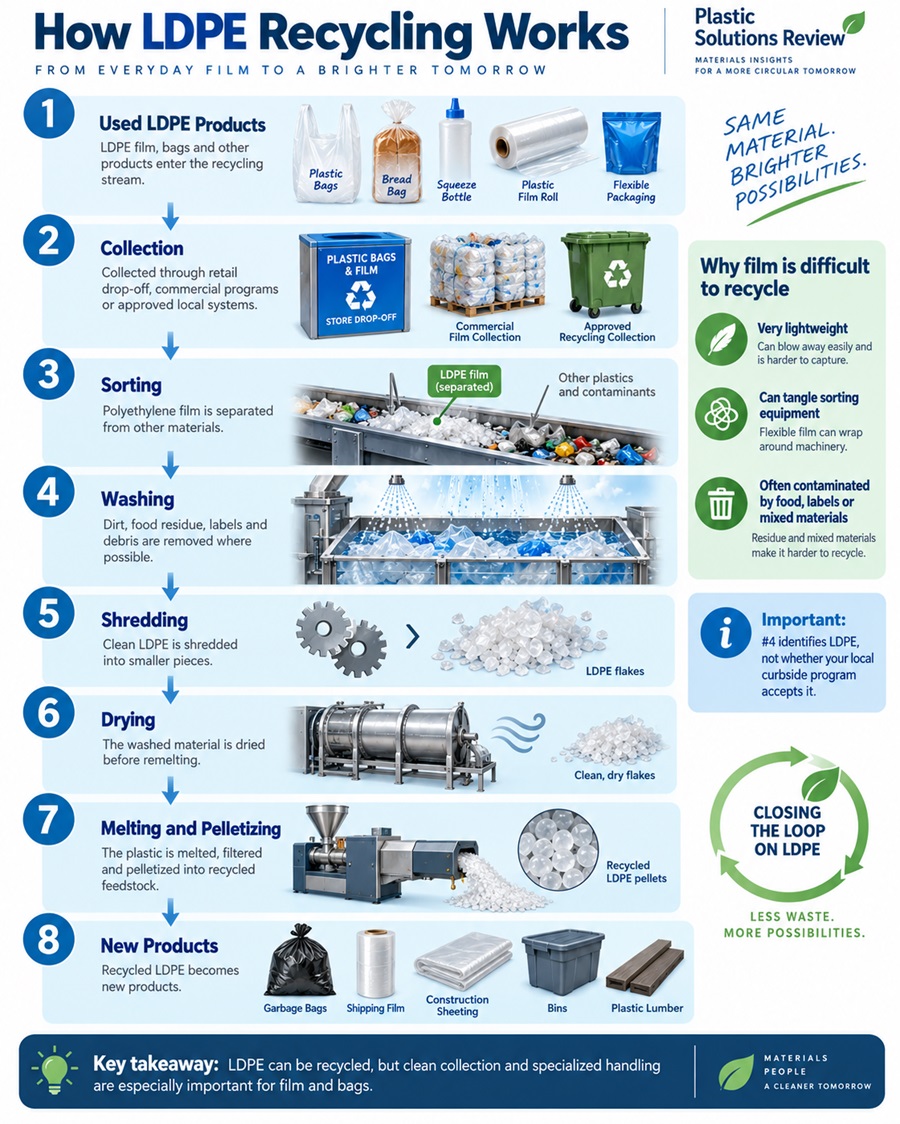
LDPE the polymer can go through standard plastic recycling. But most LDPE products are thin film, and thin film is genuinely difficult to recycle at scale for a handful of concrete reasons:
- Almost no material per item. A bread bag weighs almost nothing, so you need a huge volume of them to make recycling economically worthwhile.
- It jams equipment. Recycling facilities are built to handle rigid containers, cans, and paper. Loose film wraps around rotating machinery and literally has to be cut out by hand — it can shut down a sorting line. This isn’t a minor operational quirk: the American Chemistry Council’s Flexible Film Recycling Group has documented that facilities regularly have to halt operations entirely so employees can manually disassemble equipment and cut tangled film loose.
- Contamination kills value. Grease, food residue, tape, and labels turn clean film into unusable film fast.
- Multilayer packaging isn’t really “LDPE.” A lot of pouches and wraps bond polyethylene to foil, nylon, or other plastics for better barrier protection. You can’t just melt that down as LDPE — the layers have to be separated first, and often that’s not practical.
- Nowhere to bring it. Even clean, sorted film needs somewhere to go. In a lot of places, that infrastructure just doesn’t exist yet.
This is why most curbside programs explicitly ask you to keep bags and film out of the regular bin — not because the material can’t be recycled, but because your regular recycling stream isn’t equipped to handle it. Instead, look for drop-off bins at grocery stores, which collect film separately for the processors that can actually deal with it.
The rule of thumb: clean, dry film goes to store drop-off. Rigid #4 items sometimes go in curbside bins, depending on your local program. When in doubt, check your municipality’s actual guidance rather than trusting the resin code alone.
What Happens If It’s Not Recycled
Three main paths:
- Landfill, where it just sits — LDPE doesn’t break down there in any meaningful timeframe.
- Incineration, where some waste-to-energy plants recover a bit of energy from burning it, but the material itself is gone and its carbon becomes CO₂.
- Environmental leakage — this is the one that gets the most attention, and for good reason. Because film is so lightweight, it blows out of bins, trucks, and landfills easily, catches in trees and storm drains, and eventually works its way into rivers and oceans.
Does It Biodegrade? No — and Here’s the Distinction That Matters
LDPE does not biodegrade under normal conditions. What it does instead is fragment. Sun exposure, oxygen, and physical wear make it brittle over time, and it breaks into progressively smaller pieces — eventually microplastics. That’s an entirely different process from biodegradation, where microorganisms actually convert a material into simpler, harmless substances. Getting smaller isn’t the same as going away.
Is It Safe to Use?
Generally, yes, within the limits the manufacturer intended. A few clarifications that cut through the confusion:
Microwaving: Only safe if the specific product is labeled for it. The resin code tells you nothing about heat performance — that depends on the exact formulation and design of that item. Don’t assume.
BPA: LDPE doesn’t contain it. BPA shows up in certain polycarbonates and epoxy resins, not polyethylene. That said, finished products can include other additives, so if you have a specific concern, that’s a manufacturer question.
Food contact: LDPE is commonly used in food packaging because it seals well and resists moisture, but it’s often just one layer in a more complex structure — say, a PET exterior with an LDPE sealing layer inside. Regulators evaluate food-contact materials under defined conditions rather than blanket-approving every product made from a given polymer. The FDA’s Inventory of Effective Food Contact Substance Notifications lists specific approved substances tied to specific manufacturers and specific uses — approval is granted case-by-case, not blanket-issued to “LDPE” as a category. Calling the whole package “LDPE” would be misleading; its recycling pathway depends on the full structure, which is one reason flexible food packaging remains technically challenging even as designers cut material use.
Bio-Based LDPE: A Common Misconception
You can make ethylene from plant sugars instead of fossil fuels — ethanol-derived ethylene, essentially — and polymerize it into something chemically almost identical to conventional LDPE. This is where people get tripped up: bio-based does not mean biodegradable. Where the carbon originated and what happens to the material at the end of its life are two completely separate properties. Bio-based LDPE can still sit in a landfill indefinitely, just like the fossil-based version.
If You’re Looking for Alternatives
There’s no single drop-in replacement — it depends entirely on what the product needs to do.
For bags, options include reusable woven bags, paper, or thicker reusable polyethylene — though a reusable bag only pays off environmentally if it actually gets reused many times over.
For flexible packaging, mono-material polyethylene designs (skipping the multilayer laminate) are far easier to recycle than mixed-material pouches, even though they may sacrifice some barrier performance.
For compostable plastics like PLA or PHA — these aren’t simple swaps. PLA is generally stiffer and only breaks down under industrial composting conditions, not in a backyard bin or a landfill. Worse, if it ends up mixed into regular plastic recycling, it can contaminate the batch. PHA is more versatile and can biodegrade in a broader range of environments, but it’s currently expensive and needs its own disposal stream too. The environmental win only materializes if the material actually reaches the facility it was designed for — otherwise it can underperform plain old LDPE.
How to Actually Identify and Dispose of It
Look for the #4 stamped somewhere on the product — that’s your most reliable signal, more reliable than texture or appearance, since LLDPE and HDPE can look and feel similar.
One point is easy to misunderstand: the #4 symbol identifies the resin — it does not guarantee that the product belongs in your local recycling bin. As the EPA’s own guidance on plastics recycling confirms, resin identification codes only help identify plastic type; they don’t necessarily mean a community recycling program will accept that item.
From there:
- Check your specific local program before assuming anything is curbside-recyclable
- Keep film and bags separate — bring them to store drop-off instead of the curbside bin, unless your program explicitly says otherwise
- Keep drop-off film clean and dry
- Never toss compostable-labeled bags into regular polyethylene film recycling — they contaminate the batch
If you’re outside the U.S., note that these guidelines (EPA references, resin codes) are U.S.-centric. The EU, UK, and other countries run their own labeling and collection systems, so local rules should take priority.
The Bottom Line
LDPE isn’t a villain or a hero — it’s a material that does one job extremely well (flexible, lightweight protection) and creates one problem in the process (that same flexibility makes it genuinely hard to recycle at scale). The branching that gives it softness is the same structural trait that makes end-of-life collection so difficult.
The more useful question isn’t whether LDPE is “good” or “bad” — it’s whether it’s the right material for a given job, whether the amount used is being kept to a minimum, and whether there’s a realistic path to recycling or reuse once you’re done with it. For most people, that boils down to one habit: check your local rules before tossing #4 plastic in the bin, especially anything flexible.
Leave a Reply