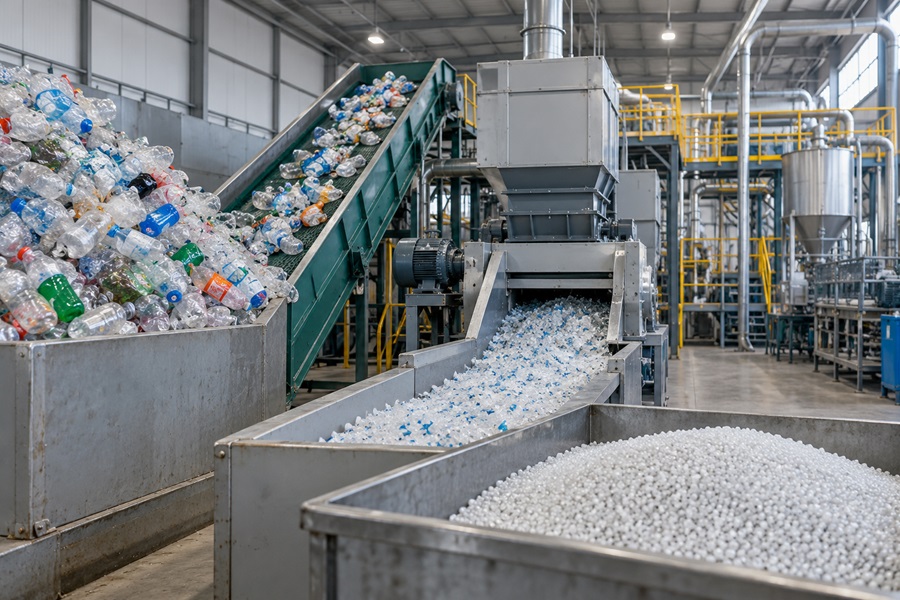
Mechanical recycling is how most recycled plastic is made today. Used plastic is collected, sorted, shredded, washed and melted into new raw material, without changing the plastic’s chemistry.
Take an empty PET water bottle. It gets cleaned, chopped into flakes, melted and formed into pellets. A manufacturer then turns those pellets into a new bottle, a food tray or polyester fiber.
It works best on clean, single-material plastics like PET and HDPE. It struggles with dirty, mixed or layered packaging. This guide covers how the process works, what it can and can’t handle, and what’s changing in 2026.
Key Takeaways
- The polymer stays intact. Plastic is physically reprocessed, not broken down into its chemical building blocks.
- Clean, sorted plastic wins. PET, HDPE and PP give the best results. Food residue, labels and mixed polymers drag quality down.
- Quality can decline. Heat, oxygen and repeated processing change the material, so “infinitely recyclable” is not a safe claim.
- Rules are catching up. The EU is setting recycled-content targets and standard counting methods, and new technology is opening up flexible packaging and food-grade recycled plastic.
- Benefits depend on the details. Real savings happen only when recycled plastic actually replaces virgin plastic.
What Is Mechanical Recycling?
Mechanical recycling turns plastic waste into reusable raw material using physical steps: sorting, grinding, washing, melting and extrusion.
It works because many common plastics are thermoplastics. They soften when heated and can be reshaped after cooling. PET, HDPE and PP all fall into this group.
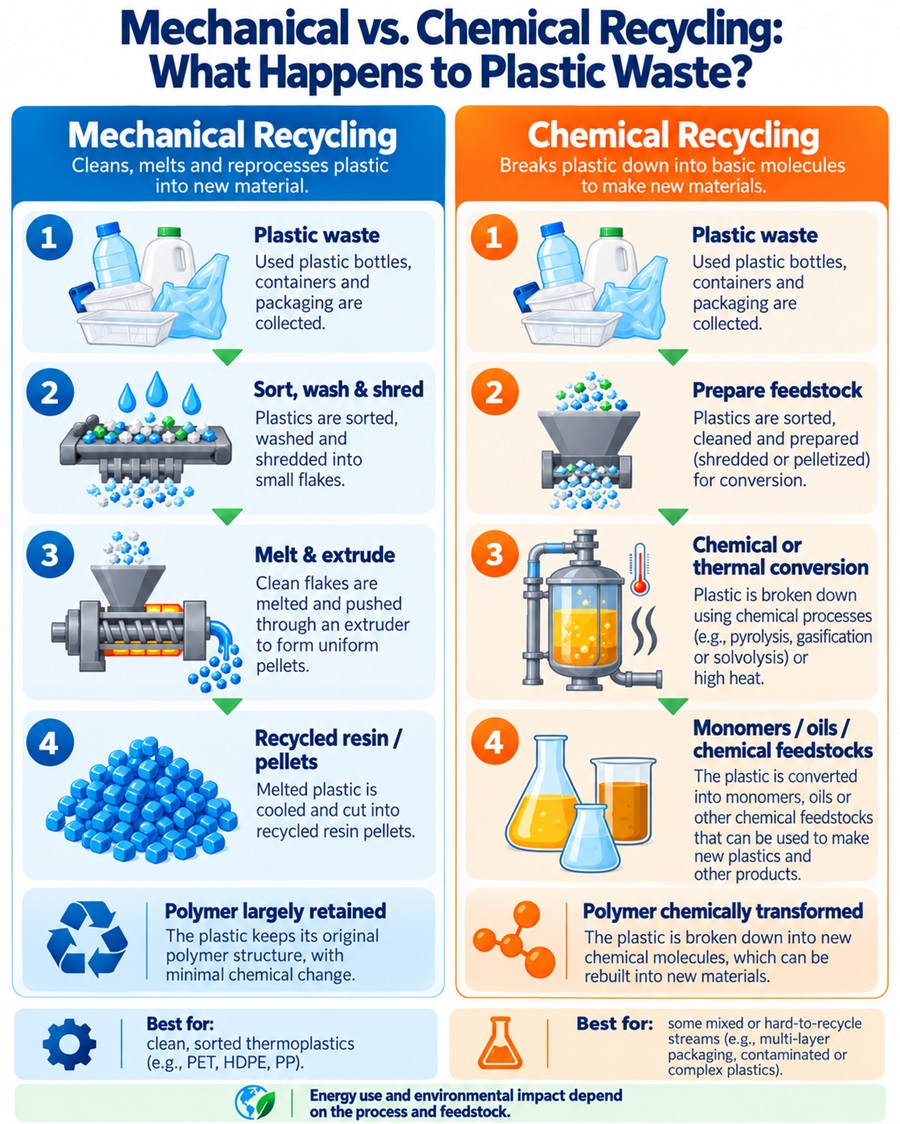
The key contrast is with chemical recycling, which deliberately breaks polymers into smaller molecules. Mechanical recycling keeps the polymer as it is. That makes it simpler and usually cheaper, but it also means the plastic carries its history with it: leftover contaminants, additives and any damage from earlier heating.
So mechanical recycling keeps the material, but it doesn’t automatically restore the quality.
How Mechanical Recycling Works, Step by Step
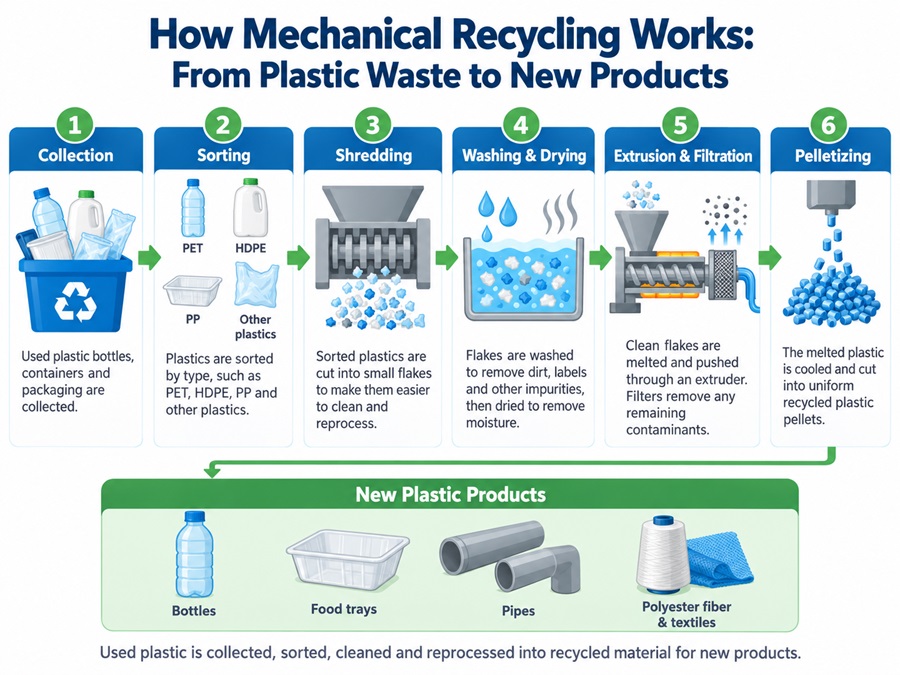
Exact equipment varies by plastic type and the quality needed, but most plants follow six stages.
1. Collection
Plastic reaches recyclers from households, businesses and factories. How it’s collected matters more than most people expect. Bottles returned through a deposit-return scheme arrive cleaner and more uniform than bottles dug out of mixed household rubbish.
Not everything collected gets recycled. Heavily soiled items, unsuitable shapes and materials that cost more to process than they’re worth are rejected.
2. Sorting
This is the most important stage. Different polymers melt at different temperatures, and mixing them gives weak, inconsistent material. Plants typically combine:
- Near-infrared (NIR) sensors, which identify polymers by how they reflect light
- Color sorting with cameras
- Magnets and eddy-current separators to pull out metals
- Manual sorting to catch what machines miss
- AI-assisted vision and robotic pickers, increasingly common in newer plants
Black plastic is a known blind spot. Many black pigments absorb the infrared light that sorters rely on, so these items often slip through unidentified.
3. Shredding
Sorted plastic is cut into small flakes. Flakes are easier to wash, separate and feed into machines than whole bottles or containers.
4. Washing, Separating and Drying
Flakes are washed to remove food residue, glue, dirt and label fragments. Plants use cold, hot or friction washing depending on how dirty the material is.
Washing also doubles as a separation step. In a float-sink tank, polyethylene (PE) and polypropylene (PP) float, while PET sinks. But PVC also sinks, and even small amounts of PVC mixed into PET can damage the recycled batch. That’s why plants combine float-sink with other sorting methods.
Flakes are then dried. Moisture causes problems in the extruder, and PET is especially sensitive to it. Wastewater has to be treated afterward so plastic particles and cleaning residue don’t leave the plant.
5. Melting, Filtering and Extrusion
Flakes go into an extruder, where heat and a rotating screw melt and mix the plastic. The melt is pushed through fine filters that catch leftover solids. Vacuum degassing pulls out moisture and volatile compounds, which also helps with odor.
Melting doesn’t count as chemical recycling here. The polymer stays largely intact, though some shortening of the polymer chains is normal.
6. Pelletizing
The melt is cut into uniform pellets, sometimes called recyclate or recycled resin. Some plants skip pellets and produce flakes, sheet or finished products directly.
For food-grade PET, many recyclers add one more step: solid-state polycondensation (SSP). It rebuilds the polymer chain length lost during melting and removes remaining contaminants, which makes bottle-to-bottle recycling possible.
The whole journey in one line: Collection → Sorting → Shredding → Washing and drying → Extrusion → Pellets → New products
Which Plastics Can Be Mechanically Recycled?
Most thermoplastics can be, but how practical it is varies a lot.
| Plastic | Common products | Mechanical recycling outlook |
| PET (#1) | Drinks bottles, food trays | Well established. Bottle streams can reach food-grade quality. |
| HDPE (#2) | Milk jugs, detergent bottles, pipes | Widely recycled wherever collection exists. |
| PVC (#3) | Pipes, window frames, flooring | Possible through specialized systems. Contaminates other streams if misplaced. |
| LDPE (#4) | Films, shopping bags | Recyclable, but dirty, thin and hard to collect. |
| PP (#5) | Food tubs, bottle caps, automotive parts | Recyclable with good sorting. Grades and additives vary. |
| PS (#6) | Rigid food packaging, foam | Technically possible, but collection and demand are limited. |
| Other (#7) | Polycarbonate, multilayer packs, bioplastics | Generally not recycled mechanically. Mixed materials are the main barrier. |
Two more points the table can’t show:
- PET and HDPE lead because of their waste streams, not just their chemistry. A clear bottle is easy to spot and collect in bulk. A snack wrapper made of several bonded layers is not.
- Thermosets (like some epoxies and rubbers) can’t be melted and reshaped, so conventional mechanical recycling doesn’t apply to them.
The lesson: technically recyclable doesn’t mean actually recycled. Local collection, sorting capacity and buyers for the material decide that.
Types of Mechanical Recycling
The most useful way to classify it is by what happens to the material afterward:
- Closed-loop: The plastic returns to the same kind of product, like a PET bottle becoming another PET bottle.
- Open-loop: The plastic becomes something different, like PET bottles becoming polyester fiber for clothing or carpets.
Open-loop isn’t automatically worse. The questions that matter are whether it replaces virgin material, whether the new product is durable, and whether it can be recycled again.
You’ll also see post-industrial recyclate (factory scrap, usually clean and well documented) and post-consumer recyclate (used products, messier and more variable). This difference matters for regulation, since many recycled-content targets count only post-consumer material.
Mechanical Recycling Examples
Mechanical recycling already runs at industrial scale. These four plants show how the setup changes with the plastic and the waste stream.
| Plant | Location | Main plastics | Scale | What it shows |
| PET Recycling Team (ALPLA Group) | Wöllersdorf, Austria | PET | 5,000 t/yr at its 2006 start; about 31,000 t/yr extrusion capacity by 2009 | Closed-loop, bottle-to-bottle recycling |
| Biffa Polymers | Redcar, UK | HDPE, PP | 83,000 t/yr (company figure) | Food-grade recycled HDPE from post-consumer plastic |
| KW Plastics | Troy, Alabama, US | HDPE, PP | 500+ million lb/yr, about 227,000 t (2025 regulatory submission) | Scale, when feedstock and buyers are reliable |
| MBA Polymers | Worksop, UK | PP, HDPE, ABS, HIPS | Not stated | Recovering polymers from mixed, complex waste |
Clean bottles, closed loop. PET Recycling Team sorts, shreds, cleans and reprocesses used PET bottles. When the output meets quality and food-contact standards, it goes back into new beverage bottles.
Same plastic, higher bar. Biffa processes milk bottles, household containers and other packaging into recycled HDPE and PP. It has also produced food-grade recycled HDPE from post-consumer plastic, which shows that good decontamination and quality control can move recyclate into demanding uses.
Built on a niche, grown to scale. KW Plastics started in 1981 recycling polypropylene from used car battery casings. It later added post-consumer HDPE and more PP streams, and its resin now goes into packaging, pipes, automotive parts and paint containers.
Mixed waste is hard mode. MBA Polymers recovers PP, HDPE, ABS and HIPS from waste containing several polymer types. That takes more sophisticated sorting and contamination removal than a uniform stream of beverage bottles.
The pattern is consistent. A bottle plant and a mixed-waste plant need different equipment, and in both cases the cleaner and more consistent the input, the more usable material comes out.
Benefits of Mechanical Recycling
It displaces virgin plastic. Every tonne of quality recyclate that replaces new resin reduces demand for fossil-based production. The key word is replaces. If recycled plastic just adds to supply, the benefit shrinks.
It usually takes less energy. Skipping the chemical production steps generally means lower energy use and emissions than making virgin plastic, though transport, electricity sources and water use all affect the result.
The technology is proven. Sorters, shredders, wash lines and extruders are in commercial use today, so suitable waste streams can be recycled now, not after a technology breakthrough.
Limitations and Challenges
Quality declines over time
Heat, mechanical stress and oxygen shorten polymer chains and can reduce strength or change how the material flows. Some plastics tolerate several cycles with good stabilizers and processing. Others lose useful properties sooner. There’s no universal number of times plastic can be recycled.
Contamination, mixed plastics and yield loss
Food residue, adhesives, incompatible polymers and some additives cause discoloration, odor and weak spots. Legacy additives, such as certain flame retardants in plastic from old electronics, add a regulatory problem on top.
Multi-layer packaging is harder still, because bonded layers don’t separate easily. And plants always lose material along the way to dirt, labels, moisture and rejects. A tonne of mixed plastic in rarely means a tonne of usable pellets out.
The economics are tough
Recycled plastic competes directly with virgin plastic. When virgin resin is cheap, recyclers struggle to cover the costs of collecting, sorting and cleaning, and low-grade recyclate is hard to sell. This is why policy matters so much here. Recycled-content mandates, producer responsibility schemes and deposit-return systems create the stable demand and funding that the market alone often doesn’t.
It can’t solve plastic pollution alone
Recycling needs collection systems, plants and buyers. Without all three, even a perfectly recyclable product ends up as waste. Using less plastic and building reuse systems remain part of the answer.
Mechanical vs. Chemical Recycling
| Mechanical | Chemical | |
| How it works | Sort, wash, shred, melt | Break polymers into smaller molecules using heat or chemistry |
| Polymer structure | Kept intact | Deliberately broken down |
| Output | Flakes, pellets | Monomers, oils, chemical feedstocks |
| Best for | Clean, sorted thermoplastics | Some mixed or contaminated streams |
| Maturity | Established | Varies widely by technology |
| Energy use | Generally lower | Often higher |
For clean, well-sorted plastic, mechanical recycling is usually the simpler and lower-energy route. Chemical recycling may help with streams that mechanical plants can’t handle, such as some multi-material films or food-contact packaging that needs very high purity. It isn’t a universal fix either. Some processes are energy-hungry, and turning plastic into fuel destroys the material rather than keeping it in the plastic cycle.
In practice, the two are increasingly treated as complements rather than rivals.
What’s Changing in 2026
This is where the field is moving fastest.
The EU now has a standard way to count recycled content in PET bottles. The European Commission adopted its first methodology for calculating, verifying and reporting recycled content in single-use PET drinks bottles, covering both mechanical and chemical recycling. Initially, only material recycled in the EU and EEA counts toward targets. From 21 November 2027, recycled plastic from OECD countries becomes eligible, unless it’s excluded under the Waste Shipment Regulation. These bottles are subject to the Single-Use Plastics Directive, which requires 25% recycled content in PET bottles from 2025 and 30% in all plastic bottles from 2030.
The Packaging and Packaging Waste Regulation (PPWR) is raising the stakes. It applies from August 2026, with minimum recycled-content targets for plastic packaging from 2030. For most non-food plastic packaging, the 2030 target is 35% post-consumer recycled content. Targets differ by packaging category, so check the regulation text for the one that applies to you.
Flexible packaging is getting a serious look. A recent Alliance to End Plastic Waste report assessed a 50,000-tonne-a-year plant using advanced mechanical recycling, meaning hot washing, double melt filtration and tighter sorting, to process household flexible packaging. The study found it can produce high-quality film for applications like shrink film, labels and pouches. It also concluded that multi-material films aimed at food contact will likely still need chemical recycling as a complement. The economics depend on producer responsibility schemes, mandated recycled content and access to low-cost capital.
Food-grade recycled polyolefins are edging closer. The European Food Safety Authority has issued Novel Technology Numbers to 24 developing recycling technologies, including mechanical and water-free cleaning processes aimed at turning PP and PE into food-contact material. That’s a significant step toward closing a gap that has held back recycled PP and PE for years.
The market is expected to grow. ICIS projects that mechanical recycling output could exceed 50 million tonnes a year by 2050, driven by recycled-content mandates, single-use plastics rules and brand commitments.
Mechanical Recycling by the Numbers
- About 9%. The share of global plastic waste that’s recycled, according to OECD estimates. Most of the rest is landfilled, incinerated or mismanaged.
- 21%. Europe’s mechanical recycling share for PET resin, per ICIS.
- 25% and 30%. EU recycled-content requirements for PET bottles (2025) and all plastic bottles (2030).
- 35%. The EU’s 2030 target for post-consumer recycled content in most non-food plastic packaging under the PPWR.
Before publishing, check each figure against its current primary source, since these numbers update regularly.
How You Can Help
Most of what helps happens at home:
- Check your local rules. What’s accepted differs by city and country. Putting the wrong items in the bin can contaminate a whole batch.
- Empty and quickly rinse containers. They don’t need to be spotless, but food residue causes real problems.
- Keep recyclables loose. Don’t bag them unless your local scheme asks you to. Small items inside bags are often missed by sorters.
- Don’t trust the chasing-arrows symbol. The numbered triangle on the bottom of a container identifies the plastic type. It doesn’t mean your local system recycles it.
- Choose simple packaging when you can. Single-material packs with removable labels are much easier to recycle than multilayer ones.
- Reuse and refill first. The most effective plastic is the plastic you didn’t need to make.
Frequently Asked Questions
What is mechanical recycling in simple terms?
It’s turning used plastic into new plastic material by sorting, cleaning, shredding and melting it, without breaking the plastic down into its chemical components.
Can all plastics be mechanically recycled?
No. Many thermoplastics can be, but mixed, contaminated and multilayer plastics are hard to process, and thermosets can’t be remelted at all.
How many times can plastic be recycled?
There’s no single answer. It depends on the polymer, contamination, processing conditions and additives. Some plastics handle several cycles, while others degrade faster.
Is recycled plastic safe for food packaging?
It can be, but only when it meets strict standards. Recycled PET is widely approved for food-contact use, in the EU and the US, when it comes from approved processes. Recycled PP and PE are still developing, with food-grade technologies now going through regulatory assessment.
What’s the difference between post-consumer and post-industrial recycled content?
Post-industrial material is factory scrap that never reached consumers. Post-consumer material comes from products people have used and discarded. Regulations often count only post-consumer content toward targets, because it’s the material that would otherwise become waste.
Does mechanical recycling release microplastics?
It can. Shredding, washing and handling release small particles, which is why good filtration, enclosed equipment and wastewater treatment matter.
Is mechanical recycling the same as downcycling?
No. Mechanical recycling describes how plastic is processed. Downcycling describes a drop in the quality or value of what it becomes. Some mechanically recycled plastic is downcycled, but bottle-to-bottle PET recycling shows it doesn’t have to be.
The Bottom Line
Mechanical recycling is the workhorse of plastic recycling. It works best when plastic is clean, sorted and designed to be recycled, and it works poorly when it isn’t. New rules and technology are widening what it can handle, but it still depends on good collection, reliable buyers and less unnecessary plastic in the first place.
Leave a Reply