
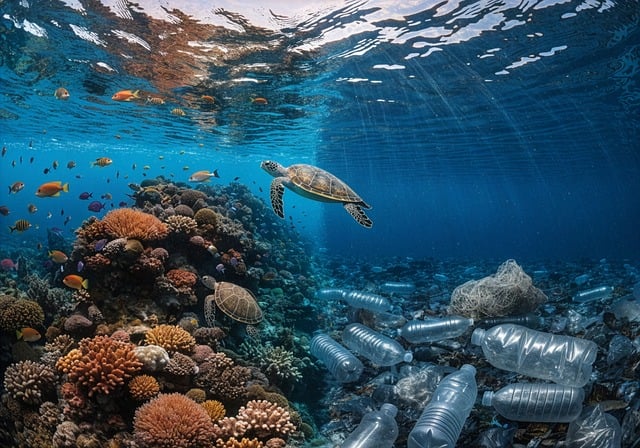
Plastic bottles showing up on beaches are just the tip of the iceberg when it comes to ocean plastic pollution. There’s heaps more of the stuff lurking out of sight – like those abandoned fishing nets down at the bottom of the sea, or tiny plastic shreds in seawater. And then there’s the waste that gets carried by rivers for hundreds of kilometres before reaching the coast. hardly anyone ever sees any of this.
Plastic can just sit around in the ocean for years, drifting from one bit of habitat to the next, or breaking down into teeny weeny pieces that keep getting smaller and smaller. Once it’s got all over the place removing it is almost impossible.
According to the OECD’s Global Plastics Outlook, a pretty rough estimate is that around 1.7 million tonnes of plastic ended up in the world’s oceans back in 2019. If we don’t get some more effective policies in place, that could get a whole lot worse over the coming decades.
The real challenge isn’t just pulling plastic out of the sea – its sorting out how to stop waste making it there in the first place. Then we can work on cleaning up where we can.
What is this Ocean Plastic Pollution Stuff Anyway?
Ocean plastic pollution is basically the build up of all that plastic junk that people just chucked out, or that fishing gear gets lost, along with industrial waste and teeny-tiny plastic bits, in all our marine environments. It’s everywhere – in beaches, in coastal waters, out in the open ocean, and even in the sediments on the sea floor.
Common stuff includes bottles, food wrappers, plastic bags, fishing lines and nets, and that other stuff. Smaller bits come from plastic breaking down, or people chucking synthetic materials and car tyre rubber into the water.
Unlike organic waste that just breaks down pretty easily, most plastics just sit there for years – they don’t rot like food waste would. Sunlight, waves and all that can start to break them down into smaller pieces, but it doesn’t actually get rid of the plastic itself.
So that’s ocean plastic pollution for you – partly a waste management headache, and partly a really long term environmental issue.
How Much Plastic enters the Ocean Every Year?
Scientists can’t possibly count every single bit of plastic that ends up in the ocean, so they have to rely on monitoring stuff, environmental models, and a few educated guesses about how waste moves through rivers and whatnot.
The OECD has put out a report called The Global Plastics Outlook that actually makes a pretty important distinction between all the plastic that ends up in our waterways, and the plastic that actually makes it into the ocean.
Ocean Plastic Pollution in Numbers
| Indicator | Estimated amount |
|---|---|
| Plastic entering aquatic environments in 2019 | 6.1 million tonnes |
| Plastic entering the oceans in 2019 | 1.7 million tonnes |
| Projected annual leakage from mismanaged plastic waste into aquatic environments by 2060 | 11.6 million tonnes |
| Projected accumulated plastic in the oceans by 2060 | 145 million tonnes |
Source: OECD Global Plastics Outlook (2022). The 2060 figures are projections under a baseline scenario, not measured outcomes.
The difference between 6.1 million and 1.7 million tonnes matters. Aquatic environments include rivers and lakes, where considerable amounts of plastic can remain trapped instead of immediately reaching the ocean.
Some plastic sinks into riverbeds. Other debris becomes caught in vegetation, accumulates along shorelines, or moves downstream during floods.
The OECD’s estimates also differ from some earlier studies because researchers use different methods to model these movements. There is no single universally accepted annual ocean-plastic figure.
What is clear is that continued plastic leakage can create a growing stock of pollution, even when not all discarded material reaches the sea immediately.
Where Does Plastic from the Ocean Actually Come From?
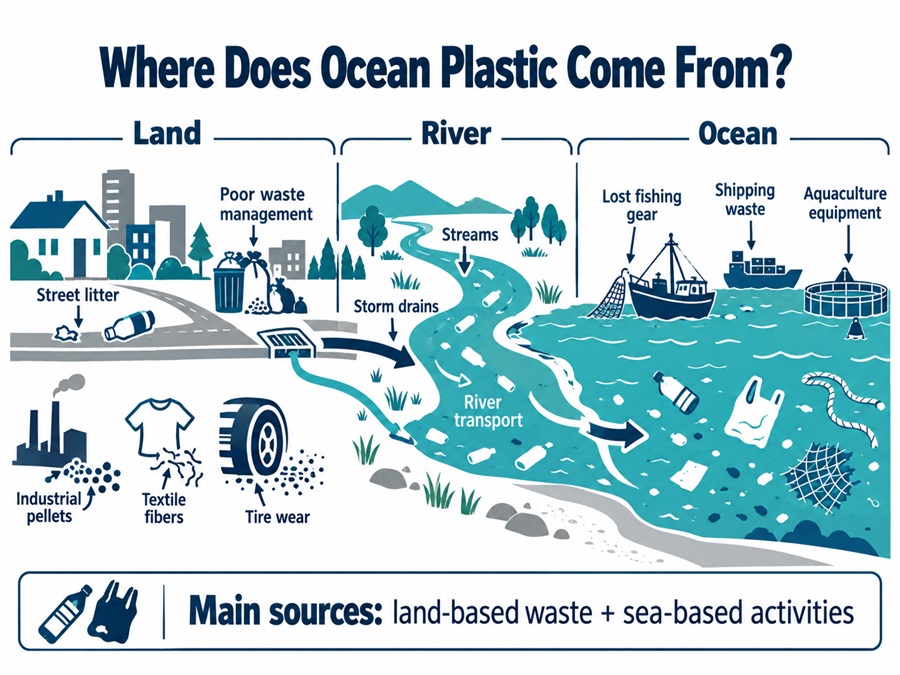
Plastic in the ocean comes from two main places: things people do on land and things that happen out at sea. Just how much of a problem each of these is can vary a lot from place to place and from one type of trash to another.
The Problem Starts on Land
Plastic that ends up in the ocean from being carelessly discarded on land can make its way into the ocean through rivers, heavy rain wash, drainage systems and the wind.
Some of the main ways this happens are:
- Littering and Poor Waste Management: Stuff that’s not sorted or thrown away properly and ends up in waterways – often from open dumpsites and overflowing landfills.
- Rainy Day Litter: All that plastic packaging and wrappers that get washed away down storm drains when it rains.
- Raw Material Pellets: The tiny little bits of plastic that get spilled or lost during manufacturing, storage and transportation.
- Wastewater From Our Clothes: Tiny bits of synthetic fibers from our washing are often washed into the sewage system.
- Road Runoff: Tiny bits of plastic from car tires and road markings can also end up in rivers.
A plastic wrapper dropped on a street far away from the sea might find itself on a long journey – from a storm drain into a stream, then a river, and eventually an estuary. The same thing happens with other bits of trash.
Not all of this stuff makes it all the way to the ocean. Some gets stuck or cleaned up along the way. But the fact that so much of this stuff starts on land and makes its way to the sea explains why sorting out waste back on land is just as important as anything else we do to look after the ocean.
And Then There Are the Sea-Based Problems
Some of this plastic gets into the sea through fishing, aquaculture, shipping and other offshore activities.
Like:
- a tangled fishing net,
- abandoned fishing gear
- bits of plastic that just get discarded from boats
- bits of plastic from improperly run fish farms
And lets be real – losing a fishing net can be especially bad news for sea life, because often the net can still catch fish even after it’s lost.
This is especially true in certain parts of the ocean where plastic just seems to be everywhere – like the Great Pacific Garbage Patch.
How Rivers Take Plastic from Land to the Ocean
Rivers are one of the main ways that the waste we generate on land ends up in the ocean.
A common path looks something like this:
Street Litter → Storm Drain → Stream → River → Estuary → Ocean
Flooding can really speed up the movement of litter, especially in areas where there are a lot of open dumpsites and crowded communities.
BUT – rivers arent just a straight pipeline. Rivers also have riverbanks, dams, wetlands and sediments that can trap and hold plastic for months or years at a time. And it’s only when these areas get flooded that some of this stuff is released into the ocean.
So stopping waste getting into rivers in the first place is really important – not just for the ocean, but for the wildlife living in the rivers too.
What Happens to Plastic Once Its in the Ocean?
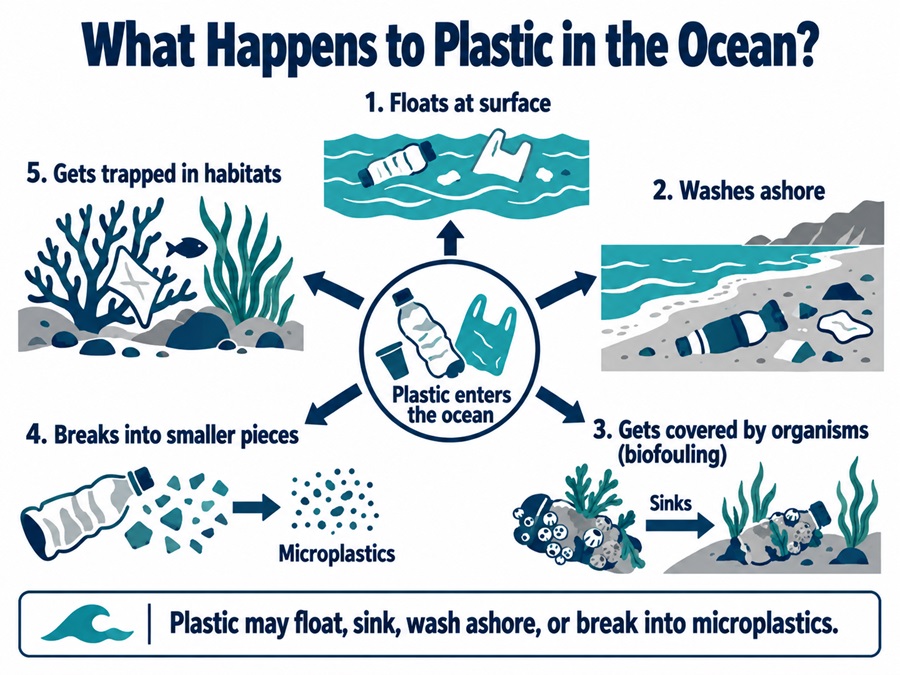
The truth is that not all plastic floats on the surface of the ocean. What happens to it really depends on how heavy or light the plastic is, how big it is, what the weather is like and of course, what sea creatures do to it.
Floating, Sinking, and Getting Broken Up
Plastic that floats is usually made of really light stuff like polyethylene (PE) or polypropylene (PP). Denser plastic tends to sink.
But just because a bit of plastic starts off floating, it doesnt mean it will stay on the surface.
Sometimes, sea creatures grow on the plastic – a process called biofouling – and that extra weight can cause the plastic to sink. And then of course, there are the tides and the waves which can carry the debris from one part of the ocean to another.
Plastic can end up in lots of different places, like:
- on the surface of the ocean
- on beaches and coastlines
- on coral reefs and in seagrass beds
- deeper down in the water column
- even on the seafloor
How Ocean Plastic Transforms into Microplastics and Nanoplastics
Day after day, the sun beating down, chemicals breaking down, and the relentless wear and tear on plastic products all start to take their toll.
Here’s one way plastic is broken down:
From plastic item to Weathering, to Cracking, to teeny-tiny fragments & then Microplastics → then potentially on down to Nanoplastics
We generally define microplastics as plastic bits smaller than 5 millimeters, but when we talk about nanoplastics, we’re taking it down even smaller – although there is no real consensus on just how small we’re talking
Its not just bigger plastic items that break down into microplastics. Tiny synthetic fibers from clothing, tire bits and other tiny particles can seep straight into our waterways.
Once plastic has become tiny and is floating around in huge amounts of water or sediment, good luck trying to find it again
To get a better idea of what these particles look like, check out our guides on Microplastics and Nanoplastics.
The Effects of Marine Plastic on Marine Life
Marine plastic pollution isn’t always just about animals getting tangled up or swallowing plastic. It causes a whole lot of harm through entanglement, ingestion and actual habitat damage. The extent of the damage depends what type of plastic it is, which animal it affects and just how they were exposed.
Entanglement and Ghost Nets
When an animal gets caught up in fishing net, rope or monofilament line and stuff, the results arent pretty
Animals can get badly tangled, unable to swim, eat or even breathe. They might even get seriously injured
Ghost nets are fishing nets and lines that have been lost or thrown overboard and are still catching animals. This can even go on long after the person who lost them has stopped fishing.
For example: say a fishing net gets lost in a storm. It can go on catching fish, turtles and other poor marine animals long after the storm has passed.
Other abandoned traps can even catch more animals and attract loads more wildlife.
The US National Oceanic and Atmospheric Administration says that derelict fishing gear is a massive threat to marine animals and their habitats.
Plastic Ingestion and the Food Chain
Animals often mistake plastic for food which can cause all sorts of problems
Sea turtles can mistake plastic bags for jellyfish or other food, and when the plastic gets inside them, it can cause serious damage inside their tummies and blockages
Seabirds and other wildlife might collect small plastic bits while they’re looking for a meal. Some birds even feed this plastic to their chicks which must be terrible for them
Fish and shellfish often eat plastic bits that are attached to the food they eat or floating loose
Even when the plastic bits are small, they can still cause damage and there are also worries about what chemicals the animals may be exposed to and what effects that might have on them
These particles can even pass from one animal to another in the food chain. Scientists call this trophic transfer which sounds fancy but just means that if a fish eats a shrimp that has eaten a particle of plastic, then it will have eaten plastic too
However, just because plastic gets passed from one animal to the next does not automatically mean the plastic levels just keep increasing up the food chain. Animals vary and so do their bodies and how they get rid of these plastic bits
Habitat damage and Coral Reefs
Plastic can actually damage the very things that marine animals need to survive
Lost nets and lines can get tangled around coral reefs, ripping them apart. Debris can also smother or scrape away seagrass and other underwater habitats.
Plastic even gives microorganisms and other creatures something to cling to and when they come floating along on some plastic debris, they can even stop in new areas and start new problems.
These effects all add up to why ocean plastic pollution is so much more than just a problem for individual animals. It can even destroy entire marine habitats.
Does Ocean Plastic Affect Human Health?
Lots of people who eat seafood or just breathe in the air may be getting exposed to tiny pieces of plastic – known as microplastics and nanoplastics – through what they eat or drink. And it’s not just seafood, mind you. There are loads of other ways we’re getting exposed to this stuff.
Researchers have actually found plastic particles in sea creatures and in human samples. And in the lab, scientists are trying to figure out what those particles might be doing to us – possibly causing inflammation, stress, and damage to our cells. Some plastics are also laced with special chemicals and when they break down they can hang out with other pollutants in the environment.
Now, finding plastic particles in the mix doesn’t necessarily mean they’re the cause of a particular illness.
Scientists are still trying to work out how all sorts of factors – the size of the particles, what chemicals are in them, how much you’re exposed to, and for how long – might be impacting our health.
As it stands, there’s some evidence that we should try to cut down on plastic pollution and reduce our exposure to it, but saying that just eating seafood with a few microplastics in it will definitely give you a disease is a step too far at this point.
What Is the Great Pacific Garbage Patch?
You’ve probably heard of the Great Pacific Garbage Patch – a big concentration of floating plastic debris out in the North Pacific Ocean, somewhere between Hawaii and California.
The ocean’s currents swirl around in big systems called gyres which can pile up floating junk in certain areas.
Now, it’s worth noting that the Great Pacific Garbage Patch isn’t actually one big solid island of plastic – it’s much more spread out than that. Plus most of the debris is teeny-tiny bits that are not exactly easy to spot.
How Big Is the Great Pacific Garbage Patch?
A big study from 2018 published in Scientific Reports reckoned that the Great Pacific Garbage Patch covers a whopping area of about 1.6 million square kilometres.
Researchers also estimated:
| Measurement | 2018 study estimate |
|---|---|
| Area | 1.6 million km² |
| Floating plastic mass | 79,000 tonnes |
| Number of plastic pieces | 1.8 trillion |
| Fishing nets’ share of plastic mass | At least 46% |
These figures describe the study’s modeled estimates, based on field surveys. They should not be treated as fixed measurements of the patch today.
The same research estimated that microplastics accounted for approximately 94% of plastic pieces by number, but only about 8% of the total mass.
That distinction matters. A small number of large objects can contribute substantial weight, while billions of tiny fragments dominate particle counts.
The estimated fishing-net share also applies to this particular accumulation zone. It does not mean fishing nets account for 46% of all ocean plastic pollution worldwide.
The patch’s boundaries and concentrations vary with currents, winds, and changing conditions.
Can Ocean Plastic Be Cleaned Up?
Yes, but some forms of ocean plastic pollution are much easier to remove than others.
Cleanup works best when debris is concentrated, accessible, and large enough to collect without excessive damage to wildlife or habitats.
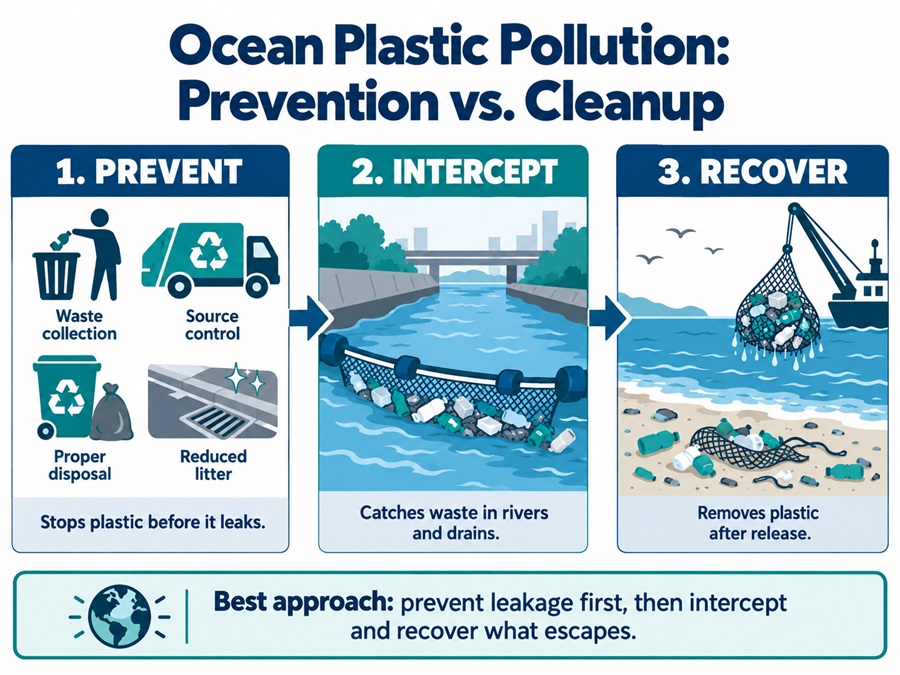
Beach cleanups can recover bottles, packaging, and fishing line before they return to the water. River-interception systems can capture some floating debris before it reaches the coast.
Removing abandoned fishing nets can also provide direct benefits by preventing further entanglement and ghost fishing.
Open-ocean cleanup presents greater challenges. Debris is spread across enormous areas, and equipment must operate safely around marine organisms.
Dispersed microplastics are especially difficult to recover because they can be mixed with plankton, sediments, and other natural material.
Large-scale cleanup systems therefore need careful monitoring of their environmental effects, operating costs, and actual amounts of plastic recovered.
Which Ocean Plastic Solutions Work Best?
| Solution | Where it works best | Main limitation |
|---|---|---|
| Waste collection | Cities and communities | Requires reliable infrastructure |
| River interception | Rivers and drainage hotspots | Cannot capture every particle |
| Fishing gear recovery | Fishing grounds and coastal waters | Retrieval can be costly and difficult |
| Beach cleanup | Accessible coastlines | New litter can accumulate |
| Open-ocean cleanup | Concentrated floating debris | Large operating areas and ecological concerns |
No single technology can remove all ocean plastic.
The most practical strategy combines targeted cleanup with measures that stop more waste from entering the water.
What are the best solutions to stop ocean plastic pollution?
Long term progress relies on cutting back on plastic leaks throughout a products whole life cycle – from the factory to our hands and ultimately to landfill.
1. Get waste collection sorted and reduce the plastic we don’t need
It’s pretty basic, but reliable waste collection is key – especially in places where trash can easily leak into waterways.
There’s a few practical ways to make this work – expanding waste collection services, cracking down on people just dumping stuff on the side of the road, making sure we have good places to dispose of it all and supporting recycling programs where they make sense.
But lets not kid ourselves, simply swapping plastic for something else isn’t always the answer – we need to look at the bigger picture and consider the environmental cost of whatever we use instead.
The bottom line is to stop sending so much avoidable trash into the environment and keep materials in use for as long as possible.
2. Stop fishing gear and industrial plastic losses
Cleaning up the fishing industry can make a big dent in our plastic problem.
Some useful measures include:
- Putting identifiers on fishing gear so we can recover it if it does get lost
- Having systems in place to report and pick up abandoned nets and traps
- Making sure there are good places to dump this stuff at ports
- Improving how gear is stored, maintained and retrieved
Plus manufacturers and other transport operators can do their part by making sure industrial pellets are contained properly, improving the way they handle their loads and responding quickly to any spills that do happen
These measures help stop pollution right at the source so it never gets out into the ocean.
3. Catch plastic before it hits the open ocean
It’s way easier to manage waste if we catch it before it gets lost in the ocean. River booms, litter traps and other interception systems can help grab floating trash at key locations.
But, we need to be smart about it too – these systems need to be able to handle floodwaters, not get in the way of water flows and not harm any wildlife.
And coastal cleanups are also important – they help pick up abandoned fishing gear and bigger pieces of trash before they break down into tiny fragments.
4. Stop the tiny plastic pollution
Cutting back on microplastic pollution means we need to think about more than just ordinary litter.
Examples include:
- designing textiles that shed fewer synthetic fibers
- finding better ways to deal with tire and road wear
- catching particles through better stormwater and wastewater treatment
- stopping industrial pellet spills
- developing products with lower particle release
Wastewater treatment can remove a lot of these particles, but the stuff that gets caught up in sewage sludge still matters – how we deal with that is important.
The key is to stop pollution at the source rather than just moving it around to somewhere else in the environment.
5. Ramping Up Government Action And International Collaboration
Governments really do hold the key to making a dent in plastic pollution by investing in waste management, setting product standards, regulating industry and making manufacturers take responsibility for the waste they churn out.
There are all sorts of policy approaches that have been tried and tested – like deposit return schemes, making manufacturers pay for the waste created by their products, restricting those disposable products that are an absolute menace, and demanding that waste gets collected and recycled properly.
One thing to watch is the ongoing effort to hammer out a global plastics treaty.
Back in March 2022, countries came together at the United Nations Environment Assembly and agreed to negotiate an international treaty that would address plastic pollution, including the blight it is on our oceans.
However the latest round of negotiations, at INC-5.2 in August 2025, ended without anyone agreeing to a final treaty.
A follow up meeting INC-5.3 took place on February 7, 2026 – but that was pretty much just organisational housekeeping and electing a new chair. No actual treaty talks took place.
The discussions have been up and down, with countries disagreeing on all sorts of issues like who should be responsible for plastic production, what chemicals get used in making it, how products should be designed, who foots the bill for it all and where all the waste ends up.
At the last update, in October 2026, there was still no final agreement on a global treaty. The UNEP was still reviewing materials.
It’s clear that we desperately need coordinated action. The OECD has modelled what would happen if we really went for it and put in place some ambitious global policies – the upshot is that we could reduce plastic waste leakage by a pretty substantial margin compared to business as usual.
For official updates on the negotiation process, see the UNEP global plastics treaty negotiations.
6. What Individual’s Can Do
Now we know personal actions are no substitute for sorting out the waste infrastructure or making industry take responsibility – but we can still make a positive impact and support better systems.
Some easy wins are choosing reusable items when you can, sorting your waste according to the local rules, making sure you don’t chuck litter down the drain, not flushing cotton wool down the loo, and getting involved in local cleanups.
You can also push for improvements to your local waste collection services and report any instances of fly-tipping you see.
Of course if we’re all making a bit more effort – and if the waste services, businesses and public policy are all working together – that’s when we’ll see some real impact.
Frequently Asked Questions
Where Does Most Of The Ocean’s Plastic Pollution Really Come From?
Ocean plastic pollution tends to come from a whole host of places including really badly managed land waste, litter that ends up in waterways, fishing activities and other types of marine pollution. To be honest the source of most of it depends on where in the world you’re looking and what kind of plastic you’re measuring.
Does All Ocean Plastic Bobs To The Surface?
No its not all that simple, some plastic does float at first but other stuff sinks. And even some of the floating plastic can go on to sink later on when it gets covered in life or just changes texture.
The Great Pacific Garbage Patch – Is It Really a Floating Island?
No its not quite as simple as that. Its actually a pretty large area of concentrated marine debris that floats around in the ocean. A lot of the plastic gets scattered and broken down into tiny bits that are almost impossible to see.
How Long Does Plastic Last In The Ocean, Anyways?
To be honest there’s no one answer to this one. The time plastic takes to degrade depends on all sorts of things like what its made of, how much sunlight it gets, the temperature, the oxygen levels and loads of other environmental conditions. Just to complicate things loads of plastics can last for decades or even longer before they break down into tiny bits.
So What Actually Works To Stop Ocean Plastic Pollution?
Well the good news is that stopping plastic from getting into the water in the first place is probably a lot easier than trying to clean it all up afterwards. What that means is we need to improve the way we collect waste, cut down on unnecessary plastic use, get fishing gear under control and do targeted cleanups of our rivers and coastlines.
The Bottom Line
Ocean plastic pollution extends way beyond the obvious stuff we see on beaches. Plastic can travel a long way up rivers, accumulate in the ocean, sink down into sediments, cause damage to marine habitats and break down into tiny bits that are just impossible to clean up.
Doing some cleaning up, particularly around coastlines and fishing areas is a good thing and can help protect wildlife – but to be honest you can’t keep patching up the problem if plastic is still flowing into the ocean all the time. We need to think about stopping the problem at its source – do a better job of collecting our trash, use less plastic if we can, look after our fishing gear and get behind sensible policies that cover the whole lifecycle of plastic.
Leave a Reply