

Key takeaways
- Chemicals have the stronger evidence. Some plastic-associated chemicals (certain bisphenols, phthalates, flame retardants, vinyl chloride) have documented hazards.
- Microplastics are real, but their health impact is unproven. Particles are found in food, water, air and human tissue. Evidence of harm is mostly experimental or associational.
- Heat, damage and reuse raise exposure. Use containers as intended.
- Recycling codes are not safety ratings.
- Practical steps are cheap and simple. You do not need a plastic-free home.
A note on interpretation: a hazard is something capable of causing harm; risk depends on dose, route and duration. Detecting a substance in the body does not by itself show it causes disease. Both “all plastic is toxic” and “all plastic is safe” are too simple, so judge each chemical, particle, product and exposure separately.
Chemicals vs. particles
They are often discussed together but assessed differently.
| Plastic particles | Plastic-associated chemicals | |
| Examples | Microplastics (<5 mm), nanoplastics (<1 µm, definitions vary), synthetic fibres, tyre-wear fragments | BPA and other bisphenols, phthalates, some flame retardants, residual monomers (styrene, vinyl chloride), PFAS |
| Exposure depends on | Size, shape, composition | Chemical properties and dose |
Particles can also carry additives, so the two overlap, but they raise different health questions.
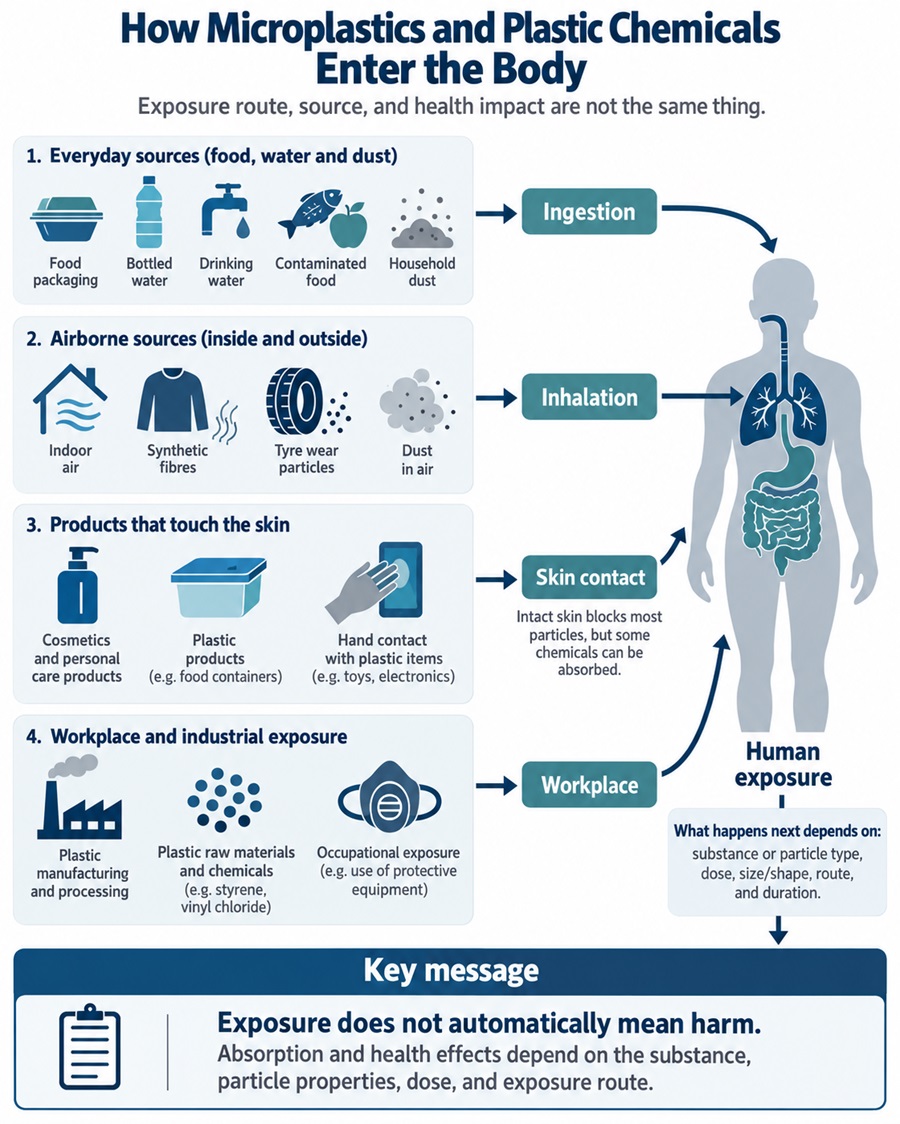
How exposure happens
- Ingestion: food-contact packaging, drinking water, contaminated food, settled dust. Chemical migration depends on material, temperature, contact time and food type (fatty foods draw out more).
- Inhalation: dust and air containing synthetic fibres, tyre wear and industrial emissions.
- Skin contact: intact skin blocks most particles, but some chemicals can be absorbed.
- Workplace: manufacturing and processing (e.g. vinyl chloride, styrene) are the highest-exposure settings.
Main particle sources (estimates vary widely): food and drinks, bottled water, indoor air and household dust, and outdoor air (tyre wear, textiles).
Bottled vs. tap water. A 2024 Columbia/Rutgers study reported hundreds of thousands of nanoplastic particles per litre in bottled water. Treat this as an early estimate, not a settled figure. Direct comparisons with tap water are still limited.
Tyre wear. Tyres shed particles and chemicals, including 6PPD-quinone, which is toxic to some fish and is an active area of regulatory attention.
Chemicals of concern
| Chemical or group | Common uses | Main concern |
| BPA and other bisphenols | Some polycarbonate, food-can coatings | Hormone-related effects |
| Certain phthalates | Flexible PVC, adhesives, consumer products | Reproductive and developmental toxicity (specific compounds) |
| Certain flame retardants | Electronics, furnishings | Endocrine, neurological effects, varies by substance |
| Styrene | Polystyrene feedstock | Residual monomer, mainly occupational; IARC Group 2A (probably carcinogenic) |
| Vinyl chloride | PVC manufacturing | Established human carcinogen (IARC Group 1), occupational |
| PFAS | Grease-resistant paper packaging, coatings | Persistence and toxicity; a separate, large chemical group |
This table ranks substances, not finished products. Ordinary finished PVC does not carry the exposure of vinyl chloride gas in a factory.
BPA
BPA can interact with hormone signalling. Researchers have studied reproductive, developmental, metabolic and cardiovascular effects.
- EU: In 2023 EFSA cut its tolerable daily intake to 0.2 ng/kg body weight/day. Regulation (EU) 2024/3190 restricts BPA in food-contact materials, with exemptions and staged transition periods. The general transition for certain single-use food-contact articles ended on 20 July 2026; some applications have longer deadlines.
- US: The FDA states that currently authorised BPA uses are safe under approved conditions and continues to monitor research.
The regulators’ differing positions reflect differences in scientific assessment, not proof that BPA is either harmless or dangerous everywhere.
BPA-free says only that BPA was left out. Some products use replacements such as BPS or BPF, and research is examining whether these share BPA’s biological activity. Safety depends on the specific substance and use.
Phthalates
Phthalates soften plastics, especially flexible PVC. Some raise endocrine, reproductive and developmental concerns, but they differ in structure, effects and exposure.
On 27 May 2026 the FDA published a scientific evaluation of eight ortho-phthalates still authorised as plasticisers in some food-contact uses, and supported grouping four of them (DEHP, DCHP, DIOP, DINP) for a future cumulative risk assessment. This is part of an ongoing review, not a ban. IARC classifies DEHP as possibly carcinogenic (Group 2B).
Medical settings. Phthalate exposure from some flexible medical plastics (e.g. IV tubing, neonatal care) is a recognised research and policy topic. Medical plastics remain essential; the issue is material choice for the most vulnerable patients, which clinicians and regulators manage.
Flame retardants and other additives
Some flame retardants are linked to endocrine disruption, neurodevelopmental effects or environmental persistence, but this depends on the compound. A product’s formulation and use say more than the word “plastic”.
PFAS in packaging
PFAS are not microplastics or ordinary plastic additives. In the US, certain PFAS grease-proofing uses in food packaging were phased out, and in 2025 the FDA determined related food-contact notifications were no longer effective after those uses were abandoned.
Microplastics and nanoplastics
What we know
- Particles have been detected in food, water, air and human samples, including blood, placenta and lung tissue, and in some studies brain and reproductive tissue.
- Lab and animal studies show possible inflammation, oxidative stress and immune responses, often at doses higher than typical human exposure.
What is unproven
- Whether typical exposure causes disease.
- How much people absorb, which particle properties matter, and how long particles stay in the body.
- Separating the effect of particles from that of additives and other contaminants.
Measurement caveat. Reliable measurement in tissue is hard. Contamination, differing methods and possible false positives (for example from body fats in pyrolysis-based methods) have led some scientists to question whether headline concentrations, including some brain findings, are overestimated. Read tissue-level numbers cautiously. Findings across studies are not always consistent, and some find little or no association.
Myth check: “you eat a credit card a week.” This widely repeated figure came from an extrapolation that researchers have since criticised as unreliable. Real intake is uncertain and likely much lower.
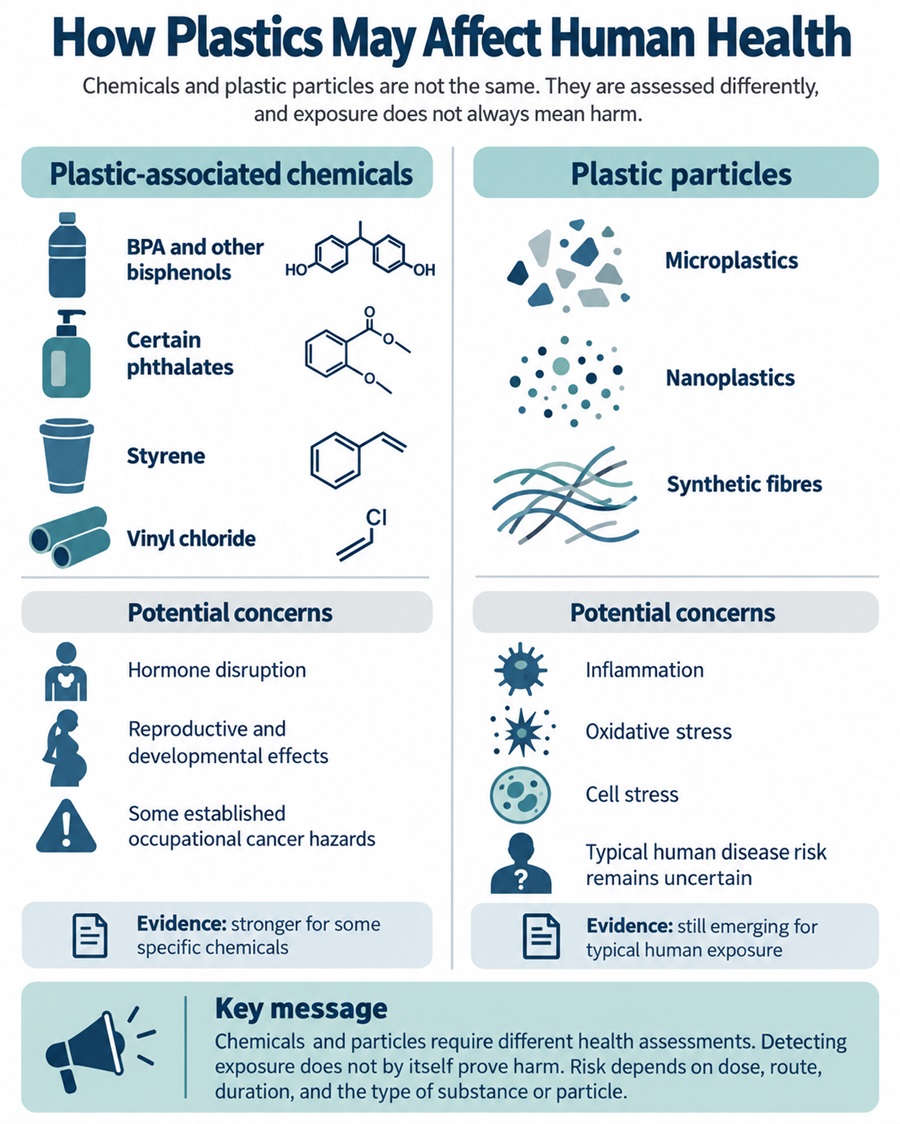
Health effects: what the evidence shows
Evidence legend: Established = strong human or regulatory evidence for specific substances; Emerging = early human data; Experimental = mainly lab or animal.
| Concern | Evidence | Key point |
| Hormone disruption | Established for certain chemicals | Not every plastic or additive does this |
| Reproductive and developmental effects | Varies by chemical and outcome | Life stage and timing matter |
| Inflammation from particles | Experimental | Human disease risk unproven |
| Cardiovascular effects from particles | Emerging (observational) | Association is not causation |
| Cancer | Established for some industrial chemicals only | Everyday microplastic exposure not established as a cause |
Cardiovascular: the 2024 NEJM study
Researchers examined carotid artery plaques from patients having surgery. Microplastics or nanoplastics were detected in plaques from about 150 of 257 patients who completed follow-up. Over roughly 34 months, 20.0% of those with detected particles had a heart attack, stroke or death from any cause, versus 7.5% of those without detected particles, a statistically significant difference.
This shows an association, not causation. All participants already had carotid disease, other risk factors and measurement limits apply, and the findings cannot be applied to healthy people. It justifies larger, more diverse studies. Check for replication or critique since publication.
Cancer
No single cancer risk applies to all plastics. Vinyl chloride is an established carcinogen (liver cancers, occupational exposure). Styrene and DEHP carry their own classifications. For microplastics, researchers are studying possible mechanisms such as inflammation and cell stress, but typical exposure has not been shown to cause cancer.
Who may be more vulnerable
Children and the developing fetus may be more sensitive to some chemicals. Children eat, drink and breathe more per body weight, have more contact with dust and mouth objects often. Pregnancy is studied because hormones guide fetal development. Workers in plastics manufacturing have the highest exposure and benefit most from ventilation and protective equipment. For everyone else, normal contact with plastic does not automatically cause harm.
Plastic types
The number in the triangle is a resin code, not a health rating. You cannot judge safety from the code alone, especially for #7.
| Code | Common uses | Consideration |
| PET (#1) | Beverage bottles, packaging | Additives, migration conditions |
| HDPE (#2) | Milk bottles, containers | Formulation, food-contact suitability |
| PVC (#3) | Pipes, flooring, medical tubing | Plasticisers in flexible products; vinyl chloride is an industrial issue |
| LDPE (#4) | Films, bags | Additives, temperature limits |
| PP (#5) | Food containers, medical products | Not all PP is microwave-suitable |
| PS (#6) | Rigid containers, foam | Residual styrene, migration under some conditions |
| Other (#7) | Mixed polymers | Composition unknown from the code |
For details, see our guides to PET, HDPE, PVC, LDPE, polypropylene, polystyrene and recycling codes.
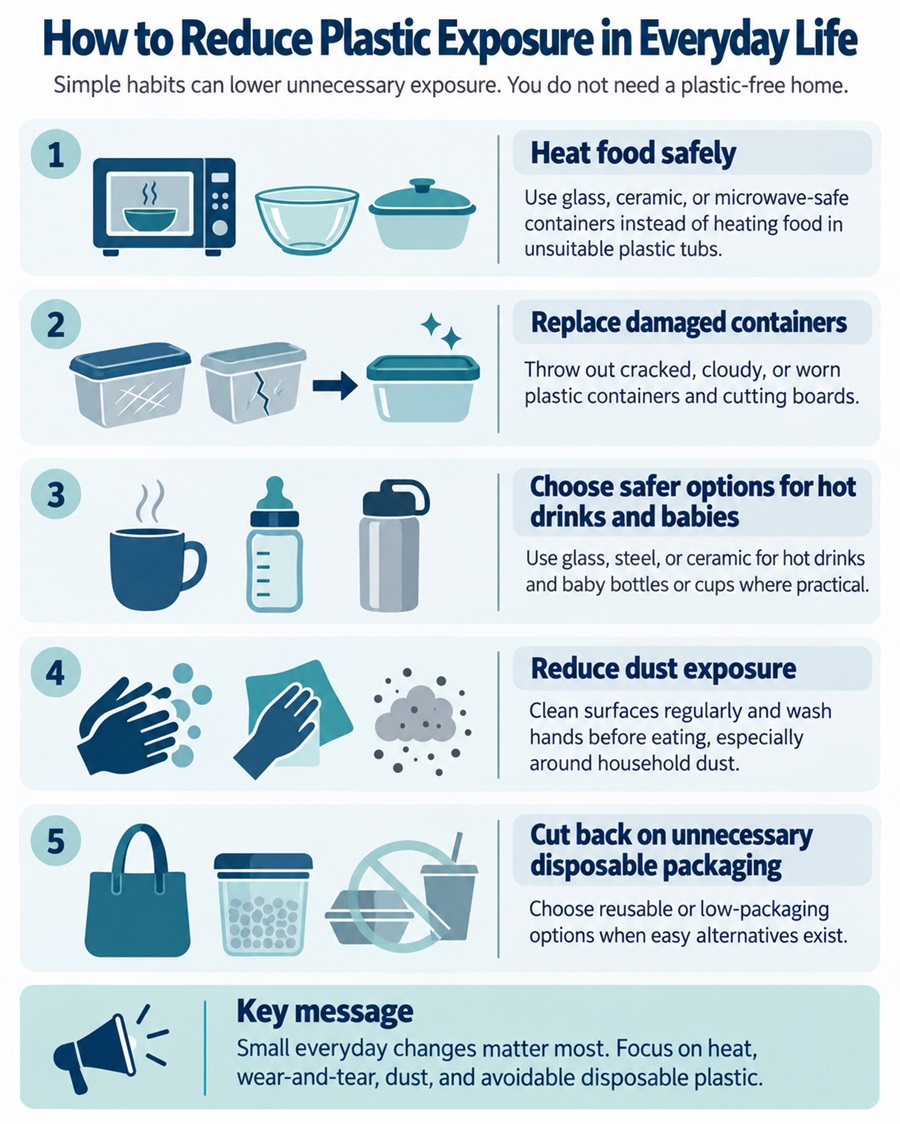
What to do: highest-impact steps first
| Priority | Do | Avoid | Why |
| 1 | Heat food in microwave-labelled containers, or glass or ceramic | Microwaving takeaway tubs, margarine tubs or damaged containers | Heat can raise migration, especially in fatty foods |
| 2 | Replace cracked, scratched, cloudy or degraded containers and cutting boards | Reusing single-use packaging repeatedly | Wear releases particles and can raise migration |
| 3 | Use glass, steel or ceramic for hot drinks, and for baby bottles and cups where practical; follow product instructions | Pouring boiling liquids into plastic not rated for it | Hot liquids can release particles and chemicals; infants have higher exposure per body weight |
| 4 | Clean regularly, wash hands before meals | Letting dust build up | Dust carries fibres and additives, and the habit has wider hygiene benefits |
| 5 | Check dishwasher and temperature guidance on labels | Assuming “dishwasher safe” means “heat safe” | Intended-use limits differ |
| 6 | Consider tap water or a filter for drinking if you wish | Assuming a filter or bottled water removes all particles | Evidence for filters is limited and bottled water can contain particles too |
| 7 | Reduce unnecessary disposable packaging | Replacing medical, sterile or safety plastics | Medical and food-preservation plastics have real benefits |
A BPA-free label does not mean free of other additives. You do not need to eliminate plastic from your home.
Regulation: where things stand
Regulators target specific chemicals, products and exposures, not “plastic” as a whole. Approaches differ by country.
| Region | Status |
| EU | BPA restricted in food-contact materials (Reg. 2024/3190), staged deadlines |
| US | FDA maintains authorised BPA uses; phthalates under review (May 2026); PFAS grease-proofing uses phased out |
| Canada, California (Prop 65), others | Have their own chemical listings and limits; add local detail for your audience |
| Global | UN plastics treaty talks in 2025 did not reach agreement; check current status |
Significant 2025 health-focused reviews include the Lancet Countdown on health and plastics and WHO work on microplastics.
A restriction does not prove harm at any detectable dose, and an authorisation does not mean a substance is free of hazard in all conditions.
Evidence gaps
- Typical human exposure levels and absorption
- Which particle sizes, shapes and chemistries matter
- Retention and elimination in the body
- Standardised, contamination-controlled measurement
- Linking measured exposure to specific health outcomes in large human studies
- Separating particle effects from additive and contaminant effects
Bottom line
Some plastic chemicals have well-established hazards. Microplastic and nanoplastic research is moving quickly but has not yet shown what typical exposure does to health. Use food-contact products as intended, avoid heating unsuitable packaging, replace damaged containers and reduce avoidable exposure where easy alternatives exist.
Leave a Reply