Plastic regulations are changing how companies produce, package, sell and dispose of plastic products. Some governments ban certain single-use items. Others require manufacturers to pay for packaging waste, use recycled materials or redesign products so they are easier to recycle.
But plastic laws are far from uniform.
A shopping bag restricted in one country may remain legal in another. A beverage bottle may carry a refundable deposit in one market but enter ordinary household recycling elsewhere. Packaging sold internationally can face different requirements depending on where it reaches consumers.
Understanding these differences matters for consumers, businesses and anyone following efforts to reduce plastic pollution.
This guide explains the main types of plastic regulations, how approaches differ around the world, and what makes environmental rules effective.
Quick Answer: What Are Plastic Regulations?
Plastic regulations are laws and legally enforceable rules that control how plastic products and packaging are manufactured, marketed, used, collected or discarded. They can include product bans, producer responsibility obligations, recycled-content requirements, packaging standards, taxes and waste-handling controls.
Their purpose is to prevent pollution, reduce unnecessary waste, improve material recovery and assign responsibility for managing plastics throughout their lifecycle.
What Are Plastic Regulations?
Plastic regulations are government rules that address specific activities involving plastic materials and products.
They can apply at several stages of a product’s life.
A manufacturer may need to meet packaging design requirements before a product reaches the market. A retailer may be prohibited from distributing certain disposable items. A company selling packaged goods may need to register with a recycling program or contribute financially to waste management.
Rules can also govern what happens after plastic becomes waste, including its collection, treatment and movement across international borders.
Not every government policy is legally binding. A national strategy may outline environmental goals without directly imposing new obligations on businesses. Voluntary industry commitments also differ from enforceable regulations.
That distinction is important when evaluating claims about progress. An announced target does not necessarily mean that a requirement is already in force.
Why Do Governments Regulate Plastics?
Plastic is useful because it is lightweight, durable and relatively inexpensive. These properties support applications ranging from food protection to medical equipment.
They also create challenges once products are discarded.
Many plastic items are designed for short-term use, while the materials themselves can persist in the environment. Collection and recycling systems cannot recover every product, especially packaging that is difficult to sort, contaminated or uneconomic to process.
Governments use regulation to address problems that voluntary consumer and business decisions may not resolve.
Several objectives are common.
Reducing avoidable waste. Restrictions on certain disposable products can prevent waste before it enters collection systems.
Improving packaging design. Standards can encourage packaging that uses fewer materials or works better with established recovery systems.
Changing financial responsibility. Producer responsibility laws can require businesses to contribute to managing the packaging they place on the market.
Creating demand for recycled materials. Minimum recycled-content requirements can encourage manufacturers to purchase recovered plastic.
Protecting health and the environment. Product and chemical restrictions can limit specific hazardous substances or uses.
These objectives are related, but they are not interchangeable. A policy that increases bottle collection may do little to address unnecessary packaging. A restriction on one disposable product does not automatically improve recycling infrastructure.
That is why governments often combine several regulatory approaches.
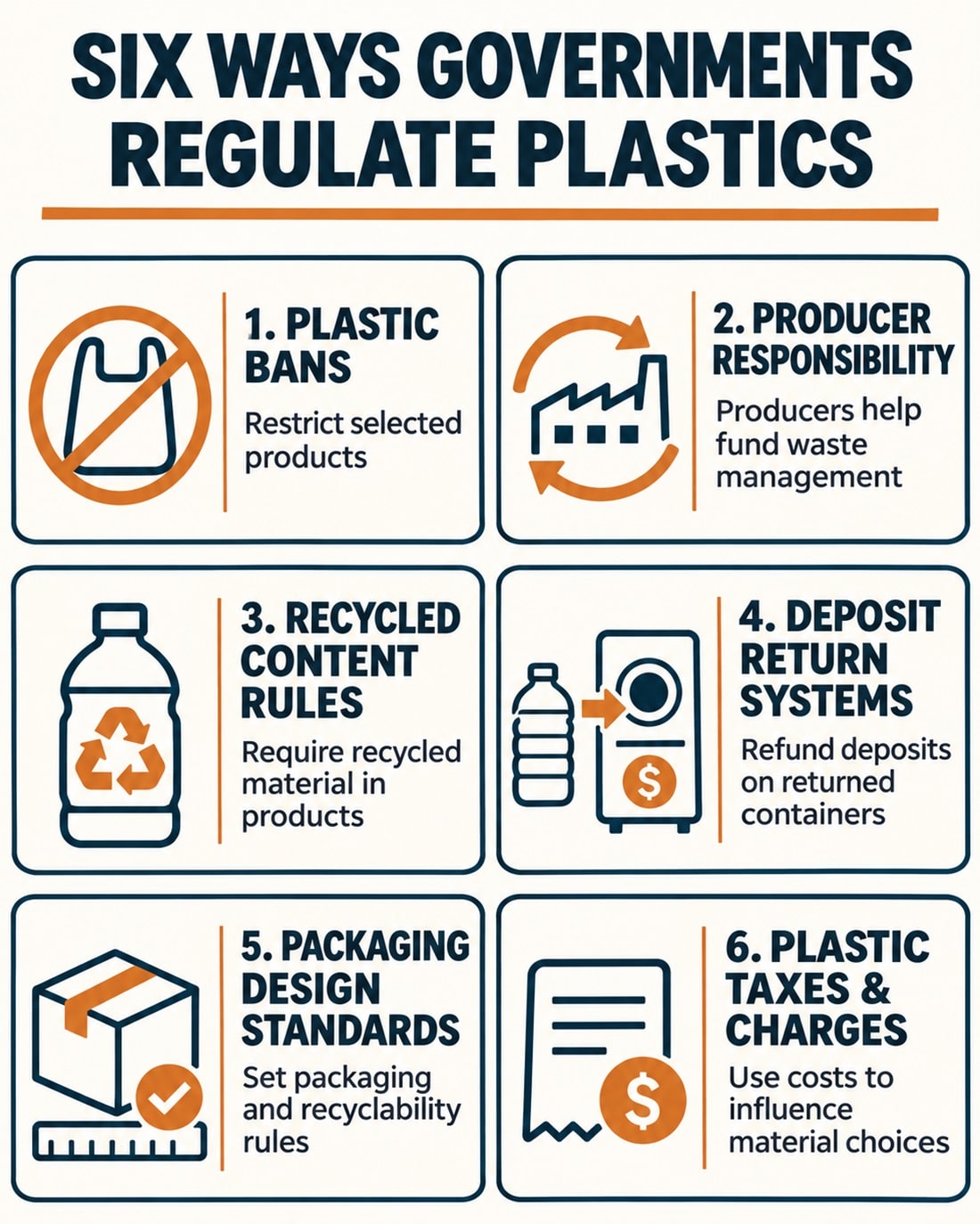
Six Main Types of Plastic Regulations
There is no single regulatory model used worldwide. Governments choose different instruments depending on the products involved, existing infrastructure, economic conditions and environmental priorities.
The following table summarizes six major approaches.
| Policy mechanism | How it works | Main objective |
|---|---|---|
| Plastic bans | Restrict selected products or uses | Prevent targeted plastic waste |
| Extended Producer Responsibility | Assign producers financial or operational obligations | Fund and improve waste management |
| Recycled content requirements | Set minimum recycled-material percentages | Increase demand for recovered plastic |
| Deposit return systems | Add a refundable deposit to eligible containers | Encourage returns and separate collection |
| Packaging design standards | Establish requirements for packaging formats and properties | Improve design and recovery |
| Plastic taxes and charges | Apply financial costs to specified products or packaging | Encourage changes in material use and design |
These approaches can operate together. A country might restrict plastic bags, charge a tax on certain packaging, and require beverage producers to participate in a deposit return scheme.
Plastic Bans and Product Restrictions
Plastic bans target specific products, materials or activities.
Common examples include restrictions on lightweight shopping bags, disposable cutlery, drinking straws and certain foam food containers.
However, the word ban can be misleading if the rule only applies to particular uses.
A country may prohibit the distribution of certain plastic bags while allowing thicker reusable bags. Another may restrict plastic straws but provide exemptions for accessibility or medical needs.
Some laws apply to manufacturing or imports. Others focus on sales, distribution or free provision to customers.
The precise legal scope determines what changes in practice.
See our forthcoming guide to Plastic Bans Around the World for product-specific restrictions, exemptions and country comparisons.
Extended Producer Responsibility
Extended Producer Responsibility, commonly called EPR, changes how the costs and responsibilities of managing products after use are allocated.
Under packaging EPR systems, certain producers may be required to register, report packaging data and contribute financially to collection, sorting or recycling programs.
The obligations vary by jurisdiction.
Oregon provides a practical example. Its Recycling Modernization Act requires covered producers to participate in an approved producer responsibility organization, report relevant product information and pay applicable fees. The program began implementing major changes in July 2025. Oregon’s Department of Environmental Quality explains the program’s structure.
EPR does not necessarily require a manufacturer to physically collect every package it sells. Responsibility may be fulfilled through an approved collective system.
A dedicated guide to Extended Producer Responsibility will explain producer definitions, fee calculations and the evidence surrounding program performance.
Recycled Content Requirements
Some laws require specified plastic products to contain a minimum proportion of recycled material.
These rules are designed to create demand for recycled plastic, which can help support markets for recovered materials.
For example, the EU Single-Use Plastics Directive includes recycled-content requirements for beverage bottles. Its targets include 25% recycled plastic in PET beverage bottles from 2025 and 30% in plastic beverage bottles from 2030.
The calculation method and legal definitions matter. Requirements may differ by product category, jurisdiction and whether the material comes from post-consumer waste.
Recycled content is also different from recyclability. A package can contain recycled plastic without being widely accepted for recycling after use.
Our detailed Recycled Content Requirements guide will compare applicable laws, targets and verification methods.
Deposit Return Systems
Deposit return systems provide a financial incentive for consumers to return eligible containers.
A refundable amount is added when a covered drink is purchased. Consumers can recover that amount by returning the empty container through an approved collection point.
These systems usually apply to selected beverage containers rather than all plastic packaging.
Regulatory details determine which materials qualify, where containers can be returned and who operates the scheme.
Deposit systems can complement curbside recycling and other collection methods. Their effectiveness depends partly on return-point accessibility, deposit value and administrative design.
For a closer look at the collection process, see Plastic Waste Collection Methods.
Packaging Design and Recyclability Rules
Packaging regulations increasingly address the characteristics of products before they become waste.
Rules may cover packaging weight, unnecessary components, recyclability, labelling and reuse.
The EU’s Packaging and Packaging Waste Regulation (PPWR) is a major example. It establishes requirements across the packaging lifecycle, with provisions applying in phases from 12 August 2026 onward.
Design standards can influence material selection and packaging formats, but regulatory compliance does not guarantee that every package will be recycled.
Actual recovery still depends on collection systems, sorting capability and available markets.
For background on these downstream processes, see our guide to How Material Recovery Facilities Work.
Plastic Taxes and Financial Incentives
Taxes and charges offer another way to influence packaging decisions.
Rather than prohibiting a product, governments can make certain material choices more expensive.
The UK’s Plastic Packaging Tax applies to qualifying plastic packaging components containing less than 30% recycled plastic. This creates a financial incentive to increase recycled content where the tax applies. UK government guidance explains the policy.
Taxes are not the same as recycled-content mandates.
A mandate imposes a legal content requirement on covered products. A tax may instead impose a financial cost when specified criteria are not met.
The difference matters when comparing policies or assessing business obligations.
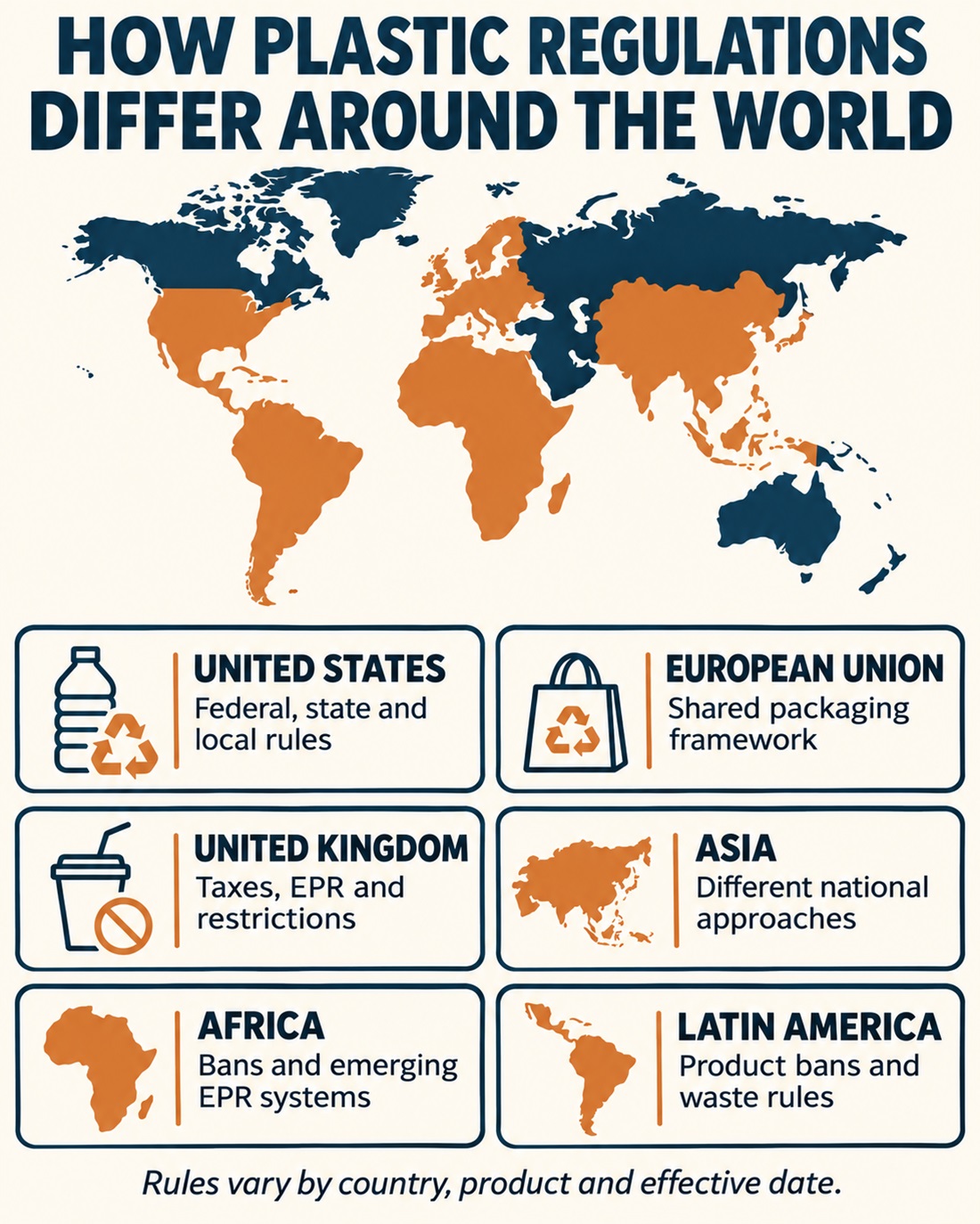
How Plastic Regulations Differ Around the World
Countries face many of the same plastic-waste challenges, but their regulatory systems have developed differently.
Some rely heavily on producer-funded waste-management programs. Others emphasize restrictions on disposable products, packaging taxes or collection requirements.
A meaningful comparison must consider what each law covers, when its obligations apply and how it is enforced.
| Region | Important policy approaches | Main characteristic |
|---|---|---|
| United States | State packaging EPR laws, deposit legislation, product restrictions | Significant variation between states |
| European Union | Packaging regulation, product restrictions, recycled-content requirements | Common EU framework with national implementation |
| United Kingdom | Packaging EPR, Plastic Packaging Tax, product restrictions, deposit return reforms | Combination of financial and regulatory measures |
| Asia | Product restrictions, packaging EPR and waste-management rules | Substantial differences between countries |
| Africa | Plastic bag restrictions, waste legislation and emerging producer responsibility systems | Enforcement and infrastructure vary |
| Latin America | Product restrictions, EPR and packaging-waste requirements | Different national and local approaches |
This comparison describes broad approaches. It should not be used to determine whether a particular product is legally permitted in an individual market.
United States: Federal and State Plastic Regulations
The United States does not operate under one comprehensive national law governing all plastic packaging.
Instead, different federal, state and local laws apply depending on the product and activity.
Federal environmental legislation addresses matters such as waste handling, pollution and chemical regulation. States can introduce additional requirements for packaging, recycling and selected disposable products, subject to applicable legal limits.
This creates substantial variation.
For example, California’s Plastic Pollution Prevention and Packaging Producer Responsibility Act, known as SB 54, establishes a producer responsibility program covering specified packaging and single-use plastic food-service products.
California also requires a statewide 25% reduction in covered single-use plastic packaging and plastic food-service ware by 2032. The reduction requirements operate through the producer responsibility framework. CalRecycle provides implementation information.
Oregon has adopted a different packaging producer responsibility model, with its own implementation requirements.
These differences matter for companies selling products across multiple states. Compliance with one state’s rules does not automatically establish compliance elsewhere.
A separate US regulatory guide can examine state laws, exemptions, reporting requirements and implementation schedules in greater detail.
European Union: A Common Framework for Packaging
The European Union has developed an extensive regulatory framework covering selected single-use plastic products, packaging, waste handling and material requirements.
Two important instruments are the Single-Use Plastics Directive and the Packaging and Packaging Waste Regulation.
The Single-Use Plastics Directive addresses specified disposable products through measures including restrictions, marking requirements, producer responsibility and collection targets.
The PPWR has a broader packaging scope. It introduces requirements intended to reduce packaging waste and improve packaging design, reuse and recycling.
The PPWR entered into force in February 2025 and began applying on 12 August 2026, with further provisions scheduled for later dates.
A shared EU regulatory framework can help establish common market requirements. However, national enforcement and implementation arrangements remain important, and businesses must identify which provisions apply to their products.
Our forthcoming EU Packaging Regulation (PPWR) guide will examine the requirements and implementation timeline.
United Kingdom: Packaging Taxes, Producer Responsibility and Restrictions
The United Kingdom uses several regulatory instruments to address packaging waste.
Its approach includes restrictions on certain disposable products, packaging producer responsibility obligations and financial incentives related to recycled materials.
The Plastic Packaging Tax is a particularly useful example because it links a product’s recycled content to potential tax liability.
The UK is also developing deposit return systems for eligible beverage containers.
These measures serve different functions.
A product restriction can prevent certain items from being supplied. A packaging tax can influence material choices. Producer responsibility can change how waste-management costs are funded.
Their combined impact depends on implementation, business responses and the performance of collection and recycling systems.
Asia: Different Approaches Across Major Markets
Asia does not have one shared plastic regulatory system.
Countries have adopted different approaches based on their economic structures, consumption patterns, manufacturing sectors and waste-management capacity.
Some governments restrict selected disposable products. Others use producer responsibility obligations, packaging standards, collection requirements or waste-import controls.
India, China and Southeast Asian countries provide useful examples of how national policies can differ considerably.
However, it would be misleading to describe these countries as following one regional model.
Regulatory obligations should be examined individually, especially when identifying restrictions, enforcement dates or exemptions.
For this cornerstone, the important point is that product and packaging requirements depend on the destination market.
Africa and Latin America: Plastic Restrictions and Producer Responsibility
Countries in Africa and Latin America have also adopted various measures addressing plastic waste.
Plastic bag restrictions are one policy approach. Producer responsibility systems and broader waste-management reforms are others.
Their effectiveness depends on factors such as enforcement resources, access to alternatives, waste-collection coverage and institutional capacity.
A restriction may be clearly written into law yet produce limited results if prohibited products remain widely available.
Conversely, well-designed collection or financing measures may improve waste management without prohibiting every plastic product.
These regions illustrate why regulation must be evaluated through implementation and measured results, rather than legislation alone.
Which Plastic Products Face the Most Regulation?
Plastic regulations commonly target products that are widely consumed, frequently discarded or difficult to recover.
The products most often addressed include disposable shopping bags, beverage containers, food-service packaging and selected packaging components.
However, regulatory treatment varies.
| Plastic product | Common regulatory measures | Why it receives attention |
|---|---|---|
| Shopping bags | Bans, charges, thickness requirements | High-volume distribution and litter |
| Beverage bottles | Deposits, recycled-content mandates, collection targets | Large volumes and identifiable recovery streams |
| Disposable cutlery and straws | Product restrictions and exemptions | Short use periods and litter |
| Foam food containers | Restrictions on specified formats | Collection and recycling challenges |
| Plastic packaging | EPR fees, design standards, taxes | High waste volumes and producer responsibility |
| Selected cosmetic products | Restrictions on intentionally added plastic particles | Environmental release concerns |
The presence of a plastic product in this table does not mean it is prohibited everywhere.
A plastic drinking straw, for example, may be restricted in one jurisdiction, permitted under certain exceptions in another, and unaffected by a specific ban elsewhere.
Consumers and businesses should therefore verify the exact product definition and local requirements.
International Agreements Governing Plastics
Plastic regulation is not limited to national legislation.
International agreements also influence how countries manage plastic waste and cooperate on environmental protection.
Two important areas are international waste shipments and efforts to develop a broader plastics treaty.
The Basel Convention and Plastic Waste Shipments
Plastic waste can cross international borders for recycling, recovery or disposal.
Without appropriate controls, international trade can move difficult-to-manage waste to places with insufficient treatment capacity.
The Basel Convention provides a framework for controlling international movements of hazardous and certain other wastes.
Its plastic waste amendments, adopted in 2019 and effective from January 2021, expanded controls over specified plastic waste shipments.
Certain shipments are subject to a prior informed consent procedure, meaning relevant authorities must agree before the movement proceeds.
The amendments do not prohibit every international shipment of plastic waste. Their application depends on the waste’s classification and the relevant legal conditions.
The Basel Convention Secretariat explains the amendments and their scope.
These controls address the movement of waste after products have been discarded, rather than the full lifecycle of plastic production and use.
The Proposed Global Plastics Treaty
Governments are also negotiating a proposed international legally binding agreement on plastic pollution.
The process began following a United Nations Environment Assembly resolution adopted in March 2022.
Unlike agreements focused principally on waste shipments, the treaty negotiations consider plastic pollution across the material’s lifecycle, including production, product design and disposal.
Countries have disagreed over important issues, including production measures, chemicals of concern, financing and the scope of international obligations.
As of November 2026, negotiations remain ongoing. No final global plastics treaty has been adopted through this process. The next formal negotiating session is planned for 2027.
For this reason, proposed treaty measures must not be presented as existing legal requirements.
Our forthcoming Global Plastics Treaty article will examine the negotiations, major disagreements and latest developments.
Who Must Comply With Plastic Regulations?
Plastic regulations can affect businesses at different stages of a product’s lifecycle.
The responsible party is not always the company that physically manufactures the plastic.
Depending on the law, obligations may apply to brand owners, importers, retailers, distributors or organizations managing waste.
| Stakeholder | Possible regulatory responsibilities |
|---|---|
| Plastic manufacturers | Material standards, chemical restrictions, manufacturing requirements |
| Packaging manufacturers | Packaging composition, design and documentation |
| Brand owners | Producer registration, reporting and EPR fees |
| Importers | Ensuring covered products meet destination-market requirements |
| Retailers | Restrictions on distribution, charges and deposit return participation |
| Waste-management operators | Collection, treatment, reporting and permitting requirements |
These responsibilities are examples, not universal rules.
A company can occupy more than one role. For instance, a business may manufacture packaged products, import packaging components and sell finished goods under its own brand.
That can make regulatory compliance more complicated.
Why Product Location Matters
For businesses operating internationally, the country where a package is manufactured is not necessarily the only relevant jurisdiction.
Rules may also apply where the packaged product is imported, distributed or placed on the market.
An exporter supplying several countries may therefore need to meet different packaging standards, reporting obligations or product restrictions.
The practical starting point is to identify the product, destination market, responsible business entity and applicable effective date.
How Are Plastic Laws Enforced?
Passing legislation does not guarantee that it will change behavior.
Regulations need clear obligations, responsible authorities and practical enforcement mechanisms.
Governments may use registration systems, documentation requirements, inspections, administrative penalties or restrictions on the sale of non-compliant products.
Some laws also require businesses to submit packaging data or demonstrate compliance with specified standards.
Enforcement can be difficult when responsibilities are unclear or regulators lack the resources needed to monitor compliance.
For example, a ban may have limited impact if prohibited products remain readily available through informal distribution channels.
A recycled-content requirement may also be difficult to verify if reliable material records and auditing arrangements are absent.
Enforcement design is therefore part of the regulation’s effectiveness, not merely an administrative detail.
Do Plastic Regulations Actually Work?
Plastic regulations can influence waste generation, recycling practices and business decisions, but their results are not uniform.
The outcome depends on what the policy is designed to achieve.
A plastic bag restriction should be evaluated partly through changes in bag distribution and consumption.
A deposit return scheme should be evaluated through eligible-container returns, collection quality and subsequent material recovery.
An EPR program may be assessed through recycling access, financing, collection performance and packaging design incentives.
These measures should not be treated as interchangeable.
What Makes a Plastic Regulation Effective?
Four factors are especially important.
A clearly defined target. Regulators need to identify which products or activities are covered and what change they expect.
Practical compliance requirements. Businesses and consumers need to understand their obligations.
Reliable enforcement. Rules are less likely to change behavior if violations are rarely detected or addressed.
Measurable outcomes. Governments need evidence showing whether the policy achieved its intended result.
Consider a rule designed to increase the use of recycled plastic.
A higher recycled-content percentage in covered packaging would be relevant evidence. But that figure alone would not establish how much total plastic waste or pollution had been prevented.
Similarly, a high collection rate does not prove that every collected item was successfully recycled.
Good policy evaluation separates each stage and measures the relevant outcome.
Can Regulations Have Unintended Consequences?
Yes. Regulatory measures can produce effects outside their original objectives.
A restriction on one packaging material may encourage businesses to substitute another material. That substitution can change product weight, transport requirements, waste-management needs or costs.
Producer fees may influence packaging decisions, but their effects depend on how those fees are designed.
Regulatory compliance can also create administrative challenges, particularly for smaller businesses working across multiple markets.
These concerns do not establish that regulation is ineffective. They show why policy decisions should consider the full consequences of a measure and be reviewed after implementation.
What Comes Next for Plastic Regulation?
Plastic regulation is increasingly addressing decisions made before products become waste.
Packaging design, material composition, recycled-content verification and producer responsibility are becoming important parts of regulatory systems.
The EU’s PPWR illustrates this wider approach by connecting packaging requirements to waste prevention, recyclability and material recovery.
At the international level, plastics treaty negotiations demonstrate the continued debate over how much regulation should address production, consumption and downstream waste management.
Future developments will depend on national legislation, international negotiations, enforcement capacity and the economic feasibility of compliance.
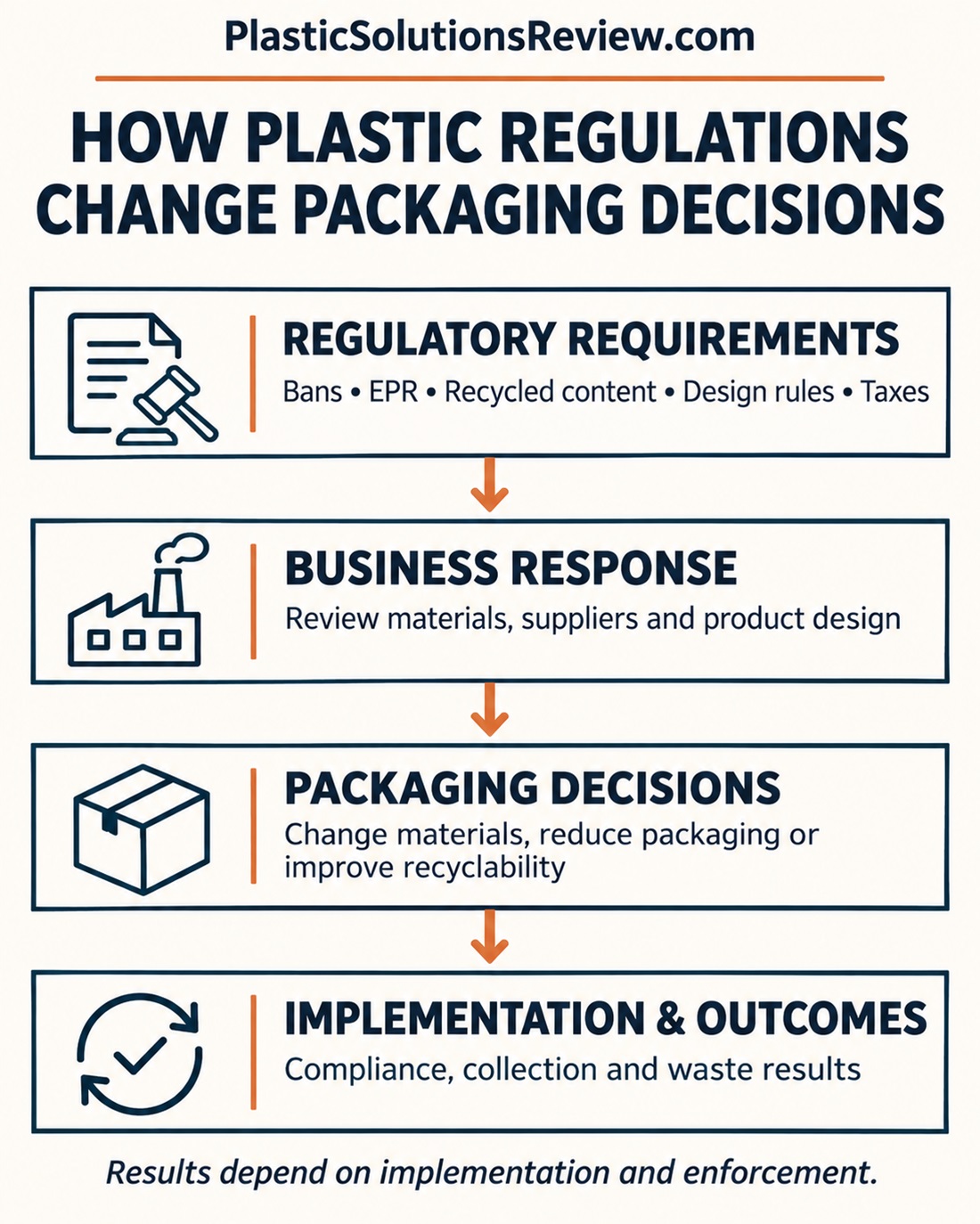
For businesses, this means that packaging decisions may increasingly involve regulatory requirements alongside performance and cost.
For consumers, it may mean changes in which products are sold, how packaging is labelled and what happens when containers are returned or discarded.
The precise effects will vary by jurisdiction and product.
Frequently Asked Questions
What are plastic regulations?
Plastic regulations are legally enforceable rules governing particular activities involving plastic products or materials. They may address manufacturing, product design, sales, recycled content, waste collection or disposal.
Are plastic regulations the same in every country?
No. Countries and regions have different laws, exemptions and implementation schedules. Requirements may also vary between states or local jurisdictions within one country.
Which countries have banned single-use plastics?
Many countries have introduced restrictions on selected single-use plastic products. However, these measures differ in scope. A ban on certain plastic bags does not mean all single-use plastics are prohibited.
What is the difference between EPR and a plastic tax?
Extended Producer Responsibility assigns specified responsibilities to producers for products or packaging, often including financing waste management. A plastic tax imposes a charge when defined taxable conditions are met. The two approaches can operate together.
Do plastic regulations require all packaging to be recyclable?
No. Requirements differ by jurisdiction, packaging category and implementation date. Some laws establish recyclability standards, but there is no universal rule covering every plastic package worldwide.
Is there a legally binding global plastics treaty?
As of November 2026, the proposed global plastics treaty remains under negotiation. Existing international agreements, including the Basel Convention, already regulate certain aspects of plastic waste.
Can recycled plastic still be subject to regulation?
Yes. Recycled plastic may be subject to requirements concerning material content, chemical safety, food contact, documentation and product design, depending on its intended use and destination market.
The Bottom Line
Plastic regulations are changing how governments assign responsibility for plastic products and waste.
Bans seek to prevent selected products from entering the market. Producer responsibility systems shift some waste-management obligations toward businesses. Recycled-content requirements create demand for recovered materials, while packaging standards influence how products are designed.
No single approach addresses every problem.
The effectiveness of plastic regulation depends on how clearly laws are written, how consistently they are enforced, and whether their results are measured.
Understanding these differences provides a stronger basis for evaluating plastic policy than looking at announcements or targets alone.
Leave a Reply