
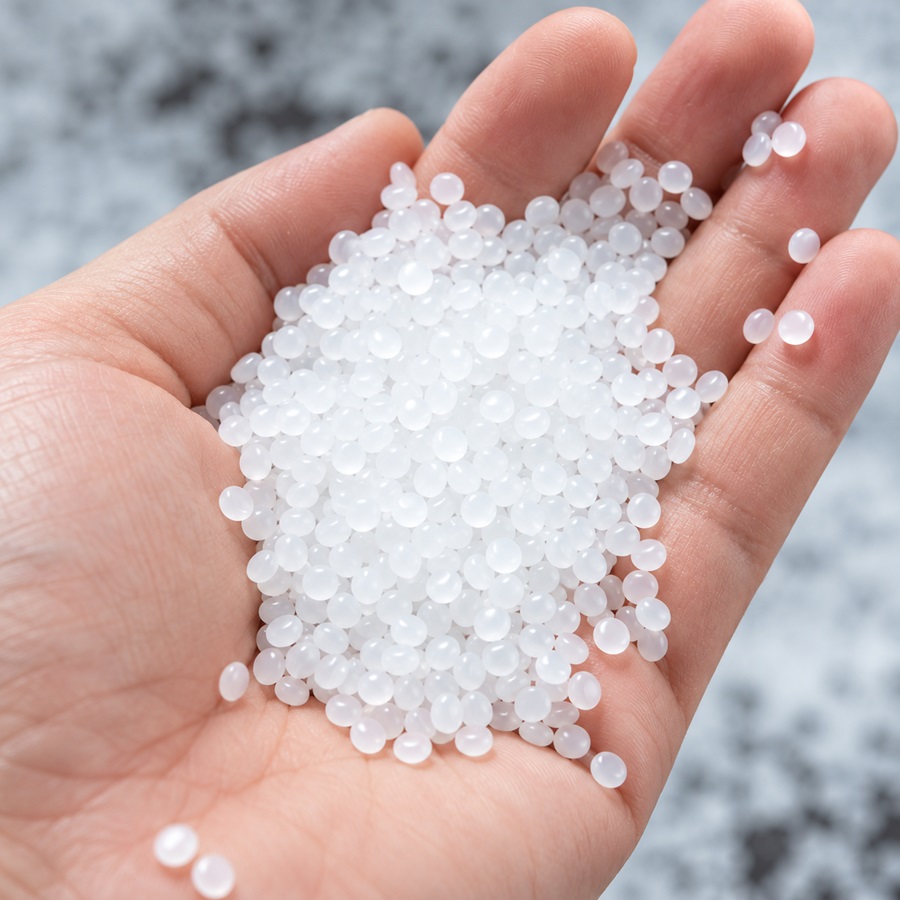
Open a yogurt tub, flip up a shampoo cap, sit in a car. You’ve touched polypropylene. It’s the plastic behind bumpers, carpets, surgical masks, reusable food boxes and the little hinge on a ketchup lid that opens ten thousand times without snapping.
Polypropylene at a glance
Polypropylene (PP) is a lightweight thermoplastic made from propylene. It resists chemicals and moisture, survives repeated flexing, and tolerates moderate heat, so it appears in food packaging, car parts, textiles and medical products. Its resin identification code is #5.
- Formula: (C₃H₆)ₙ, also called polypropene
- Density: about 0.90–0.91 g/cm³, so it floats in water
- Melting point: about 160–165 °C for homopolymer
- Recyclable: technically yes, but local acceptance varies a lot
- Biodegradable: no
PP is one of the world’s biggest commodity plastics. According to PlasticsEurope’s Plastics – the Fast Facts 2025, polypropylene made up about 19% of the 430.9 million tonnes of plastics produced worldwide in 2024. That scale explains why two questions come up so often: what makes it so useful, and what happens to it afterward.
This guide answers both, with real numbers where they help.
What Is Polypropylene Plastic?
Polypropylene is a thermoplastic polyolefin: a plastic built by linking thousands of propylene molecules into long chains. “Thermoplastic” means it softens when heated and hardens as it cools, so manufacturers can melt it, shape it and, in principle, melt it again later.
You’ll see polypropylene plastic, PP plastic, PP material and PP plastic material used interchangeably. They all mean the same polymer family. But “PP” covers a lot of ground. A stiff bucket, a clear takeaway tub and a woven feed sack are all PP, and they behave very differently because of the grade, additives and manufacturing process behind them.
| Item | Polypropylene |
| Abbreviation | PP |
| Other names | Polypropene |
| Resin identification code | #5 |
| Polymer class | Semi-crystalline thermoplastic polyolefin |
| Typical appearance | Translucent to opaque; clear in some copolymer and film grades |
| Main strengths | Low density, chemical resistance, fatigue resistance, low water uptake, low cost |
| Main weaknesses | Weak UV resistance unless stabilized, brittle near 0 °C in some grades, hard to glue or paint, flammable |
Chemistry and History
What the molecule looks like
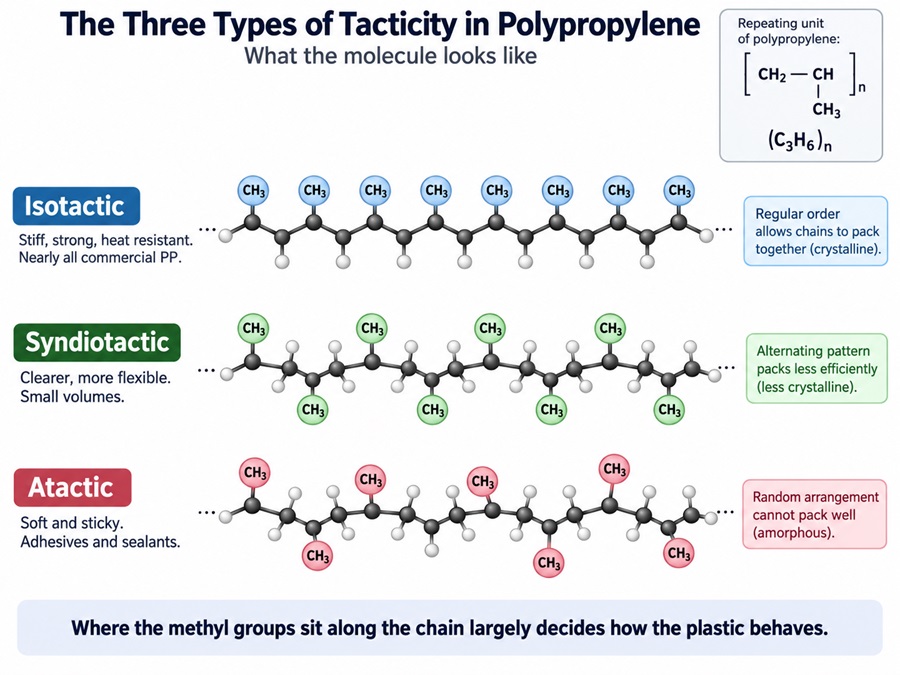
Polypropylene is a chain of repeating propylene units. Each unit carries a small methyl (–CH₃) side group, and the way those groups line up along the chain, called tacticity, shapes the plastic’s behavior.
- Isotactic PP: all methyl groups sit on the same side. The chains stack neatly, like well-organized pencils, which makes the plastic stiff, strong and heat resistant. Nearly all commercial PP is isotactic.
- Syndiotactic PP: the groups alternate sides. It’s clearer and more flexible, but it’s made only in small volumes with metallocene catalysts.
- Atactic PP: the groups are random, so the chains tangle like spaghetti. The result is soft and sticky, and it’s used mostly in adhesives, sealants and roofing.
Commercial PP is semi-crystalline. The tightly packed crystalline regions give stiffness and heat resistance, and the disordered regions give toughness. Much of grade design is about balancing the two.
A quick history
- 1951: Phillips Petroleum chemists made crystalline polypropylene.
- 1954: Giulio Natta in Italy produced highly ordered isotactic PP using Ziegler-type catalysts.
- 1957: Commercial production started in Italy.
- 1963: Natta and Karl Ziegler shared the Nobel Prize in Chemistry for their catalyst and polymer work.
- 1980s onward: Better Ziegler-Natta and metallocene catalysts allowed tighter control of structure, leading to clearer, tougher and more specialized grades.
Polypropylene Properties
PP’s real advantage isn’t any single property. It’s getting a decent set of them in one cheap polymer. The values below are typical for unfilled homopolymer. Grades differ, so treat these as a starting point and check the datasheet before you design anything.
| Property | Typical value | What it means in practice |
| Density | 0.90–0.91 g/cm³ | Floats on water and is lighter than most plastics |
| Melting point | ~160–165 °C | Handles hot-fill and hot food |
| Glass transition (Tg) | Around 0 °C or slightly below | Homopolymer can turn brittle in the cold |
| Tensile strength (yield) | ~30–40 MPa | Moderate; below nylon, PET or polycarbonate |
| Flexural modulus | ~1.3–1.8 GPa | Fairly stiff; copolymers are softer |
| Max continuous service temperature | ~90–100 °C (stabilized) | Fine for hot water and most dishwashers, not for sustained high heat |
| Water absorption (24 h) | < 0.03% | Barely changes when wet |
| Mold shrinkage | ~1–2.5% | Needs careful mold design to prevent warping |
| Flammability | UL 94 HB | Burns slowly; flame-retardant grades exist |
| Surface energy | ~29–31 mN/m (low) | Adhesives, paint and ink struggle to grip |
What PP does well
It’s light. At 0.90 g/cm³, PP cuts weight in packaging and car parts, which can reduce material use and shipping costs.
It shrugs off most chemicals. Water, dilute acids, alkalis, detergents and alcohols don’t bother it much. That’s why you find PP in battery cases, lab ware and chemical tanks.
It stays dry. With almost no water absorption, PP keeps its dimensions and properties in damp conditions.
It survives repeated bending. This is PP’s signature trick. A thin strip of PP can flex thousands of times before it fails, which is why it’s the standard material for living hinges, the one-piece hinge on flip-top caps and lunch-box lids.
It insulates electricity. That earns it a place in cable systems, appliance parts and capacitor films.
It’s cheap to make and easy to process. Nearly every plastic forming method works with it.
Where PP struggles, and how engineers work around it
| Weak spot | Why it happens | Common fix |
| Breaks down in sunlight | UV cuts the polymer chains | UV stabilizers, carbon black, pigments |
| Brittle in the cold | Tg sits near 0 °C in homopolymer | Impact or random copolymer grades |
| Oxidizes with heat | Oxygen attacks the chains, and copper speeds it up | Antioxidants; avoid direct copper contact |
| Hard to paint or glue | Low surface energy | Flame, corona or plasma treatment; primers |
| Some chemicals attack it | Strong oxidizers degrade it; aromatic and chlorinated solvents swell it, especially when hot | Check a compatibility chart for your exact chemical and temperature |
| Warps after molding | Crystallization causes uneven shrinkage | Mold design; fillers like talc or glass fiber |
| Burns | It’s a hydrocarbon | Flame-retardant additives |
Types of Polypropylene
When someone says “PP,” they could mean any of these. The differences matter more than most people expect.
| Type | What’s in it | Key traits | Typical uses |
| Homopolymer (PP-H) | Propylene only | Stiffest, strongest, best heat resistance; weaker impact strength in the cold | Fibers, sheet, rigid containers, tanks, pipes |
| Random copolymer (PP-R) | Propylene plus a few percent ethylene, scattered randomly | Clearer, more flexible, lower melting point (~130–150 °C), seals well | Clear packaging, medical ware, hot-water pipes |
| Impact / block copolymer (PP-B, ICP) | Homopolymer matrix with an ethylene-propylene rubber phase | Much tougher, especially in the cold; a bit less stiff | Bumpers, crates, appliance housings, freezer containers |
| Filled or reinforced PP | PP with talc, calcium carbonate, glass fiber or long-fiber reinforcement | Stiffer, higher heat deflection, less shrinkage | Dashboards, structural parts, appliance components |
| BOPP and CPP film | Biaxially oriented or cast PP film | Clear, strong, good moisture barrier | Snack wrappers, labels, tape, polymer banknotes |
| Expanded PP (EPP) | Foamed PP beads | Light, energy-absorbing, reusable | Bumper cores, protective packaging, toys |
| Fibers and nonwovens | Spunbond, meltblown, staple fiber | Hydrophobic, light, cheap | Masks, diapers, geotextiles, carpets, filters |
One naming trap: in packaging, “PP-R” means random copolymer, and in plumbing, “PP-R pipe” is a random-copolymer pipe built for hot and cold water. Same meaning, different industry vocabulary.
How PP Is Made and Processed
From feedstock to pellets
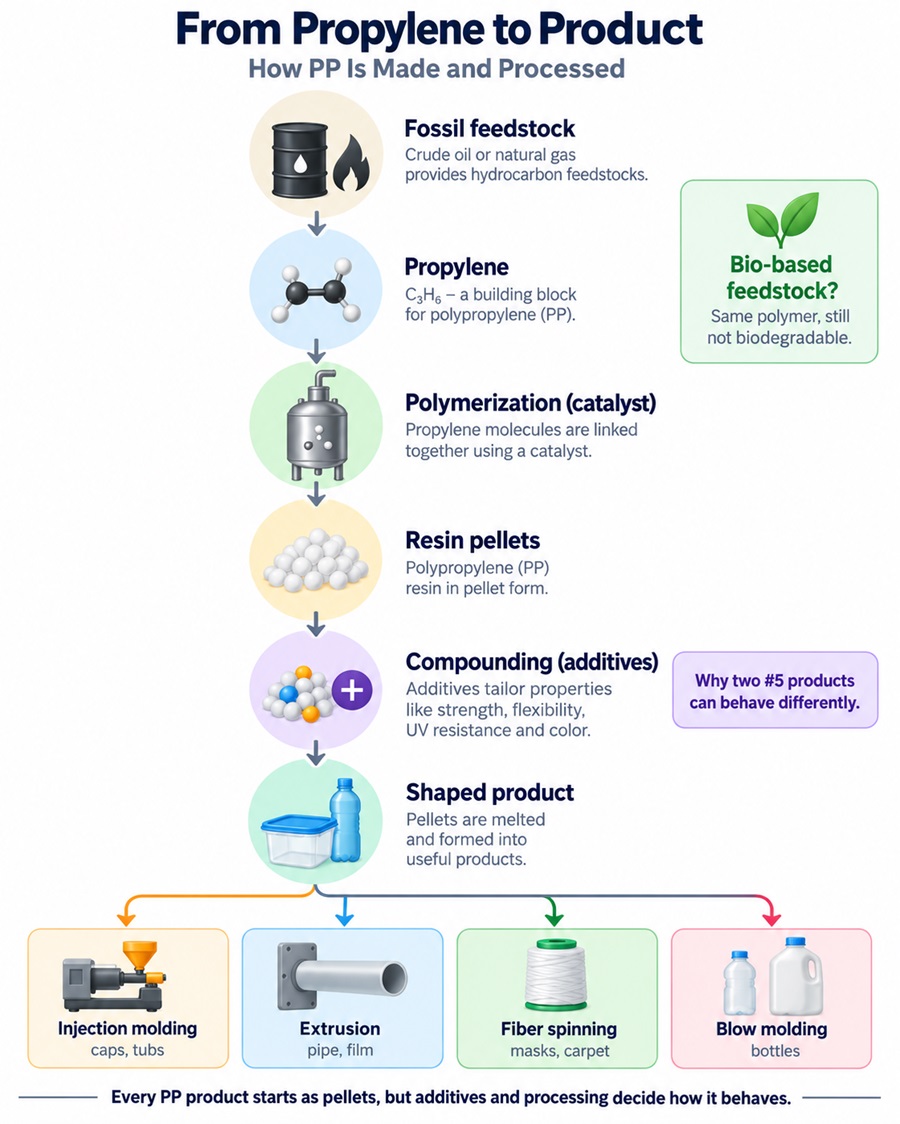
Feedstock → propylene → polymerization → resin → pellets → compounding → product
- Making propylene. Most of it comes as a by-product of steam cracking and refinery cracking. Some is made on purpose through propane dehydrogenation (PDH) or, in some regions, methanol-to-olefins. Almost all of it is fossil-derived today.
- Polymerizing. Propylene reacts with Ziegler-Natta or metallocene catalysts in bulk, slurry or gas-phase reactors. Catalyst and conditions set the chain structure, crystallinity and molecular weight.
- Pelletizing. The resin is stabilized and cut into pellets, which is how converters buy it.
- Compounding. Compounders mix in antioxidants, UV stabilizers, pigments, clarifiers, fillers, impact modifiers or flame retardants. This step is why two #5 products can perform very differently.
What about bio-based PP? PP can be made from renewable feedstocks, often tracked through mass-balance accounting. The polymer is chemically the same as fossil PP, so it is not biodegradable and won’t compost.
How PP gets shaped
| Process | Typical products | Notes |
| Injection molding | Caps, tubs, crates, car parts, housings | Melt temperatures around 200–280 °C; high-flow grades fill thin walls |
| Extrusion | Sheet, pipe, profiles, film, cable coating | Lower-flow grades give better strength |
| Blow molding | Bottles, jars, hollow parts | Random copolymers improve clarity |
| Thermoforming | Trays, cups, deli containers | Formed from extruded sheet |
| Film production | CPP and BOPP film | BOPP is stretched in two directions for clarity and strength |
| Fiber spinning | Spunbond, meltblown, tape yarn, staple fiber | Feeds nonwovens, carpets and woven sacks |
| Foaming | EPP beads and parts | Molded into lightweight shapes |
| 3D printing | Filament and powder | Warps and sticks poorly to print beds, so it needs a PP-compatible build surface |
Welding, gluing and painting
PP welds beautifully. Hot-air, hot-plate, ultrasonic, spin and friction welding all make strong joints.
Glue and paint are a different story. The surface is so low in energy that most adhesives, inks and coatings bead up or peel. To make things stick, you’ll need flame, corona or plasma treatment, a polyolefin primer, or an adhesive made for low-energy plastics.
What Is Polypropylene Used For?
| Sector | Examples | Why PP fits |
| Food and drink packaging | Yogurt and margarine tubs, deli containers, microwaveable trays, straws, cups, snack film | Low water uptake, hot-fill tolerance, chemical resistance, low cost |
| Closures and dispensers | Flip-top caps, hinged lids, pump parts | Living-hinge fatigue resistance |
| Automotive | Bumpers, dashboards, door panels, battery cases, wheel-arch liners | Low weight, tough copolymers, easy molding |
| Textiles and nonwovens | Carpets, rope, geotextiles, woven sacks, diaper layers, filter media | Hydrophobic, light, cheap |
| Healthcare | Syringes, specimen containers, surgical masks, meltblown filter layers, sutures, hernia mesh | Chemical resistance, sterilization compatibility (depends on method and grade) |
| Household goods | Storage boxes, buckets, chairs, kitchenware, toys | Durable, cheap, dishwasher tolerant |
| Building and industry | PP-R hot-water pipes, tanks, corrugated PP sheet (often sold as Coroplast), pallets, chemical-handling equipment | Chemical resistance, weldability, light weight |
| Electrical | Capacitor film, appliance parts, cable insulation | Insulating properties |
| Currency and labels | Polymer banknotes, BOPP labels | Strong, durable, printable after treatment |
How to Identify Polypropylene
Say you’re holding a mystery plastic object. Here’s how to work out whether it’s PP, from easiest to riskiest.
- Look for #5. It’s usually molded into the base or side, often with “PP” underneath. Its purpose is to identify the resin, and it doesn’t tell you whether your local program recycles it.
- Think about the product. Yogurt tubs, most bottle caps, flip-top hinges, food-storage boxes and corrugated plastic sheet are usually PP.
- Try the float test. PP floats because its density is below 1 g/cm³. So does polyethylene, and heavily filled PP may sink, so this only narrows things down. PET, PVC and PS sink.
- Use your hands. PP feels stiffer and springier than polyethylene, with a slightly waxy surface. Ordinary glue barely sticks.
- Flame test, as a last resort. PP burns with a yellow flame, drips, and smells like burning petroleum. Use a tiny sample, outdoors, away from anything flammable. Burning plastic releases harmful fumes, and a datasheet or supplier confirmation is more reliable.
PP vs. Other Plastics
The master comparison
Values are approximate for common unfilled grades.
| Plastic | Resin code | Density (g/cm³) | Tensile strength (MPa) | Approx. max continuous use (°C) | Clarity | Relative cost |
| PP | 5 | 0.90–0.91 | 30–40 | 90–100 | Translucent; clear in copolymer and film grades | Low |
| HDPE | 2 | 0.94–0.97 | 20–32 | 70–80 | Translucent to opaque | Low |
| LDPE | 4 | 0.91–0.93 | 8–20 | 60–75 | Translucent | Low |
| PET | 1 | 1.38–1.40 | 55–75 | ~60–70 (higher if crystallized) | High | Low–medium |
| Polystyrene (GPPS) | 6 | 1.04–1.05 | 35–55 | 60–70 | High, but brittle | Low |
| ABS | 7 | 1.04–1.06 | 40–50 | 70–85 | Opaque | Medium |
| Nylon 6 | 7 | 1.13–1.14 | 70–85 (dry) | 80–100 | Translucent | Medium–high |
| Polycarbonate | 7 | 1.20 | 55–75 | 115–125 | High | High |
| PLA | 7 | 1.24–1.25 | 50–65 | 45–55 | High | Medium |
PP vs. polyethylene
They’re close relatives, but PP is stiffer, handles more heat, and wins on hinge fatigue. PE is softer and tougher in the cold. That split explains the packaging aisle: HDPE for milk jugs and detergent bottles, PP for caps, tubs and hot-food containers. In recycling, keep them apart, because even a little PE in PP (or the reverse) hurts the recycled resin.
PP vs. polyester
In textiles, “polyester” almost always means PET. PP fiber is lighter, water-repellent and cheaper, but it melts at about 160 °C versus roughly 250 °C for PET, handles UV worse, and is hard to dye. That’s why PP ends up in carpets, hygiene products and industrial fabrics, while PET dominates clothing.
PP vs. PVC
PVC contains chlorine and leans heavily on additives, while PP is a plain hydrocarbon. PVC leads in rigid pipe, cable and window profiles. In a PP recycling stream, PVC is a nasty contaminant, so accurate sorting matters.
Is Polypropylene Safe?
For food contact and medical use, PP has a strong track record. But safety belongs to the finished product, not the letters “PP.”
Food contact
In the U.S., FDA regulations and food contact notifications cover specific PP formulations under specific conditions of use. In the EU, food-contact plastics fall under Regulation (EC) No 1935/2004 and Regulation (EU) No 10/2011, which set authorized substances and migration limits. A food-storage tub and an industrial bucket can both be PP, but only one was designed and tested for food.
Microwave, dishwasher, freezer and hot liquids
- Microwave: Many PP containers are made for it, but #5 doesn’t mean microwave safe. Look for the manufacturer’s microwave symbol or statement, and retire containers that are scratched or warped.
- Dishwasher: Most PP kitchenware copes, usually best on the top rack. Follow the label.
- Freezer: Homopolymer PP can turn brittle when frozen. Containers meant for the freezer typically use random or impact copolymers.
- Hot liquids: PP handles hot fill better than many plastics, but its limit is real and varies by grade.
BPA and additives
PP isn’t made from bisphenol A. BPA belongs to polycarbonate and some epoxy resins. But “BPA-free” only covers one chemical. Pigments, stabilizers, slip agents and fillers depend on the product.
Microplastics: what the research shows
A 2020 study in Nature Food from Trinity College Dublin found that polypropylene baby bottles released up to 16.2 million microplastic particles per litre of prepared formula, and that sterilization and high-temperature water significantly increased the release. What that means for health is still being studied. If you’d like to reduce exposure anyway, avoid heating food in scratched or worn plastic, let hot liquids cool a bit before pouring them into plastic, and replace old containers.
Medical use
PP is common in syringes, containers and packaging, but suitability depends on the grade and the sterilization method (steam, gamma or ethylene oxide). Some grades survive autoclaving. Others don’t.
Recycling and Environmental Impact
The environmental picture
Most PP comes from fossil propylene, and every production step uses energy. PlasticsEurope’s data puts global plastics production at 430.9 million tonnes in 2024, and PP is the largest single polymer category in that total.
There’s an upside. PP’s low density can cut material and transport weight, and a durable PP box used for a decade beats a stack of disposable containers. But lightweighting isn’t automatically greener, so lifecycle assessments matter.
The downside is persistence. Conventional PP doesn’t biodegrade in normal environments or compost heaps. It weathers and breaks into ever-smaller pieces, and fragmenting is not the same as biodegrading. Those pieces, plus shed fibers, add to microplastic pollution.
Can you recycle polypropylene?
Technically, yes. In practice, it depends on where you live.
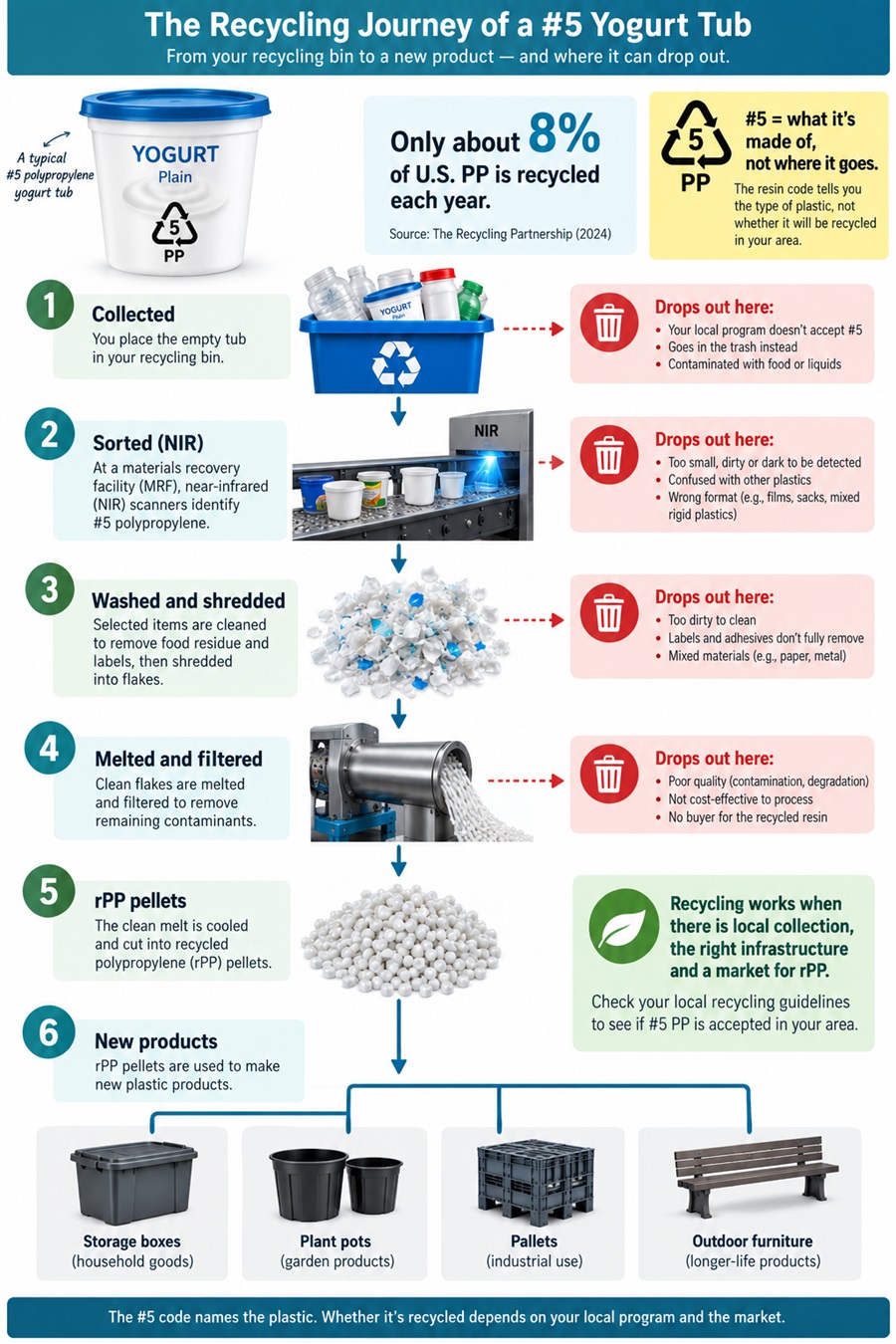
The #5 code comes from the ASTM resin identification standard, and it only identifies the resin. It doesn’t mean a recycling system exists for that item. In the U.S., only about 8% of PP is recycled each year, according to The Recycling Partnership. Its Polypropylene Recycling Coalition has deployed more than $15 million through 60 grants, improving or adding PP recycling access for about 48 million people.
How mechanical recycling works
Collection → sorting → washing → shredding → separation → melting and filtering → pelletizing
- Collection: Curbside bins, drop-off points or industrial scrap. Clean factory scrap is far easier to recycle than mixed household waste.
- Sorting: Facilities use screens, near-infrared (NIR) optical sorters and manual checks.
- Washing and shredding: Food residue, labels and adhesives come off, and the plastic is shredded into flakes.
- Separation: A sink-float tank pulls out denser plastics like PET, PVC and PS. PP and PE both float, so NIR sorting has to separate those two.
- Melting and pelletizing: Flakes are melted, filtered and cut into recycled PP (rPP) pellets.
Why so little PP gets recycled
- Patchy collection. Many municipal programs don’t take #5, or accept tubs but not caps, trays or film.
- Too many formats. Rigid tubs, film, woven sacks, fibers and multilayer packs need different processes.
- Contamination and color. Food, labels, glue, black pigment and mixed materials cut quality and value.
- Economics. When virgin PP is cheap, recycled PP struggles unless collection and demand are strong.
- Odor and consistency. Post-consumer rPP often smells and varies from batch to batch, which limits high-spec uses.
Chemical recycling and rPP
“Chemical recycling” is an umbrella for very different technologies. Pyrolysis heats plastic without oxygen to make oils and gases. Other routes include depolymerization and solvent-based purification. Yields, energy use, emissions and commercial maturity vary widely, so judge each process on its own evidence. It complements mechanical recycling and doesn’t replace it.
Recycled PP comes from two sources: post-industrial scrap (clean, known composition) and post-consumer waste (needs heavier sorting and cleaning). It goes into crates, buckets, furniture, car parts, pipes and non-food packaging. Food-contact rPP needs process-specific approval, such as an FDA opinion letter in the U.S. or an authorized recycling process in the EU.
Policy is changing the picture
- EU: Regulation (EU) 2025/40 covers the whole packaging life cycle, including recyclability, waste prevention and extended producer responsibility (EPR), which makes producers pay for collection and recycling. It began applying on 12 August 2026, and recyclability requirements phase in toward 2030.
- Elsewhere: A growing number of countries and U.S. states are adding EPR laws or recycled-content rules. Acceptance of #5 still differs city by city and country by country.
How to recycle PP at home
- Check your local list. Search your municipality’s accepted materials instead of trusting the number.
- Empty and scrape. A quick rinse is enough, and it doesn’t have to be spotless.
- Follow the local rule on caps. Some programs want them on, others want them off.
- Keep film and woven sacks out of curbside bins unless your program accepts them. Use store drop-off points where available.
- Reuse durable PP. A storage box that lasts years has a lower footprint than any single-use item.
What would make PP more circular
Brands can design mono-material packs with easy-to-remove labels. Cities can expand collection of tubs and caps. Sorters can improve optical detection, and buyers can commit to using rPP. And everyone can use less material in the first place.
How to Choose a PP Grade
If you’re buying or specifying PP rather than just curious about it, these are the questions that matter.
| Question | What to look at |
| Rigid and heat resistant, or flexible and tough? | Homopolymer for stiffness, random copolymer for clarity and flexibility, impact copolymer for cold toughness |
| How will you process it? | Melt flow index (MFI, g/10 min at 230 °C/2.16 kg): roughly 10–40+ for thin-wall injection molding, ~0.3–4 for extrusion, pipe and blow molding; fiber and meltblown grades run much higher |
| Will it live outdoors? | UV-stabilized or carbon-black grades |
| Do you need clarity? | Random copolymer with a clarifier, or BOPP for film |
| Need more stiffness or less shrinkage? | Talc, mineral or glass-filled grades |
| Food or medical contact? | Grades with documented food-contact or medical compliance |
| Flame or heat requirements? | Flame-retardant or heat-stabilized grades |
| Sustainability claims? | rPP or certified mass-balance grades, with paperwork |
Ask your supplier for the technical datasheet and compliance declarations, then test samples in the real application before committing.
Frequently Asked Questions
What does PP stand for, and is “PP plastic” the same as polypropylene?
PP stands for polypropylene. “PP plastic,” “PP material” and “PP plastic material” all mean the same polymer family.
What number plastic is polypropylene?
It’s #5. The number names the resin. It doesn’t promise local recyclability.
Is polypropylene waterproof?
The material barely absorbs water, so yes. A finished product can still leak through weaves or seams, as woven PP sacks do.
Is polypropylene flammable?
Yes. It burns and drips (UL 94 HB), though flame-retardant grades exist.
Is polypropylene UV resistant?
Not unless it’s stabilized. Outdoor PP needs UV stabilizers or carbon black.
What temperature can polypropylene handle?
It melts around 160–165 °C, and continuous use is usually limited to about 90–100 °C for stabilized grades. Homopolymer gets brittle near 0 °C, while impact copolymers cope better with cold.
Is polypropylene the same as polyester?
No. Polyester is usually PET, which is denser and melts at a much higher temperature. PP is a polyolefin.
Can you glue, weld or paint polypropylene?
You can weld it easily. Gluing and painting need surface treatment, a primer or a specialty adhesive.
Is polypropylene toxic?
The polymer itself has low toxicity and is widely used in food and medical products. A finished item’s safety depends on its additives, intended use and regulatory compliance.
Is PP safe in the microwave?
Only if the product is labeled for it.
Is PP stronger than polyethylene?
It’s usually stiffer and more heat resistant than most PE, while PE can be tougher in the cold. The grade matters more than the family.
Can PP be recycled with PET or HDPE?
Facilities may collect them in the same bin, but they sort them into separate streams. Mixing polymers lowers recycled-resin quality.
Can recycled PP go into food packaging?
Sometimes, if the specific recycling process and application have been approved by the relevant regulator.
Can you 3D print with polypropylene?
Yes, but it warps and adheres poorly, so it’s harder than PLA or PETG and needs a PP-compatible build surface.
The Bottom Line
Polypropylene is a light, chemically resistant, inexpensive plastic with fatigue resistance few rivals can match. That’s why it fills so many roles in packaging, closures, vehicles, textiles and healthcare. Its weak spots (UV, cold brittleness in some grades, difficult bonding) are manageable if you pick the right grade and additives.
Recycling is the harder part. PP can be recycled, but whether your yogurt tub actually is depends on your local program, contamination and market demand. Check the local rules before you toss it, and keep durable PP items in use as long as you can.
Leave a Reply