
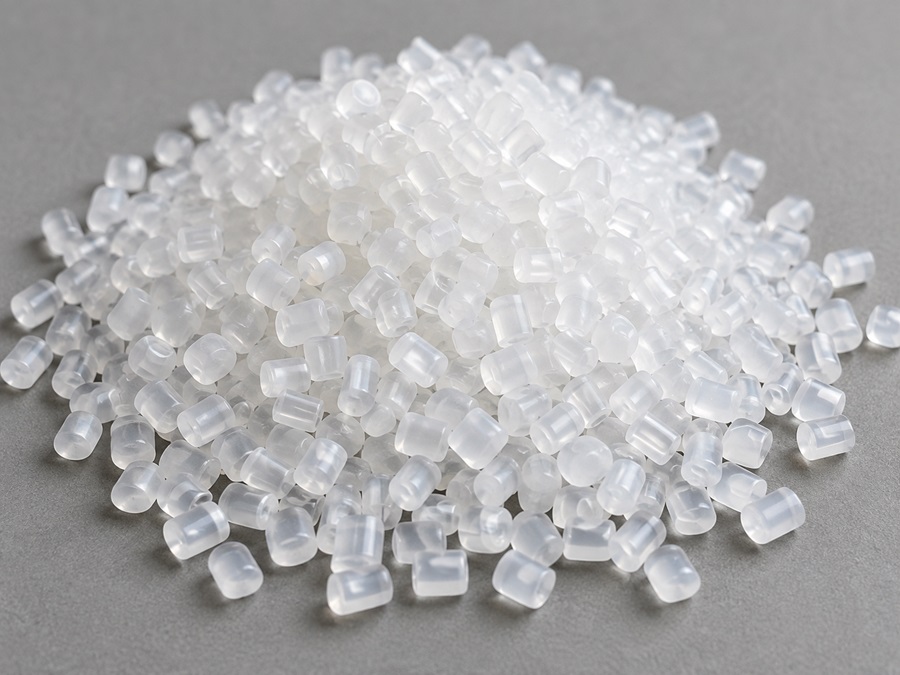
Polystyrene (PS) is a plastic made from styrene. It comes as a hard solid or a lightweight foam (EPS and XPS), and it carries resin code #6. It’s cheap, insulates well and molds easily, which is why it’s everywhere. It’s technically recyclable, but very few programs collect it.
You’ve almost certainly touched some today: a yogurt pot, a disposable cup, the white block around a new TV, or the insulation inside a wall.
Polystyrene at a glance
| Item | Details |
| Chemical name / formula | Poly(1-phenylethene), (C₈H₈)ₙ |
| Abbreviation / resin code | PS / #6 |
| Main types | GPPS, HIPS, EPS, XPS |
| Common uses | Food packaging, protective packaging, insulation, appliances, lab ware |
| Softens at | About 90–100 °C (glass transition) |
| Recyclable? | Technically yes, but rarely collected curbside |
| Biodegradable? | No. It breaks into smaller pieces instead |
| Food-safe? | Only when used as the manufacturer intends |
| Same as Styrofoam? | No. Styrofoam is a brand of XPS insulation |
What is polystyrene plastic?
Polystyrene is a thermoplastic: long chains of styrene molecules that soften when heated and harden as they cool. That’s why manufacturers can melt and reshape it by injection molding, extrusion and thermoforming. “PS” just means polystyrene, and in the Resin Identification Code system it’s number 6.
Two things trip people up:
- The #6 symbol names the plastic, not the recycling rule. The S. EPA explains that resin identification codes do not necessarily mean a plastic is accepted for recycling in your community. Check your local program before putting #6 PS in the recycling bin.
- Polystyrene looks very different depending on its form. A clear takeaway container, a black refrigerator liner and a white foam block can all be polystyrene, so appearance won’t tell you.
Regional names vary. In the US, people say “Styrofoam” for white foam cups and packaging. In the UK, Australia and much of Europe, “polystyrene” usually means the white foam itself. In India, Bangladesh and much of South Asia, it’s called thermocol. All of these usually mean expanded polystyrene (EPS).
How is polystyrene made?
Manufacturers start with styrene, an organic chemical made from petroleum and natural-gas feedstocks. In a process called polymerization, styrene molecules link into long repeating chains:
Feedstocks → styrene monomer → polymerization → polystyrene resin → molding or foaming → finished product
The resin then goes one of two ways:
- Rigid products: the resin is melted and shaped by injection molding, extrusion or thermoforming.
- Foam products: the polymer is expanded, or extruded with a blowing agent, until it fills with gas and forms a cellular structure. EPS beads typically use pentane for this.
Styrene (the monomer) and finished polystyrene (the polymer) behave very differently. That distinction matters in the safety section below.
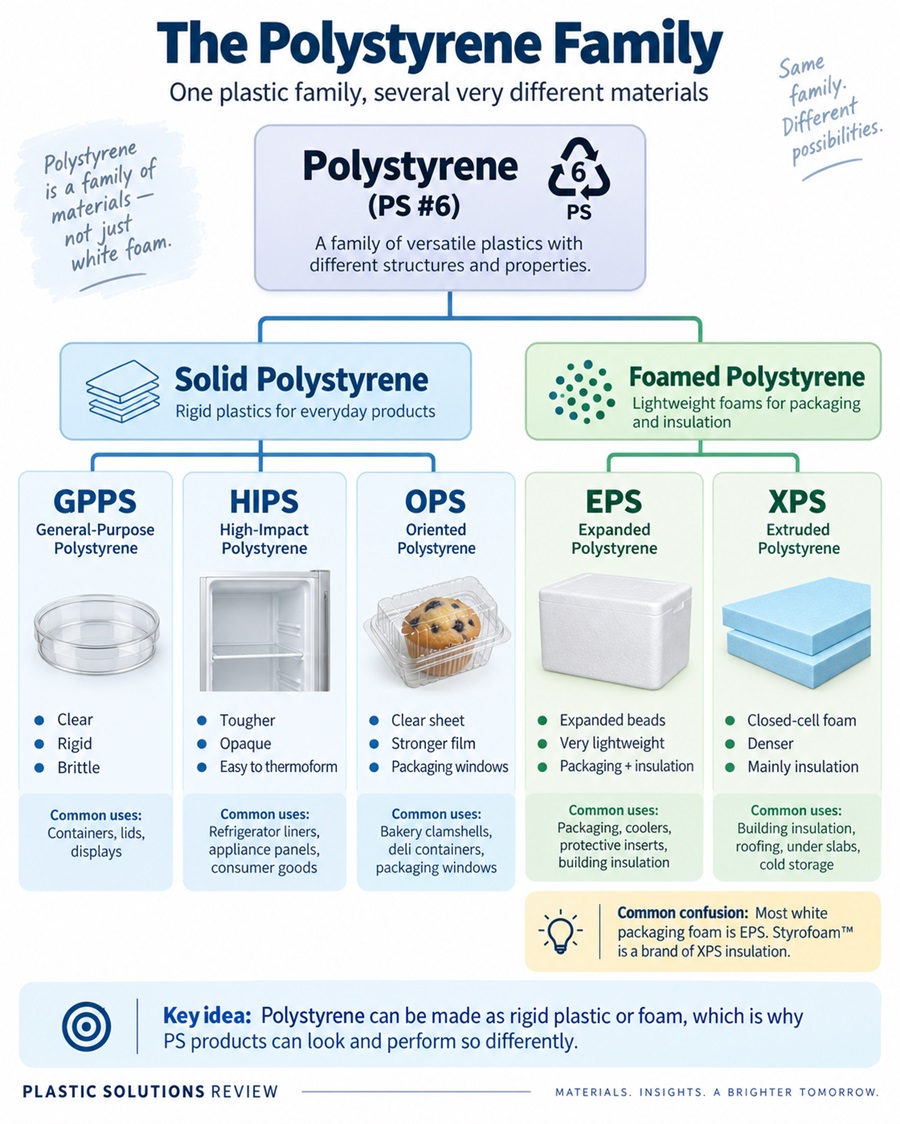
Types of polystyrene
Polystyrene is a family of materials, not one plastic.
GPPS (general-purpose polystyrene). Hard, clear, stiff and easy to mold, but brittle. You’ll find it in disposable lab ware, CD cases, cutlery and clear packaging parts.
HIPS (high-impact polystyrene). GPPS toughened with a rubber component such as polybutadiene. It’s opaque, tougher and easy to thermoform. Think refrigerator liners, appliance housings, trays, yogurt cups and toy parts. It’s also a popular support material in 3D printing.
OPS (oriented polystyrene). Film or sheet stretched in two directions, which makes it clearer and stronger. It’s used for bakery and produce windows, deli containers and clamshell packaging.
EPS (expanded polystyrene). Small beads are expanded with steam and fused in a mold. Industry sources put EPS at about 98% air by volume, which explains how light it is. It’s used for protective packaging, coolers, takeaway boxes, insulation boards and geofoam.
XPS (extruded polystyrene). Molten polystyrene is extruded with a blowing agent into a continuous, uniform closed-cell foam. It’s denser and more moisture-resistant than EPS, so it’s mainly used for building insulation, especially below grade, on roofs and in foundations.
Look-alikes. A few related plastics get confused with PS:
- Syndiotactic polystyrene (SPS) is a crystalline, heat-resistant engineering plastic, unlike ordinary amorphous PS.
- ABS, SAN and SBS are styrene-based copolymers (with acrylonitrile and/or butadiene). They’re different plastics with different properties, and they aren’t resin code #6.
EPS vs. XPS
| Feature | EPS | XPS |
| Manufacturing | Expanded beads fused in a mold | Continuous extrusion |
| Structure | Fused-bead cells | Uniform closed cells |
| Density (typical) | ~10–35 kg/m³ | ~25–45 kg/m³ |
| Insulation (R-value per inch, approx.) | ~3.6–4.2 | ~4.5–5 |
| Moisture resistance | Good, but can absorb some water | Better |
| Typical uses | Packaging, coolers, insulation | Mostly building insulation |
| Appearance | White beads | Often blue, pink or green |
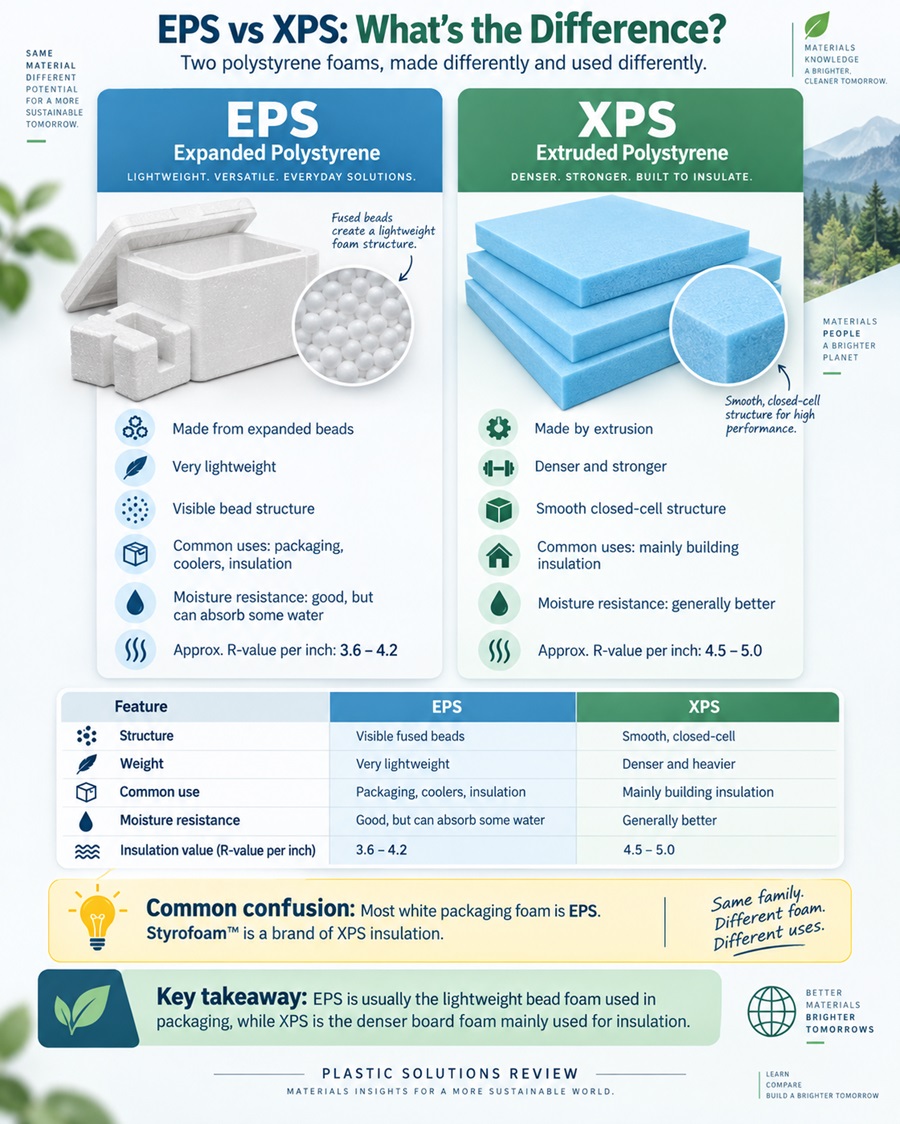
Is polystyrene the same as Styrofoam?
No. Polystyrene is the plastic family. Styrofoam™ is a trademarked brand of XPS building insulation. Older Styrofoam-brand boards were widely recognized by their blue color, but DuPont completed a North American transition to a lower-GWP grey formulation by the end of 2023.
The white cups, takeaway boxes and packaging foam people call Styrofoam are almost always EPS. So all Styrofoam-brand material is polystyrene, but most of what people call Styrofoam isn’t Styrofoam-brand.
Properties, advantages and disadvantages
| Property | Typical value or behavior | Comment |
| Density | GPPS ≈ 1.04–1.05 g/cm³; EPS ≈ 10–35 kg/m³ | Foam is mostly gas |
| Glass transition | ≈ 90–100 °C | Practical continuous-use limit is lower, roughly 70–80 °C |
| Rigidity | High | Stiff and easy to mold |
| Impact resistance | Low in GPPS; better in HIPS | GPPS cracks rather than bends |
| Clarity | High in GPPS and OPS | HIPS is opaque |
| Thermal insulation | Good in EPS and XPS | Thermal conductivity ≈ 0.03–0.04 W/m·K |
| Electrical insulation | Good | Used in electronic components |
| Water resistance | Good | Water-resistant, not fully waterproof (EPS can absorb some) |
| Chemical resistance | Resists water, many acids and alkalis | Dissolves in acetone, toluene, xylene and many other solvents |
| Flammability | Burns readily with black, sooty smoke | Some insulation grades use flame-retardant systems |
| Cost and processing | Cheap, fast to mold, extrude and foam | The main reason for its popularity |
What it does well
- Very light, especially as foam
- Low cost at high volume
- Excellent cushioning
- Good insulation when foamed
- Clear (GPPS) or tough (HIPS), depending on grade
- Easy to mold and thermoform
Where it falls short
- Brittle in standard rigid form
- Limited heat resistance
- Attacked by many solvents and by some oils and fats
- Flammable, so insulation needs flame retardants and fire-safe design
- Bulky, low-value waste that’s expensive to collect and transport
- Breaks into small fragments when littered
- Made mostly from fossil feedstocks
Flame retardants and blowing agents
Two technical details affect both safety and recycling:
- Flame retardants. Some EPS and XPS insulation products use flame-retardant systems to meet fire-performance requirements. HBCD (HBCDD) was historically used in polystyrene insulation and is listed as a persistent organic pollutant under the Stockholm Convention. Legacy HBCD-containing insulation can therefore complicate recycling and demolition-waste management.
- Blowing agents. XPS has historically used blowing agents with high global-warming potential, including certain HFCs. Regulations in major markets are pushing XPS toward lower-GWP formulations; in the United States, for example, federal AIM Act restrictions now limit the GWP of blowing agents used in newly manufactured or imported XPS products.
What is polystyrene used for?
| Sector | Typical products | Main form |
| Food service and food packaging | Cups, clamshells, trays, yogurt pots, lids, cutlery | GPPS, HIPS, OPS, EPS |
| Protective packaging | Cushioning for TVs, computers, appliances, medical equipment | EPS |
| Cold chain | Coolers, insulated shipping boxes, fish boxes, vaccine carriers | EPS |
| Building and construction | Wall, roof, foundation and under-slab insulation; insulated concrete forms; geofoam | EPS, XPS |
| Appliances | Refrigerator liners, housings, internal panels | HIPS |
| Consumer goods | Toys, storage boxes, cosmetic packaging, office products | GPPS, HIPS |
| Medical and laboratory | Petri dishes, culture ware, trays, diagnostic components | GPPS |
| Crafts and decoration | Foam blocks, models, festival decorations | EPS, XPS |
HIPS and 3D printing. HIPS filament is a common support material for ABS prints. You can dissolve it away in d-limonene and get a clean surface. Nozzle temperatures run about 230–250 °C, so print somewhere ventilated, as you would with any thermoplastic.
Is polystyrene safe?
It depends on which thing you mean. There are three to separate:
- Styrene monomer, the chemical used to make PS
- Finished polystyrene polymer
- Additives, residues and use conditions for a specific product
What health agencies say about styrene. The International Agency for Research on Cancer (IARC) classifies styrene as Group 2A, “probably carcinogenic to humans”. The U.S. National Toxicology Program lists styrene as “reasonably anticipated to be a human carcinogen.” These are hazard classifications for styrene exposure, not classifications of finished polystyrene products. They do not mean that a finished polystyrene cup itself is a Group 2A carcinogen.
Food contact. Many countries authorize polystyrene for specific food-contact uses. In the US, the FDA lists polystyrene in its inventory of food-contact substances and points to the applicable conditions in 21 CFR. Trace styrene can migrate from some food-contact materials, and the amount depends on the product, food, temperature and contact conditions. That is why a container should be used only for the conditions its manufacturer specifies.
Practical guidance
| Question | Answer |
| Can you microwave polystyrene? | Only if the product is labeled microwave-safe. Never microwave unlabeled foam or PS containers. |
| Is it safe for hot drinks? | Cups designed for hot drinks are made for that. Don’t repurpose containers for uses they weren’t designed for. |
| Does it leach? | Small amounts of styrene can migrate, especially with hot, fatty or alcoholic contents. Regulators set limits for approved food-contact use. |
| Can you burn it? | No. Burning PS can produce dense smoke, soot and hazardous combustion products. Household or open burning is not an appropriate disposal method; use an authorized waste route instead. |
| Can acetone dissolve it? | Yes, but it’s not a safe disposal method. You get flammable vapor and a sticky residue that’s still plastic. |
Rule of thumb: use a PS food container only for the conditions it was designed for, and follow the manufacturer’s heating instructions.
Is polystyrene recyclable?
Technically yes, but very little gets recycled. That gap between what’s possible and what actually happens is the core problem with PS waste.
Why it’s hard to recycle
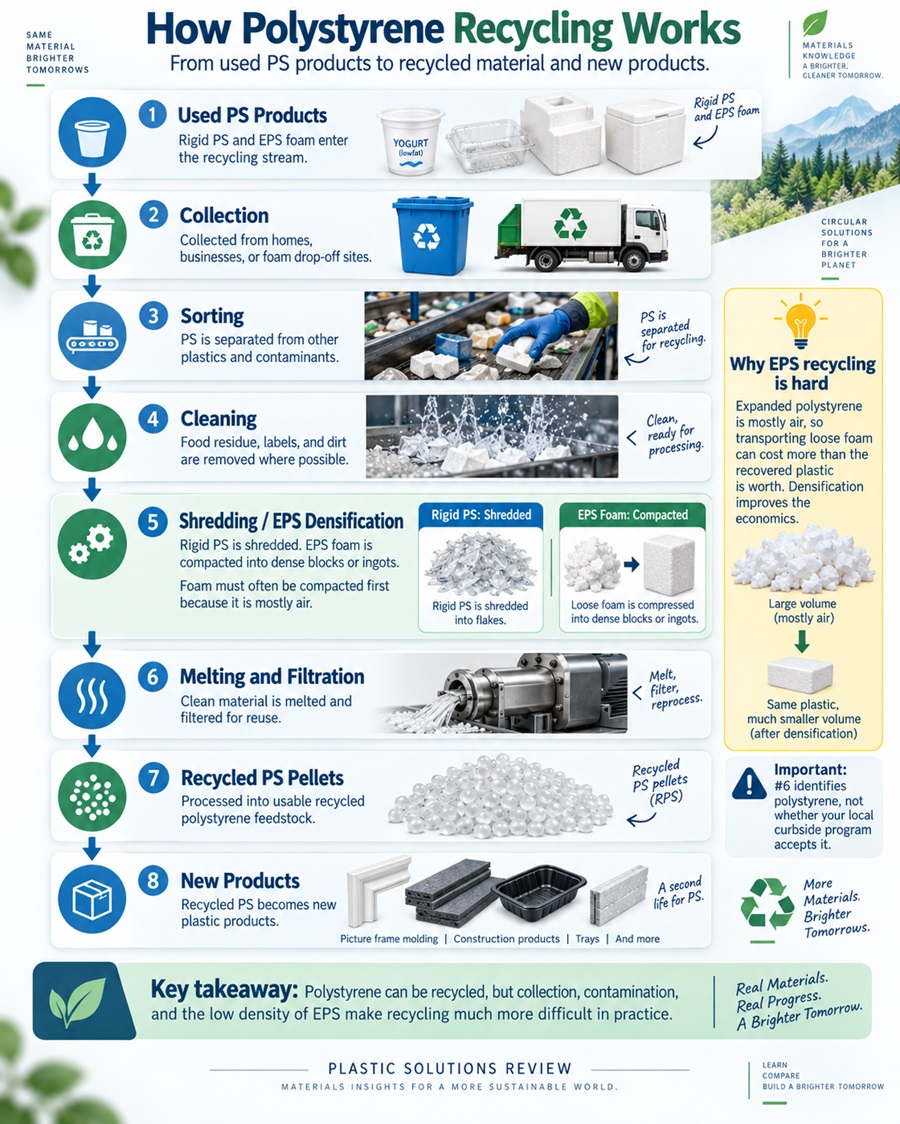
- Low density. Foam is mostly air, so transport is expensive unless it’s compacted first.
- Food residue, grease, labels and dirt make used foodware costly to clean.
- Limited collection. Many curbside programs don’t take #6 plastic.
- Facilities need PS-specific equipment and end markets, and crumbled foam contaminates other streams.
- Weak economics. Virgin PS is cheap, so recycled PS often can’t compete without policy support.
How much is recycled?
- EPA data (US, 2018): This remains the EPA’s latest comprehensive national municipal-solid-waste dataset, so it should not be presented as a 2026 recycling rate. The EPA reports that 3.6% of PS containers and packaging was recycled in 2018, while less than 5,000 tons of roughly 80,000 tons of PS foam containers were recycled.
- Industry data (North America, 2022): A Resource Recycling Systems survey commissioned by the EPS Industry Alliance estimated a 31% post-consumer recycling rate for EPS transport packaging in North America. That is a narrower product category and geography than the EPA municipal-waste figures, so the percentages are not directly comparable.
- Bottom line: Recycling rates depend heavily on what is counted—rigid PS versus EPS, household versus commercial material, packaging versus all PS products, and recycling versus broader ‘recovery.’ Always check the scope before comparing percentages.
How mechanical recycling works
Collect → sort → clean → shred or densify → melt → filter → pelletize → manufacture
For EPS, the key step is densification: compressing foam into dense blocks or ingots to squeeze out most of the air. Recycled PS often ends up as picture frames, molding, construction products and other non-food items. Repeated processing and contamination degrade quality, so recycled PS rarely goes back into its original use.
Chemical and solvent-based recycling
“Chemical recycling” covers very different technologies, so judge each one on its own:
- Solvent-based purification (dissolution). PS is dissolved, contaminants are filtered out, and the polymer is recovered with its chains intact. That makes it physical (purification) recycling, not chemical recycling.
- PS is broken back down toward styrene, which can be used to make new PS. This is the closest thing to a true chemical loop.
- PS is thermally broken down into oils or fuels. Turning plastic into fuel isn’t the same as plastic-to-plastic recycling.
Example: PolyStyreneLoop
This plant shows both the promise and the difficulty:
- It opened in Terneuzen, the Netherlands, in June 2021 to recycle EPS demolition insulation, including HBCD-containing material.
- It uses dissolution to remove the flame retardant and recover the polymer and bromine.
- A German consortium later bought it out of insolvency and relaunched it, and regular operations began in 2023.
- An EU review of the original project found the process worked technically, but throughput fell well short of plan before the project ended early.
The technology can work. Collection, logistics and economics decide whether a plant survives.
What should you do with polystyrene waste?
Don’t put something in curbside recycling just because it has a #6 on it. Check your local program’s rules first. Unaccepted items create contamination that sorters have to pull out.
| Item | Usually accepted curbside? | Best option |
| Rigid #6 cup or tray | Rarely | Check your local program |
| Clean EPS packaging (TVs, appliances) | Rarely | Foam drop-off, mail-back program or dedicated foam recycler |
| Greasy foam takeaway box | No | Trash, so it doesn’t contaminate other recycling |
| Packing peanuts | No | Reuse, or return to shipping stores that accept them |
| XPS or EPS insulation offcuts | No | Contractor takeback or specialist recycler |
| Large amounts of clean foam | No | Dedicated foam recycler with a densifier |
Before you toss anything, try reducing and reusing: keep clean foam for shipping or storage, choose products with less packaging, and bring reusable containers for takeaway food.
Environmental impact of polystyrene
Production. Most PS comes from fossil feedstocks. The footprint depends on the energy source, manufacturing process, product density, transport, product lifetime and end-of-life treatment. Foam uses relatively little polymer for its volume, which helps during use but does nothing for end-of-life.
Disposal.
- Landfill: PS doesn’t readily biodegrade, and foam takes up a lot of space for its weight.
- Incineration: it cuts volume and may recover energy, but it destroys the material and releases CO₂.
- Leakage: lightweight foam is easily carried off by wind, stormwater and rivers.
Litter, water pollution and microplastics. Foam breaks into many small pieces that are extremely hard to collect, and EPS fragments turn up regularly in shoreline and marine litter surveys. Sunlight, waves and abrasion make PS brittle and break it down further. Preventing leakage matters far more than trying to clean up fragments afterward.
Wildlife. Animals can swallow or get tangled in plastic debris. How much risk that poses depends on species, particle size and exposure, so it’s fair to say persistent plastic doesn’t belong in ecosystems without claiming every fragment does the same harm.
Does polystyrene biodegrade? Not under ordinary environmental conditions. It cracks, crumbles and fragments, but fragmentation isn’t biodegradation. Real biodegradation means microorganisms convert the material into simpler compounds. A foam cup that breaks into microscopic pieces has become more dispersed, not gone.
Polystyrene bans and regulations
Most laws target single-use EPS foodware and loose-fill packaging, not every form of polystyrene. Rigid PS, insulation and appliance parts generally stay legal. Rules change often, so check current law where you live.
| Region | What applies (summary) |
| EU | The Single-Use Plastics Directive (2019/904) banned EPS food containers, beverage containers and cups from July 2021. |
| India | A national ban on identified single-use plastic items took effect on 1 July 2022 and covers polystyrene and expanded polystyrene (thermocol) items such as decoration. |
| Canada | Federal Single-use Plastics Prohibition Regulations restrict certain foodservice ware containing EPS or XPS foam. The regulations remain in force; on January 30, 2026, the Federal Court of Appeal upheld the federal listing that provides the legal authority for the rules. |
| Australia | Rules vary by state and territory. Several jurisdictions have banned or phased out EPS food and beverage containers, while the federal government continues to work on harmonising restrictions on problematic plastics. |
| New York (US) | Covered businesses have been barred from distributing certain EPS foodservice containers and loose-fill packaging since 2022. From January 1, 2026, the rules extend to certain EPS cold-storage containers such as unencased foam coolers. |
| California (US) | Under its packaging law, the 25% recycling-rate threshold for EPS foodservice ware wasn’t met, so restrictions have applied since January 1, 2025. |
| Other US states | A growing number, including Maine, Maryland, New Jersey, Colorado and Washington, restrict EPS foodware. |
Regulations last checked: September 21, 2026.
A restriction on EPS food containers isn’t a ban on polystyrene as a material.
Alternatives to polystyrene
No alternative wins in every situation. The right choice depends on the job the material has to do.
| Use case | Alternatives | Trade-offs |
| Cups and takeaway boxes | Paperboard, molded fiber, reusable containers, PP | Paper cups usually have a plastic lining. Reusables only pay off if they’re reused enough times. Compostable items only help if a composting system exists locally. |
| Protective packaging | Molded pulp, corrugated cardboard inserts, paper cushioning | Often heavier or bulkier, which can raise transport impact. Less moisture-resistant. |
| Cold-chain shipping | Reusable insulated boxes, wool or fiber-based insulation liners | Higher upfront cost. Depends on return logistics. |
| Building insulation | Mineral wool, cellulose, wood fiber, polyiso | See the comparison below. |
Insulation comparison (approximate values)
| Material | R-value per inch | Notes |
| EPS | ~3.6–4.2 | Low cost, good moisture tolerance |
| XPS | ~4.5–5 | Strong and moisture-resistant, but has historically used HFC-type blowing agents |
| Polyisocyanurate | ~5.6–6.5 | High R-value, but performance can drop in cold conditions |
| Mineral wool | ~3.7–4.3 | Non-combustible, vapor-permeable |
| Cellulose | ~3.5 | Often recycled content, but needs careful moisture control |
A better question than “what replaces polystyrene?” is “what delivers the function I need with the lowest overall burden?” Sometimes that’s a substitute. Sometimes it’s less packaging, reuse, or keeping a durable PS product in service longer.
Polystyrene vs. other plastics
| Plastic | Code | Clarity | Heat resistance | Impact resistance | Typical uses | Curbside recycling access |
| PS | #6 | High (GPPS) or opaque (HIPS) | Low–moderate | Low (GPPS), moderate (HIPS) | Foam, packaging, insulation, lab ware | Limited |
| PET | #1 | High | Moderate | Good | Beverage bottles, trays | Widely accepted |
| HDPE | #2 | Low | Moderate | High | Bottles, jugs, pipes | Widely accepted |
| PVC | #3 | Variable | Moderate | Variable | Pipes, flooring, cable | Rare |
| LDPE | #4 | Low–moderate | Low | High (flexible) | Films, bags | Limited (drop-off) |
| PP | #5 | Moderate | High | Good | Food tubs, caps, automotive | Growing |
PS vs. PP: PP handles heat better and is tougher, which is why it often replaces PS in hot-fill and microwave food packaging.
PS vs. PE: PE is flexible and impact-resistant, while PS is rigid and brittle.
No resin code tells you whether a plastic is environmentally “good” or “bad.” Each solves different problems and has its own end-of-life system.
How to identify polystyrene
- Check for the mark. A triangle with a 6 and “PS” is usually molded into the base or back.
- Rigid PS is glossy, stiff and brittle, clear or colored. It cracks or snaps instead of bending.
- Foam PS is white or colored, made of fused beads (EPS) or a smooth, uniform cell structure (XPS).
- No mark? Don’t guess. Follow your local waste authority’s guidance for that product.
A short history
- 1839: German pharmacist Eduard Simon isolates a styrene-derived substance from resin, without knowing what it is.
- 1920s: Hermann Staudinger shows that polymers are long chains of repeating units.
- 1930s: Commercial production begins in Germany and the US.
- 1940s: Dow chemist Ray McIntire develops the foam later sold as Styrofoam.
- 1950s: BASF develops EPS for insulation and packaging.
- 2010s onward: Single-use EPS regulation grows, along with flame-retardant restrictions and chemical-recycling pilots.
Frequently asked questions
What is polystyrene plastic?
A synthetic thermoplastic made from styrene. It can be a hard solid or a lightweight foam, it’s abbreviated PS, and it carries resin code #6.
What does PS stand for in plastic?
Polystyrene, the resin marked with recycling code #6.
What recycling number is polystyrene?
#6. The number identifies the resin. It doesn’t guarantee your local program takes it.
Is polystyrene recyclable?
Technically, yes. It can be mechanically recycled, and some purification and chemical processes can handle it. In practice, access is limited, especially for food-contaminated items and bulky EPS foam.
Is PS the same as Styrofoam?
No. PS is the whole plastic family. Styrofoam is a brand of XPS insulation, and white foam cups and packaging are usually EPS.
What’s the difference between EPS and polystyrene?
EPS is a type of polystyrene: a foam made by expanding and molding polystyrene beads.
What is thermocol?
The popular South Asian name for expanded polystyrene (EPS) foam.
Is polystyrene toxic?
Styrene, the building-block chemical, is classified as probably carcinogenic to humans (IARC Group 2A), based mainly on occupational exposure. Finished polystyrene is a different substance and is authorized for specific food-contact uses. Follow the product’s intended-use instructions.
Can you microwave polystyrene?
Only if it’s labeled microwave-safe.
Is polystyrene safe for hot drinks and food?
Products made for hot food and drinks are designed for it. Small amounts of styrene can migrate more with heat, fat and alcohol, so don’t use containers outside their intended conditions.
Does polystyrene melt?
It softens around 90–100 °C and flows at processing temperatures well above that. It can deform in hot cars, dishwashers and ovens.
Is polystyrene waterproof?
Water-resistant, not fully waterproof. Closed-cell XPS resists moisture better than EPS, which can absorb some water between beads.
Is polystyrene flammable?
Yes. It burns readily and gives off dense black smoke. Some building-grade foam uses flame-retardant systems and requires proper fire protection when installed.
What dissolves polystyrene?
Acetone, toluene, xylene and many other organic solvents. It’s not a safe or effective disposal method.
Is polystyrene biodegradable?
No. It weathers and fragments into smaller pieces, including microplastics, but that isn’t biodegradation.
Why is polystyrene banned in some places?
Restrictions target single-use EPS foodware and loose-fill packaging because the foam is light, breaks apart easily, persists in the environment and is hard to collect and recycle.
Why is polystyrene difficult to recycle?
Limited collection, contamination, low material value and EPS’s very low density all drive up costs, especially when foam has to be transported uncompacted.
Can polystyrene go in the recycling bin?
Only if your local program specifically accepts that type. The #6 mark alone isn’t enough.
What is polystyrene used for?
Food packaging, protective packaging, insulation, appliance parts, lab ware, toys and many consumer goods.
What’s the difference between HIPS and GPPS?
GPPS is clear, stiff and brittle. HIPS is rubber-toughened, opaque and more impact-resistant.
Key takeaways
- Polystyrene (PS, #6) is a family of plastics: rigid GPPS and HIPS, and foam EPS and XPS.
- Styrofoam is a brand of XPS insulation, not the white foam in cups and packaging (usually EPS).
- Styrene and finished polystyrene are different. Use food containers only as intended, and never microwave unlabeled PS.
- It’s technically recyclable but rarely recycled: foam is bulky, food-soiled items are costly to clean, and collection is limited.
- Check your local rules, because the #6 mark alone doesn’t mean an item is accepted.
- Many bans target single-use EPS foodware, not all polystyrene. Judge alternatives by overall function and impact, not material name.
Leave a Reply