
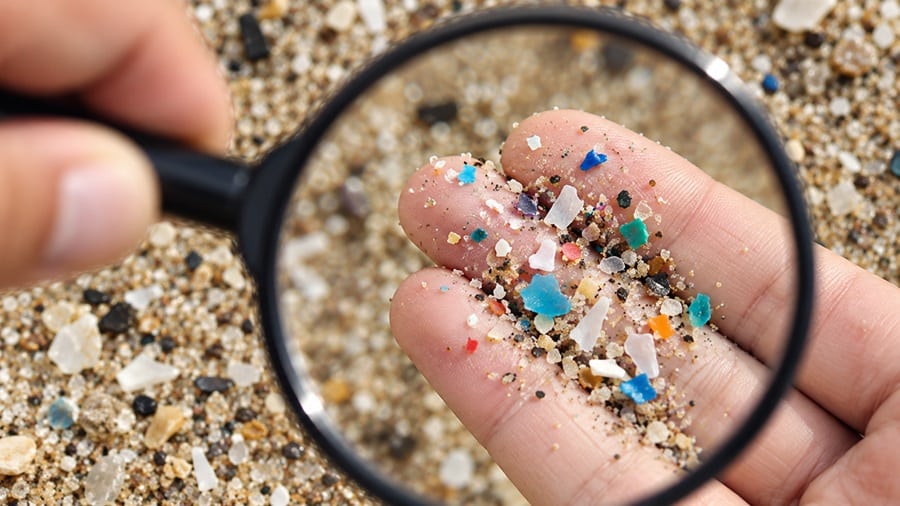
Plastic pollution does not disappear when a bottle, bag or piece of packaging breaks apart. In many cases, it simply becomes harder to see.
That is where microplastics come in.
These tiny plastic particles have now been found in oceans, rivers, sediments, soil, air, drinking water, food and human biological samples. Some begin life at microscopic or near-microscopic sizes. Others form when larger plastic products gradually wear down or fragment.
Their widespread presence is well established. What is less settled is exactly what different levels of exposure mean for human health.
Quick answer: Microplastics are plastic particles under 5 millimeters, roughly a pencil eraser or smaller. Some are made that small on purpose, but most form when tires, clothing, packaging and other plastics wear down. They’ve turned up in water, soil, air, food and human tissue. What they do to our health is still being worked out.
This guide explains what microplastics are, where they come from, how microplastic pollution spreads, how people and wildlife are exposed, and what researchers currently know about their environmental and health effects.
What Are Microplastics?
Microplastics are small pieces or fibers of plastic.
The U.S. National Oceanic and Atmospheric Administration (NOAA) defines microplastics as plastic pieces or fibers smaller than 5 millimeters, roughly the size of a pencil eraser or smaller. They may occur as fragments, fibers, films, foam, beads or pellets.
Some particles near the 5 mm upper limit are easy to see. Others are so small that specialized laboratory instruments are needed to identify them.
There is less agreement about the lower boundary. Depending on the scientific framework, extremely small particles may be classified separately as nanoplastics.
This matters when comparing research. A study that measures particles down to a few micrometers may report far more particles than one capable of detecting only larger fragments.
Microplastics are also not a single material. They may be made from polyethylene (PE), polypropylene (PP), PET, polystyrene (PS), PVC, polyester, nylon, acrylic and many other polymers.
Their size, shape, polymer type, additives and degree of weathering can influence how they move through the environment and interact with organisms.
Primary vs. Secondary Microplastics
Microplastics are commonly divided into primary and secondary microplastics.
Primary microplastics
Primary microplastics are manufactured at a small size.
Examples include:
- pre-production plastic pellets or nurdles
- some industrial abrasives
- intentionally added plastic particles
- certain cosmetic microbeads
Plastic pellets deserve particular attention because spills during manufacturing, loading or transport can release them directly into drains, rivers and coastal environments.
Secondary microplastics
Secondary microplastics form when larger products wear down or fragment.
Common sources include:
- plastic packaging and litter
- vehicle tires
- synthetic clothing and textiles
- fishing nets and ropes
- paints and coatings
- construction materials
NOAA explains that larger plastics can break down repeatedly into smaller pieces, while microfibers can also be released from synthetic fabrics such as polyester and nylon.
A plastic object breaking apart has therefore not necessarily biodegraded. Its pollution may simply have changed form.
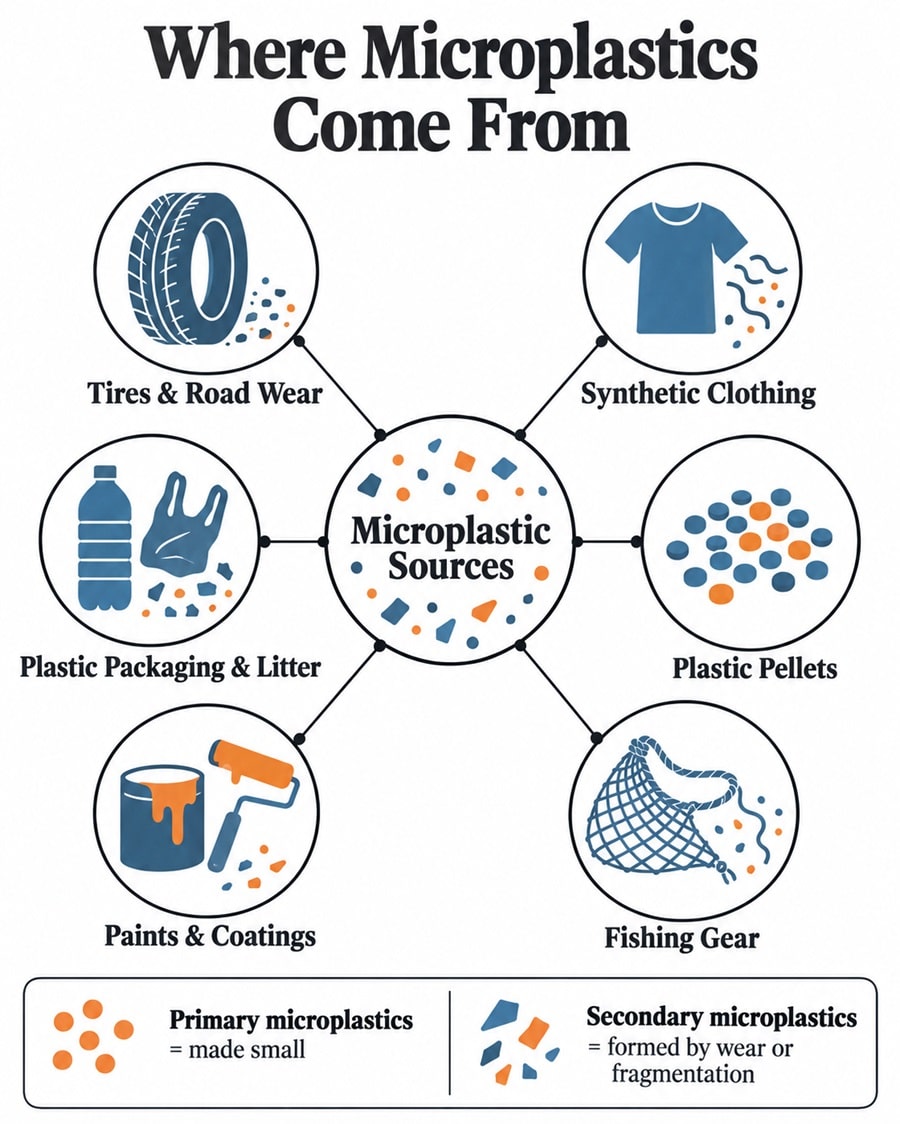
Where Do Microplastics Come From?
There is no single source everywhere. The mix depends on transport, industry, waste management and consumer behavior.
Tires and road traffic
Tires gradually lose material through friction with road surfaces.
These particles can accumulate on roads and later be carried into drains, waterways and soil by stormwater.
Synthetic clothing and textiles
Polyester, nylon, acrylic and many other synthetic fibers are plastics.
Clothing and household textiles can shed fibers during wearing, washing and drying. Wastewater treatment captures some, while others may remain in treated water or become concentrated in sewage sludge.
Plastic packaging and litter
Bottles, bags, wrappers and other discarded plastics can become brittle under sunlight and weathering.
Abrasion then breaks them into progressively smaller fragments.
A bottle fragmented into thousands of pieces has not disappeared — it has simply become more difficult to recover.
Paints and coatings
Road markings, buildings, ships and other coated surfaces can release particles as paint weathers or abrades.
Plastic pellets
Resin pellets are another preventable source.
The European Union introduced specific rules to reduce pellet losses during handling and transport. These rules entered into force on December 16, 2025 and require operators to take measures to prevent, contain and clean up pellet spills.
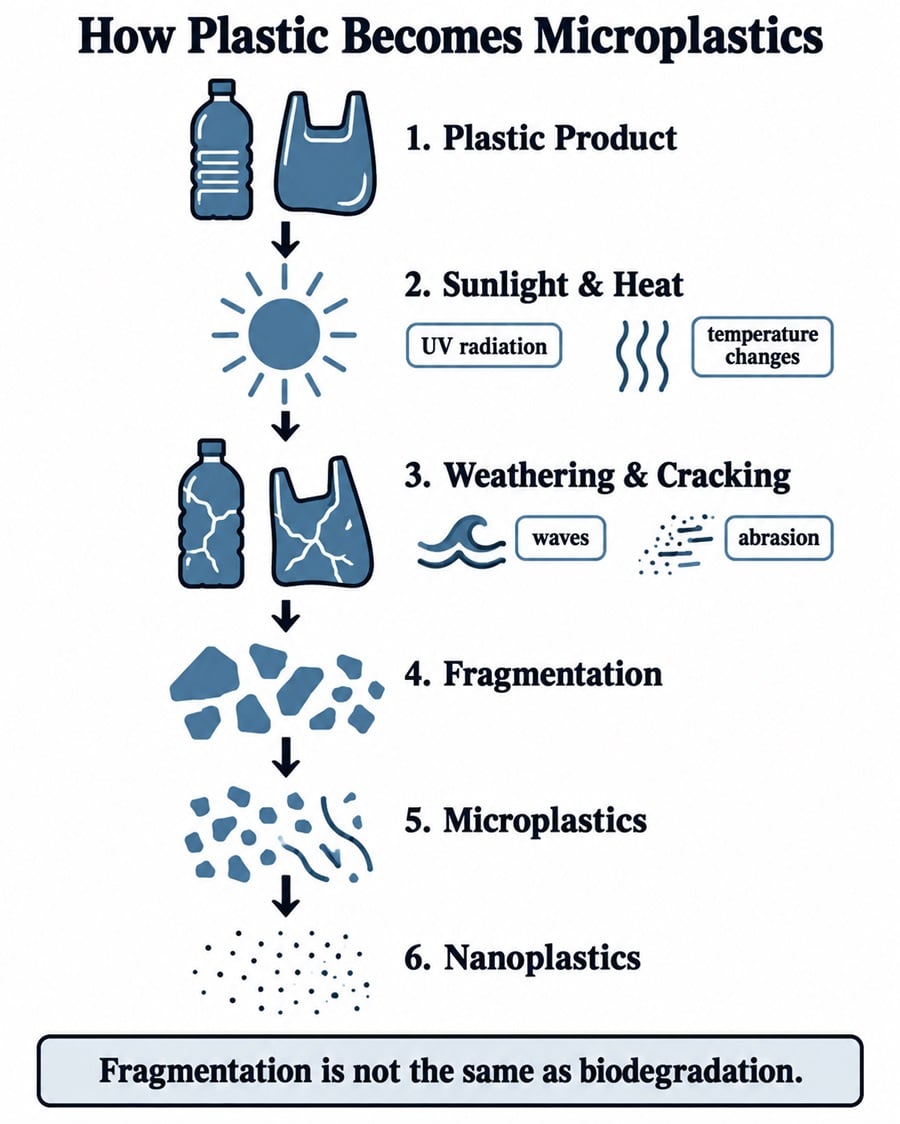
How Does Plastic Turn Into Microplastics?
Most conventional plastics do not quickly decompose into harmless natural materials.
Instead, environmental stresses weaken them:
Plastic item → sunlight and heat → weathering → cracking → fragmentation → microplastics → still smaller particles
Ultraviolet radiation can alter polymer structures. Waves, sand and physical movement create abrasion. Temperature changes and oxidation can also make plastics brittle.
The result is fragmentation, which is different from complete biodegradation.
NOAA notes that many common plastics do not fully mineralize in marine environments. Instead, they can continue breaking into smaller pieces over time.
This distinction is also relevant to oxo-degradable plastics. Accelerating fragmentation does not automatically solve pollution if persistent plastic particles remain afterward.
Where Are Microplastics Found?
Microplastics have been detected across marine, freshwater, terrestrial and atmospheric environments.
Oceans, rivers and lakes
They have been documented from ocean surface waters to marine sediments and the seafloor.
NOAA’s marine microplastics database notes that particles occur from the sea surface down to sediments covering the ocean floor.
Rivers can also act as both accumulation zones and transport routes, receiving particles from stormwater, wastewater, litter and urban runoff.
Soil
Agricultural plastics, sewage sludge, litter, synthetic fibers and atmospheric deposition can introduce microplastics into soils.
Once mixed into soil, removing them without disturbing the surrounding ecosystem is extremely difficult.
Air
Some microplastics are light enough to become airborne.
Indoor fibers may come from clothing, furniture and carpets, while outdoor particles may originate from traffic, construction materials and weathered surfaces.
This creates another human exposure route: inhalation.
Microplastics in Food and Drinking Water
Researchers have reported microplastics in drinking water and various foods, including seafood and salt.
However, numbers from different studies should be compared carefully.
Reported concentrations depend heavily on:
- the smallest particle size measured
- sampling methods
- contamination controls
- laboratory techniques
- the definition of microplastics used
A study capable of detecting much smaller particles will usually report more of them.
This is why simple claims such as “people consume X number of particles per day” can be misleading without knowing how the particles were measured.
Can water treatment remove microplastics?
Conventional and advanced water-treatment systems can capture some microplastics through coagulation, sedimentation, filtration and membrane processes.
More intensive methods such as ultrafiltration and reverse osmosis may remove smaller particles under suitable conditions.
But capture is not the same as destruction. Particles removed from water can become concentrated in sludge or other treatment residues.
Regulatory interest is also increasing.
In April 2026, the U.S. Environmental Protection Agency included microplastics as a contaminant group in its draft Sixth Contaminant Candidate List (CCL 6). The list covers contaminants that are not currently subject to national primary drinking-water regulations but may warrant further evaluation under the Safe Drinking Water Act.
Importantly, inclusion on the CCL does not mean that EPA has already established a federal safety limit for microplastics.
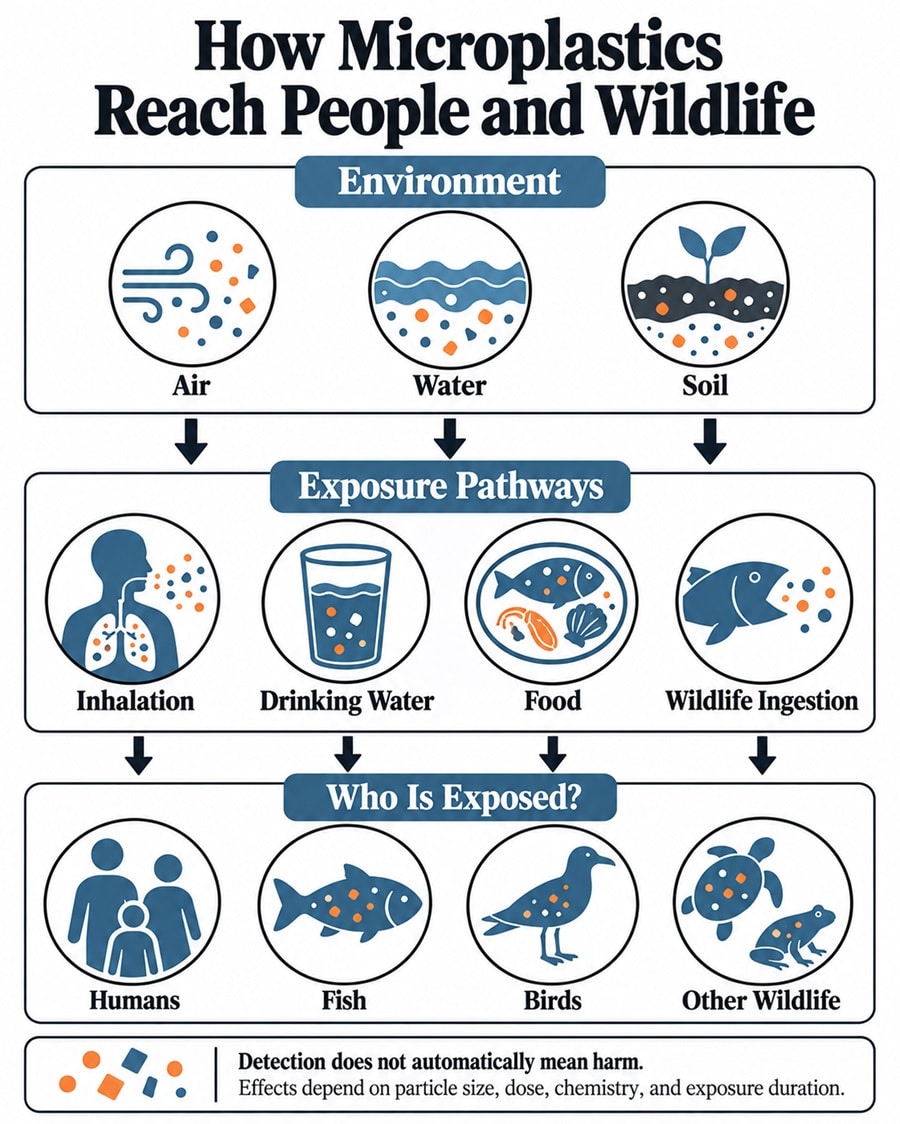
How Do Microplastics Enter the Human Body?
Researchers focus mainly on two pathways.
Ingestion
Particles may enter through drinking water, food or material that settles onto food during preparation and storage.
Inhalation
Airborne fibers and particles can be breathed in.
Particle size matters because it influences where material may deposit within the respiratory system.
Skin exposure is also being investigated, although ingestion and inhalation are currently considered more established environmental exposure routes.
Have Microplastics Been Found in Humans?
Yes. Research has reported micro- and nanoplastics in several types of human biological samples and tissues.
But detection and disease are not the same thing.
Finding particles does not automatically tell researchers:
- how long they have been present
- how much exposure occurred
- whether they caused tissue damage
- whether they contributed to a particular disease
Measurement is also technically difficult. Very small particles are challenging to identify, and samples can be contaminated during collection or laboratory processing.
These limitations are one reason health findings require cautious interpretation.
Are Microplastics Harmful to Human Health?
There is growing scientific concern, but major uncertainties remain.
The World Health Organization has reviewed exposure through food, water and air and concluded that important evidence gaps remain around the potential effects of micro- and nanoplastics on human health. WHO specifically highlights uncertainties involving particle characteristics, exposure levels and the chemicals associated with plastic particles.
Researchers are investigating several possible mechanisms.
Inflammation and oxidative stress
Laboratory studies have examined whether particles can trigger inflammatory responses or oxidative stress, which can damage cells when severe or persistent.
Cellular effects
Particle size may influence how plastics interact with cell membranes and biological barriers.
Very small particles may behave differently from larger fragments.
Chemicals associated with plastics
The particle itself is only part of the issue.
Plastics may contain:
- plasticizers
- stabilizers
- pigments
- flame retardants
- processing aids
- UV stabilizers
Weathered particles may also interact with chemicals already present in water, soil or sediment.
Researchers therefore need to distinguish between effects caused by the physical particle, chemicals released from it, contaminants on its surface, or a combination of these factors.
What can we conclude today?
Current evidence supports concern and continued research, but it does not justify claiming that everyday microplastic exposure has been proven to cause a specific disease.
A useful summary is:
Human exposure is established. Potential biological effects are plausible and actively studied. The doses and particle characteristics required to cause specific human diseases remain uncertain.
Why Is Microplastic Health Research So Complicated?
There is no single standard microplastic.
A polyester fiber in indoor air may behave differently from a weathered polyethylene fragment in seawater or a tiny polystyrene particle used in a laboratory study.
Risk can depend on:
- size
- shape
- polymer type
- concentration
- exposure duration
- route of exposure
- additives
- surface chemistry
- environmental contaminants
This is why laboratory results cannot always be translated directly into everyday human risk.
Better measurement standards and more consistent research methods are essential.
How Do Microplastics Affect Wildlife?
Aquatic animals can encounter microplastics through water, sediment and food.
Particles may be swallowed accidentally or mistaken for food.
Researchers have investigated effects including:
- altered feeding
- digestive irritation
- inflammation
- changes in growth or energy use
- exposure to plastic additives
- interactions with environmental contaminants
Small organisms can also pass particles through food webs when larger animals eat them.
Not every particle presents the same risk. Effects depend on size, concentration, polymer type, species and exposure time.
Microplastics vs. Nanoplastics
Nanoplastics are even smaller plastic particles at the lower end of the size range.
Definitions vary, but many scientific frameworks use approximately 1 micrometer (µm) as a dividing point.
| Feature | Microplastics | Nanoplastics |
| Size | Generally below 5 mm | Commonly below about 1 µm |
| Visibility | Some can be seen | Require specialized equipment |
| Measurement | Difficult | Even more challenging |
| Origin | Manufactured small or formed through fragmentation | Often formed through further fragmentation |
| Research base | Large and growing | Newer and rapidly developing |
Size matters because smaller particles have more surface area relative to their mass and may interact differently with cells and biological barriers.
How Can Microplastic Pollution Be Reduced?
Once microplastics are dispersed through oceans, rivers, soil and air, large-scale removal becomes difficult.
Preventing releases is more practical than relying on cleanup.
Control pellet losses
Manufacturers and transport operators can improve storage, loading, containment and spill response.
Prevent larger plastic pollution
Better waste collection and litter control matter because today’s bottle or bag can become tomorrow’s secondary microplastics.
Reduce textile shedding
Possible measures include better fabric design, washing-machine filtration and improved wastewater treatment.
Responsibility should not fall only on consumers; textile and appliance design also matter.
Address tire wear
Potential approaches include longer-lasting tires, lighter vehicles, improved stormwater capture and transport systems that reduce unnecessary road traffic.
Electric vehicles remove tailpipe emissions, but they do not eliminate tire-wear particles.
Improve wastewater and stormwater treatment
Treatment infrastructure can intercept particles before they reach rivers and oceans, particularly in densely populated areas.
Are Microplastics Being Regulated?
Yes, although regulation varies substantially by country and source.
The European Union’s REACH restriction on intentionally added synthetic polymer microparticles began applying in 2023, with different transition periods for affected products.
The EU has also introduced rules aimed specifically at reducing plastic-pellet losses.
In the United States, the Microbead-Free Waters Act of 2015 restricted plastic microbeads in certain rinse-off cosmetics.
The EPA’s addition of microplastics to draft CCL 6 in 2026 shows that regulatory attention is increasingly shifting beyond visible plastic litter toward microscopic contamination.
The larger policy trend is clear: reducing microplastic pollution requires controlling releases throughout production, use and disposal, not only cleaning up plastics after they become waste.
Frequently Asked Questions
What is the main source of microplastics?
There is no single global source. Major contributors include fragmentation of larger plastics, tire wear, synthetic textiles, paints, coatings and plastic pellets.
Are microplastics visible?
Some are. Particles near the 5 mm upper limit are visible, while much smaller particles require microscopes or specialized analytical instruments.
Are microplastics found in drinking water?
Yes. Studies have detected them in both tap and bottled water, although reported concentrations vary because researchers use different methods and particle-size limits.
Are microplastics found in humans?
Research has reported micro- and nanoplastics in several human biological samples. Detection confirms exposure, but it does not prove that the particles caused disease.
Do microplastics cause cancer?
Current evidence does not establish that normal environmental exposure to microplastics causes cancer in humans. Scientists are investigating mechanisms that could potentially contribute to disease, but direct causal evidence remains limited.
Do water filters remove microplastics?
Some filtration systems can reduce microplastics. Effectiveness depends strongly on particle size and filtration technology.
Do microplastics biodegrade?
Most conventional plastics do not rapidly biodegrade simply because they have become microscopic. They may persist, weather and fragment into still smaller particles.
The Bottom Line
Microplastics are not one pollutant from one source. They include fibers, fragments, pellets, films and other particles produced throughout the plastic lifecycle.
They come from obvious sources such as plastic litter, but also from everyday processes including tire wear, textile shedding and paint abrasion.
Their presence in oceans, freshwater, soil, air, food and drinking water is well established. Human exposure is also increasingly documented.
What remains less certain is exactly how different particles, doses and exposure periods affect human health. Current evidence supports continued investigation, but it does not justify turning every microplastic detection into a claim of proven disease.
From an environmental perspective, the practical lesson is clearer: stopping plastic particles at their source is far easier than trying to recover them after they have dispersed through water, soil, air and food webs.
Leave a Reply