
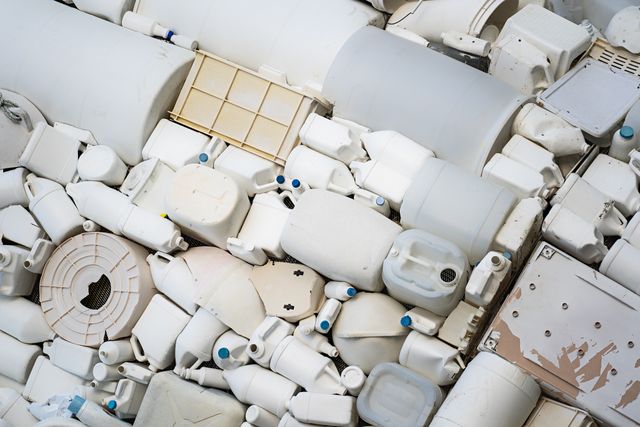
Look under a milk jug, a shampoo bottle, or a laundry detergent container and you’ll usually find a little “2” stamped inside a triangle. That’s HDPE — high-density polyethylene — and it’s quietly everywhere: water pipes, recycling bins, crates, outdoor furniture, the works.
What makes it so popular is a rare combination: it’s light, tough, resistant to chemicals, and cheap to produce. Ethylene feedstock is inexpensive, and the manufacturing methods used to shape it — blow molding, injection molding, extrusion — are well-established and efficient. That’s a big part of why HDPE shows up in so many unrelated products.
You’ll also see it called HDPE #2 plastic. That number 2 sits inside the resin identification symbol on most HDPE containers, and it tells you what the plastic is — not whether your curbside bin will actually take it. That distinction matters more than people realize, and we’ll get into why below.
HDPE at a Glance
- What it is: A stiff, durable thermoplastic made from ethylene, with less molecular branching than LDPE — which gives it a denser, more crystalline structure.
- Resin code: #2, printed inside the chasing-arrows symbol.
- Typical uses: Milk jugs, detergent bottles, pipes, crates, buckets, outdoor furniture.
- Recyclable? Yes, mechanically — and it’s one of the more widely accepted plastics in U.S. recycling programs. But “recyclable” and “actually recycled” are two different things (more on that shortly).
- Biodegradable? No. It weathers and breaks into smaller pieces over time, but it doesn’t break down biologically.
What Is HDPE?
HDPE — high-density polyethylene — is a thermoplastic polymer built mainly from ethylene. “Thermoplastic” just means it softens when heated and hardens again when it cools, which is exactly what lets manufacturers mold it into products and, under the right conditions, melt it down and reuse it later.
The “high-density” part comes from how the polymer chains are arranged. HDPE has relatively little branching compared to LDPE (low-density polyethylene), so its chains pack together more tightly. That tighter, more crystalline structure is the reason HDPE ends up stiff, strong for its weight, chemically resistant, and barely absorbs moisture — properties we’ll break down with real numbers further down.
It’s also why the same basic material can become something as simple as a milk jug and something as demanding as an underground water pipe.
What Is HDPE Material Made From?
It starts with ethylene — a small hydrocarbon molecule, typically produced from natural gas liquids or petroleum.
During polymerization, thousands of these ethylene molecules link together into long polyethylene chains. Manufacturers control the reaction with catalysts and processing conditions that shape the final resin’s molecular weight, density, and branching. That means HDPE isn’t one single formula — it’s a whole family of grades, each engineered for a different job. Bottle-grade HDPE and pressure-pipe HDPE aren’t interchangeable, even though both carry the same name.
Pigments, stabilizers, and other additives get mixed in depending on what the resin is ultimately used for.
What Does HDPE Stand For?
High-density polyethylene.
- High-density refers to the tightly packed polymer structure.
- Poly means “many” — as in many ethylene units linked together.
- Ethylene is the small building-block molecule.
It sits alongside LDPE and LLDPE in the broader polyethylene family.
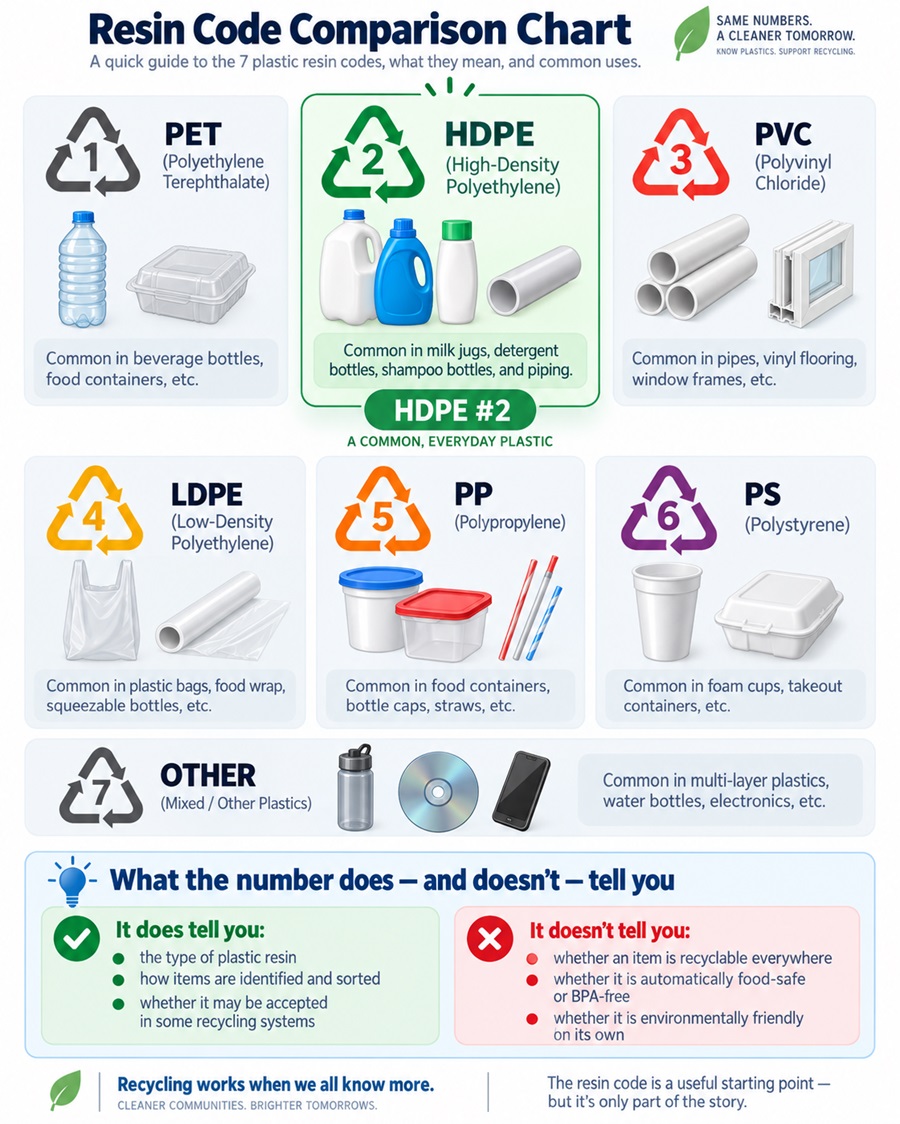
What Is HDPE #2 Plastic?
HDPE carries Resin Identification Code #2, so you’ll see “2 HDPE” molded into the bottom of bottles and containers.
ASTM, which maintains the U.S. resin coding standard (D7611), is clear on one point that trips a lot of people up: the number tells you what resin was used — it says nothing about whether a specific item can actually be recycled through your local program.
So #2 means HDPE. It doesn’t mean “automatically recyclable everywhere.” A milk jug might sail through your local facility with no problem, while a large HDPE toy, a multilayer package, or some other odd #2 item might not fit the same sorting system at all.
How Can You Identify HDPE Plastic?
Look for the #2 mark alongside “HDPE.” You’ll find it on natural or translucent milk jugs, colored detergent bottles, household cleaner containers, some shampoo and personal-care bottles, buckets, crates, and various rigid storage containers.
The EPA describes HDPE as stiff, strong, and chemically resistant — it can be translucent (like milk jugs) or pigmented (like most detergent and bleach bottles).
One caveat: looks alone won’t tell you what a plastic is made of, since different polymers can look nearly identical. Check the resin code when you can.
HDPE Plastic Properties (With Numbers)
Here’s what “high-density” and “strong for its weight” actually look like in practice. These are general ranges — exact numbers shift depending on the specific grade and manufacturer.
| Property | Typical Range | Why It Matters |
| Density | ~0.941–0.965 g/cm³ | What makes it “high-density” vs. LDPE (~0.910–0.940 g/cm³) |
| Melting point | ~120–180°C (250–355°F) | Sets processing temperature and heat tolerance |
| Max continuous service temp | ~60–80°C (140–175°F), grade-dependent | Limits for hot-fill or hot-liquid contact |
| Tensile strength | ~20–37 MPa | How well it resists pulling/stretching |
| Impact resistance | High relative to most rigid plastics | Why HDPE containers survive drops so well |
| Chemical resistance | High to most acids, bases, alcohols | Why it’s used for detergents, cleaners, industrial fluids |
| Water absorption | Very low (<0.01% typical) | Suits it to pipes, tanks, outdoor products |
| Electrical insulation | Good dielectric properties | Useful in some conduit and cable applications |
For anything engineering-critical, treat these as ballpark figures — the manufacturer’s actual product datasheet is the real authority, not a general table.
Why Is HDPE Strong?
Its polymer chains are relatively straight, with less branching than LDPE, so they pack closer together — which is what gives HDPE its extra stiffness and tensile strength. That doesn’t make it the strongest plastic out there; other polymers beat it in specific categories. What HDPE offers is a solid all-around combination: decent strength, toughness, chemical resistance, low weight, and a low price tag.
Is HDPE Flexible or Rigid?
Both, depending on how it’s made. A thick HDPE crate feels rock-solid, thin HDPE film bends easily, and HDPE pipe strikes a middle ground — flexible enough to handle ground movement without acting like flimsy packaging film. Thickness, molecular structure, additives, and manufacturing method all play a role in where any given product lands.

How Is HDPE Made?
The short version: Ethylene → Polymerization → HDPE resin pellets → Finished product
- Producing ethylene — Conventional HDPE starts with fossil-derived hydrocarbons, refined into ethylene, one of the petrochemical industry’s core building blocks.
- Polymerizing the ethylene — Catalysts link individual ethylene molecules into long polyethylene chains under carefully controlled conditions, since molecular structure determines nearly everything about the final material’s performance.
- Producing HDPE resin — The polymer is processed into small pellets — easy to transport, store, and feed into manufacturing equipment.
- Making the final product — Manufacturers melt and shape those pellets using blow molding (bottles and containers), injection molding (caps, crates, rigid products), extrusion (pipes, sheets, profiles), or rotational molding (larger hollow products like tanks).
That flexibility in shaping methods is a big reason HDPE ends up in so many unrelated-looking products.
Common HDPE Plastic Uses
Ask someone where HDPE shows up and bottles are usually the first thing that comes to mind. Fair enough — but it’s only part of the story.
HDPE Packaging
HDPE is a natural fit for rigid packaging because it pairs impact resistance with strong chemical resistance: milk and water jugs, laundry detergent bottles, bleach and household cleaner containers, shampoo bottles, personal-care packaging, motor-oil containers, bottle caps, and some food containers.
Natural HDPE tends to be translucent, while pigments create colored bottles — and that color distinction matters later, since natural and colored HDPE often end up in separate recycling streams.
HDPE Pipes
Piping is arguably HDPE’s most important job outside of packaging — drinking water systems, irrigation, drainage, gas distribution, sewer lines, industrial pipelines, and protective conduit. Unlike metal pipe, it won’t rust, it tolerates ground movement, and it comes in long continuous lengths that cut down on joints during installation.
Pressure-rated HDPE pipe is graded — most commonly PE80 or PE100 — based on its long-term hydrostatic strength rating, essentially how much pressure it can handle over decades of service. Actual pressure capacity also depends on the pipe’s SDR (Standard Dimension Ratio), the relationship between wall thickness and outer diameter. It’s why a pressure pipe and a detergent bottle can share the same “HDPE” label while having wildly different requirements.
Household, Consumer, Industrial, and Agricultural Products
Buckets, waste bins, storage containers, toys, cutting boards, garden products, outdoor furniture, reusable crates — all leaning on HDPE’s durability under repeated handling and outdoor exposure.
On the industrial and agricultural side: chemical drums, pallets, storage tanks, agricultural pipes, geomembranes, protective liners, and plastic lumber. In these applications, durability is genuinely an asset — a product that stays in service for years needs replacing less often. The catch is that the same durability becomes a liability the moment a product escapes into the environment instead of staying in use (more on that shortly).
HDPE vs Other Common Plastics
| Plastic | Resin Code | General Characteristics | Common Uses |
| PET | #1 | Strong, often clear, good barrier properties | Beverage bottles, food packaging |
| HDPE | #2 | Tough, relatively stiff, chemical resistant | Bottles, pipes, crates |
| LDPE | #4 | Softer and more flexible | Films, bags, flexible packaging |
| PP | #5 | Tough, relatively heat resistant | Food tubs, caps, automotive parts |
- LDPE: Both are polyethylene, but HDPE’s chains have less branching and pack tighter, making it stiffer and stronger. LDPE stays soft and flexible. That’s the difference between a detergent bottle and a roll of plastic film.
- PET: Both get used for bottles, but PET usually wins for strong, clear beverage bottles, while HDPE tends toward opaque or translucent containers for milk, detergent, and personal care. They also belong to different recycling streams — mixing them reduces the quality of the recycled material, so sorting accuracy actually matters here.
- Polypropylene (PP, #5): Both common in rigid packaging, but PP generally handles heat better, while HDPE leans on chemical resistance and toughness. Neither one is universally “better” — it depends on the product.
Is HDPE Recyclable?
Yes — HDPE is one of the more established materials in mechanical recycling, and along with PET (#1), it’s among the plastics most commonly accepted by U.S. recycling programs, according to the EPA’s recycling data on plastics.
But “recyclable” and “recycled” aren’t the same word in practice. A material can be perfectly capable of recycling and still end up in a landfill because it was never collected, your local program doesn’t take that particular format, it was contaminated with leftover food or chemicals, it was too small for sorting equipment, it got mixed with incompatible materials, there was no market for the recycled output, or it got lost somewhere in processing.
That gap is real: EPA’s most recent published figures put the recycling rate for natural (uncolored) HDPE bottles at roughly 29%, while overall U.S. plastic recycling across all resin types has been estimated at under 10% in more recent assessments. HDPE clearly outperforms the plastics average — but it’s nowhere near universal, and colored or mixed HDPE items typically recycle at lower rates than plain natural bottles.
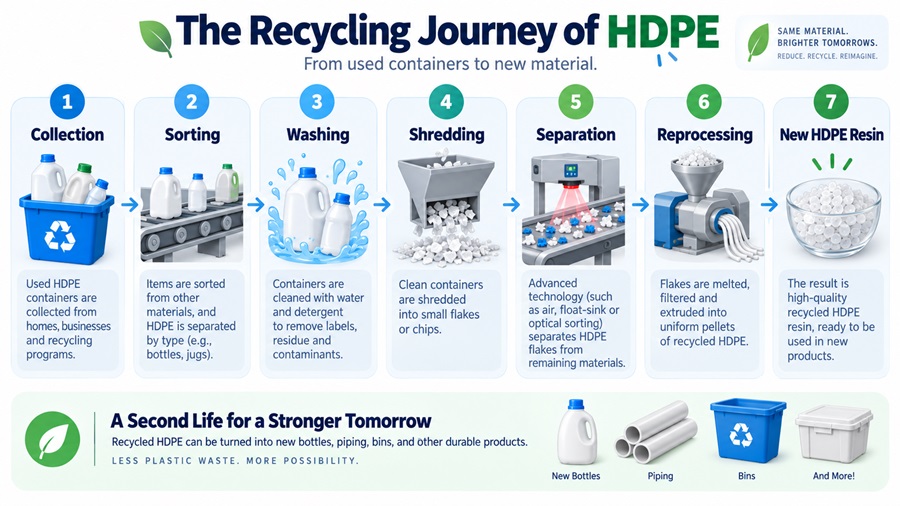
How Does HDPE Recycling Work?
Most HDPE recycling is mechanical, not chemical:
Collection → Sorting → Baling → Washing → Shredding → Separation → Reprocessing → Recycled HDPE resin
- Collection — Used bottles and containers come in through curbside pickup, deposit systems, commercial programs, or drop-off sites.
- Sorting — A material recovery facility separates plastics from paper, metal, and glass, then splits HDPE from PET and other polymers. Natural and colored HDPE are often sorted separately, since each has a different market value.
- Washing — Removes product residue, dirt, adhesives, and other contamination. How clean this step gets directly affects the quality and safety of the recycled resin.
- Shredding — Containers are ground into flakes, which makes further cleaning and separation much easier.
- Separation — Density differences and optical sorting remove leftover incompatible plastics and contaminants.
- Reprocessing — Clean flakes are melted, filtered, and turned into recycled resin — often sold as pellets that become raw material for the next manufacturing run.
What Can Recycled HDPE Become?
Recycled HDPE — rHDPE for short — turns into non-food bottles, waste and recycling bins, crates, buckets, pipe, garden products, plastic lumber, automotive components, construction products, and some new packaging. The EPA specifically calls out non-food bottles, plastic lumber, buckets, crates, garden edging, and recycling bins as common destinations.
The best outcome is keeping recovered material in applications where it can replace virgin HDPE without a meaningful drop in performance.
Can HDPE Be Recycled Into New Bottles?
Sometimes, and it depends heavily on the bottle’s intended use. Food-contact recycled plastic faces much stricter controls around contamination and purity than non-food applications. The FDA evaluates proposed recycling processes for food-contact use, scrutinizing leftover contaminants, unsuitable feedstock entering the stream, and additives that might not meet food-contact rules.
The FDA’s database includes favorable opinions for specific recycled-HDPE processes, with new entries added during 2026 — but those approvals apply to specific processes and conditions of use, not to recycled HDPE in general. Food-grade recycled HDPE exists. Random recycled HDPE isn’t automatically food-grade just because it says #2.
How Many Times Can HDPE Be Recycled?
There’s no clean, universal number here — claims like “HDPE can be recycled exactly five times” oversimplify things. Every melt-and-reprocess cycle can bring oxidation, molecular degradation, and contamination, gradually chipping away at strength, color, and processability. A clean, well-managed HDPE stream can hold up across multiple cycles; badly contaminated material can lose its value much faster. It really comes down to the original resin grade, processing conditions, contamination levels, additives, sorting quality, and whether the recycled resin gets blended with virgin material.
Example: HDPE Recycling at Envision Plastics
Envision Plastics, in Reidsville, North Carolina, shows what HDPE recycling looks like at commercial scale. The company turns used HDPE into post-consumer resin (PCR) that manufacturers can put into new products. Since it started in 2001, Envision says it has made nearly 1.5 billion pounds of recycled resin.
Its best-known product is EcoPrime®, a recycled HDPE resin made from curbside-collected plastic. A patented cleaning process removes contaminants, volatile compounds and odors from the recovered material. The resin has an FDA Letter of No Objection for certain food-contact uses, so it can go into food and beverage packaging, personal-care containers and other rigid or flexible packaging.
The process also shows why sorting matters. Natural #2 HDPE bottles from curbside and other collection programs make a valuable raw material. But other plastics and contaminants have to come out first, or the resin won’t be consistent enough to use.
Color adds another challenge, and Envision has a system for it. Its PRISMA® technology sorts plastic by color, so recovered material can go back into colored packaging instead of relying only on virgin resin and fresh colorants.
The takeaway: a discarded #2 bottle can become feedstock again, but only if collection, sorting, cleaning and quality control all work well enough to give manufacturers resin they can actually use.
The Environmental Impact of HDPE
HDPE runs into a familiar plastics trade-off: the strength and durability that make it useful are the exact same traits that turn into a problem once the material escapes collection systems.
It starts fossil-based. Most conventional HDPE begins as fossil-derived ethylene. Extracting the feedstock, producing ethylene, polymerizing it, and manufacturing the final product all take energy and generate emissions — the climate impact doesn’t start when someone throws a bottle away. The OECD’s Global Plastics Outlook shows that production of fossil-based polymers and converting them into products account for the majority of lifecycle emissions in its global modeling. The footprint of any individual HDPE item still depends on its weight, how it was made, the energy source behind it, how long it stays in use, transportation, and what happens to it at end of life.
Durability is a double-edged sword. An HDPE water pipe designed to last decades genuinely benefits from that durability — a longer service life means fewer replacements and less material used overall. A disposable HDPE item that escapes into a river tells a very different story: the exact same resistance to moisture and biological breakdown becomes the problem. Material properties don’t carry a fixed environmental value — it all depends on how and where the material is actually used.
It doesn’t just vanish. Large HDPE items left in sunlight, heat, and mechanical stress become brittle and start fragmenting. A smaller piece is less visible than a whole bottle, but the polymer hasn’t gone anywhere — it just keeps breaking into smaller pieces, eventually including microplastics. Fragmentation and biodegradation are two very different processes.
Is HDPE Biodegradable?
No. HDPE’s carbon-carbon backbone strongly resists biological attack, and microorganisms don’t break it down the way they process natural organic material. It’ll crack, discolor, get brittle, oxidize, and fragment under sun and weather — but turning one piece of plastic into thousands of smaller pieces isn’t the same as converting it into harmless biological matter. That distinction matters a lot, especially for plastics marketed as “degradable.”
Can HDPE Become Microplastic?
Yes. Like most conventional plastics, HDPE sheds microplastic particles when larger products get broken down by weathering, abrasion, and physical wear — sunlight, waves, sand, traffic, machinery, repeated handling. Stopping plastic from entering the environment in the first place beats counting on it to eventually fragment or degrade after it’s already become litter.
Is Recycled HDPE Better for the Environment?
Using recycled HDPE cuts demand for virgin polymer, keeps recovered material productive, and avoids some of the impact tied to producing new resin from fossil feedstock. It’s not impact-free, though — recycling still needs collection, transport, sorting, washing, grinding, electricity, heat, and reprocessing, and some material inevitably gets lost along the way.
The real comparison isn’t “recycling has an impact, so why bother” — it’s whether producing usable secondary HDPE from recovered material creates a smaller overall footprint than producing the same material entirely from virgin resources. OECD modeling generally shows secondary plastics carrying substantial lifecycle greenhouse-gas advantages over primary plastics, though the numbers shift by polymer, region, and energy system. For HDPE specifically, the advantage is real when collection streams stay clean and the recycled resin genuinely displaces virgin material — not when it’s a token gesture.
Is HDPE Safe?
HDPE is widely used in products meant to touch food, beverages, personal-care items, and household chemicals — but “HDPE is safe” on its own skips over the important part. Safety depends on the whole picture: resin grade, additives, manufacturing conditions, contaminants, temperature, contact time, food type, and whether the material is virgin or recycled.
In the U.S., food-contact materials fall under FDA requirements, and recycled plastics proposed for food-contact use get extra scrutiny around contamination and processing. A #2 symbol tells you the polymer family — it doesn’t tell you that every #2 bucket, bottle, or industrial container is fit for storing food.
Can You Reuse HDPE Containers?
Sometimes — let the container’s original purpose guide you. A sturdy HDPE bottle might physically survive repeated use, but surviving isn’t the same as being appropriate for a new job. Don’t repurpose anything that previously held pesticides, solvents, automotive fluids, cleaning concentrates, industrial chemicals, or other hazardous substances for drinking water or food storage. And watch for wear — a scratched, cracked, or degraded container is much harder to clean properly. For food and beverage use, stick with products actually designed and approved for that purpose rather than trusting the #2 mark alone.
Advantages and Disadvantages of HDPE
| Advantages | Limitations |
| Strong for its weight | Usually made from fossil feedstocks |
| Good chemical resistance | Doesn’t readily biodegrade |
| Durable | Can persist if littered |
| Moisture resistant | Can fragment into microplastics |
| Useful across many industries | Not every HDPE product is locally recyclable |
| Established mechanical recycling routes | Contamination can reduce recycled-material quality |
| Recycled HDPE has real end markets | Repeated processing can alter material properties |
| Relatively cheap to produce | Recycling rates still lag well behind collection potential |
Calling HDPE either “environmentally friendly” or “environmentally harmful” misses the point. A lightweight HDPE product that lasts decades and gets properly recovered at end of life looks nothing like an unnecessary single-use item that ends up in a waterway.
Virgin HDPE vs Recycled HDPE
Virgin HDPE is resin made from freshly produced feedstock. Recycled HDPE (rHDPE) comes from plastic that’s already been through at least one manufacturing and use cycle, and it comes from two main sources:
- Post-industrial HDPE — manufacturing scrap like offcuts, rejected components, and production waste. Since its origin is well controlled, it’s typically clean and consistent.
- Post-consumer HDPE — recovered from products discarded after use, like milk jugs and detergent bottles. This stream matters most for circular-economy goals, since it redirects plastic that already made it into the consumer waste stream.
Does Recycled HDPE Perform the Same as Virgin HDPE?
Not always. High-quality recycled HDPE can perform very well, but it depends on the quality of the recycling stream — contamination, mixed resin grades, color, additives, prior heat exposure, molecular degradation, and inconsistent feedstock can all cause it to differ from virgin material. Manufacturers sometimes use 100% recycled resin, and sometimes blend recycled with virgin material. The goal isn’t forcing recycled material into every application regardless of fit — it’s using recycled HDPE wherever it can reliably replace virgin resin while still meeting the product’s technical and safety requirements.
HDPE and the Circular Economy
A recycling symbol on a product doesn’t create circularity by itself. For HDPE to actually circulate, several pieces need to work together:
- Design for recycling — a theoretically recyclable HDPE bottle gets hard to process fast if it has incompatible materials, problematic labels, heavy pigmentation, or parts that can’t be separated.
- Convenient collection — a recyclable product has little chance of being recovered without a practical collection route for households and businesses.
- Clean sorting — recyclers need consistent material streams that meet buyers’ quality bar.
- Manufacturer demand — collecting material without a market just shifts it from one location to another. Circularity needs manufacturers actually willing to use recycled resin instead of virgin.
- Reduce and reuse where it makes sense — recycling shouldn’t be a justification for unnecessary consumption. Cutting packaging or designing durable, reusable products can save more material than repeatedly manufacturing single-use items ever will.
How Should You Dispose of HDPE?
- Look for the #2 HDPE marking on the bottom or side of the product.
- Check your local recycling rules — don’t assume every #2 item belongs in your bin. A program that takes #2 bottles might not take toys, pipes, buckets, or other bulky HDPE.
- Empty the container — leftover liquid or residue causes contamination.
- Follow your local rinsing instructions, since requirements vary by program.
- Keep unusual HDPE items separate unless your program specifically accepts them — large rigid products may need a dedicated recycling service.
- Never burn HDPE at home. Open burning creates hazardous air pollution and isn’t a form of recycling.
The most useful rule of thumb: identify the material, then follow whatever collection system actually exists where you live.
The Bottom Line
HDPE earns its spot as one of the most useful commodity plastics by combining strength, low weight, chemical resistance, moisture resistance, and relatively cheap, straightforward manufacturing. It’s also one of the more established plastics in mechanical recycling — but that recycling symbol doesn’t make HDPE #2 automatically circular. Whether a given product actually gets recycled comes down to its format, design, cleanliness, the local collection system, sorting infrastructure, and whether there’s demand for the recycled resin.
The environmental trade-off deserves equal weight: HDPE’s durability is a genuine asset when a pipe, crate, or reusable product stays in service for years, and a genuine liability when a disposable product ends up in soil, rivers, or oceans. The smarter approach isn’t slapping a “good” or “bad” label on HDPE — it’s using the material where its properties actually add value, cutting unnecessary applications, designing products for recovery, expanding the use of recycled resin, and building collection systems that turn “technically recyclable” into “actually recycled.”
Frequently Asked Questions About HDPE
What is HDPE? HDPE, or high-density polyethylene, is a thermoplastic made primarily from ethylene. Its relatively linear polymer structure gives it strength, stiffness, moisture resistance, and chemical resistance. It’s commonly used for bottles, containers, pipes, crates, and other durable products.
What is HDPE material? A polyethylene polymer made by linking ethylene molecules into long chains. Compared to LDPE, its chains have less branching and pack more tightly, which is where its density and stiffness come from.
What does HDPE stand for? High-density polyethylene.
Is HDPE plastic #2? Yes — HDPE carries Resin Identification Code #2. The number identifies the resin type, but it doesn’t guarantee your local program will recycle every #2 product.
Is HDPE recyclable? Yes, mechanically, and many recycling programs accept HDPE bottles. Actual recycling still hinges on collection, sorting, contamination, product design, and local infrastructure — natural HDPE bottles have historically recycled at roughly 29% in the U.S., well above the plastics-wide average.
What products are made from HDPE? Milk jugs, detergent bottles, shampoo containers, water and gas pipes, buckets, crates, waste bins, storage containers, and some outdoor furniture.
Is HDPE biodegradable? No. Conventional HDPE doesn’t readily biodegrade under normal conditions. It weathers and fragments into smaller pieces, but that’s not the same as biodegrading.
What’s the difference between HDPE and PET? HDPE (#2) is normally opaque or translucent and used for milk, detergents, and rigid products. PET (#1) is commonly used for clear beverage bottles.
What’s the difference between HDPE and LDPE? HDPE has less molecular branching and is generally stiffer and stronger. LDPE has more branching and is typically softer and more flexible — common in films, bags, and flexible packaging.
Can recycled HDPE be used for food packaging? Yes, when the recycling process, feedstock, and finished material meet applicable safety requirements — but recycled #2 plastic shouldn’t be assumed food-grade by default.
Can HDPE be recycled more than once? Yes, potentially across multiple cycles, but there’s no universal fixed number. Heat, oxidation, contamination, and processing history gradually change the polymer’s properties.
Does the #2 symbol mean an HDPE product will actually be recycled? No. It identifies the material as HDPE — whether it’s accepted and ultimately recycled comes down to the specific product and the local recycling system.
Leave a Reply