
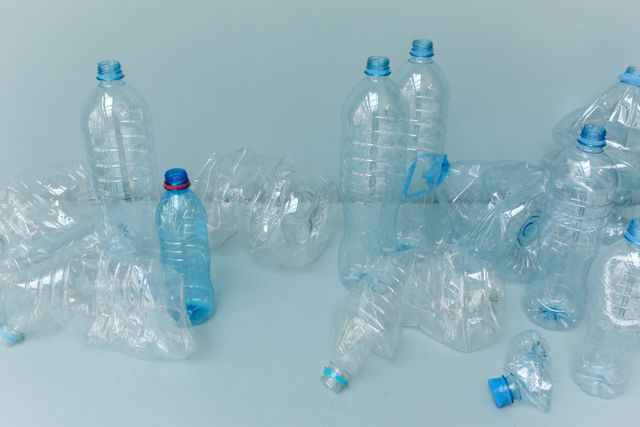
Grab any clear water bottle or soda bottle off a store shelf and odds are you’re holding PET plastic. It’s everywhere — but most people who use it every day couldn’t tell you what it actually is, or what happens to it after it goes in the bin.
PET stands for polyethylene terephthalate. It got popular for simple reasons: it’s light, tough, see-through, doesn’t shatter, and does a great job keeping food and drinks safe without adding bulk. It also has something most plastics don’t — an actual, functioning recycling market.
That doesn’t mean most PET gets recycled. Far from it.
In 2024, the U.S. only collected 30.2% of PET bottles for recycling — down from a revised 32.5% the year before (NAPCOR, 2024 PET Recycling Report). Broaden that to all of North America and the number climbs to 39.2%, which is still nowhere near where it needs to be. Meanwhile, demand for recycled PET keeps growing: over 60% of the rPET sold into U.S. and Canadian markets in 2024 went straight back into new bottles.
So here’s the real tension: we know how to recycle PET. We just aren’t collecting enough of it, keeping it clean enough, or turning it back into something useful often enough. Let’s dig into what PET actually is, where you’ll find it, and what really happens after that bottle leaves your hand.
What Is PET Plastic, Exactly?
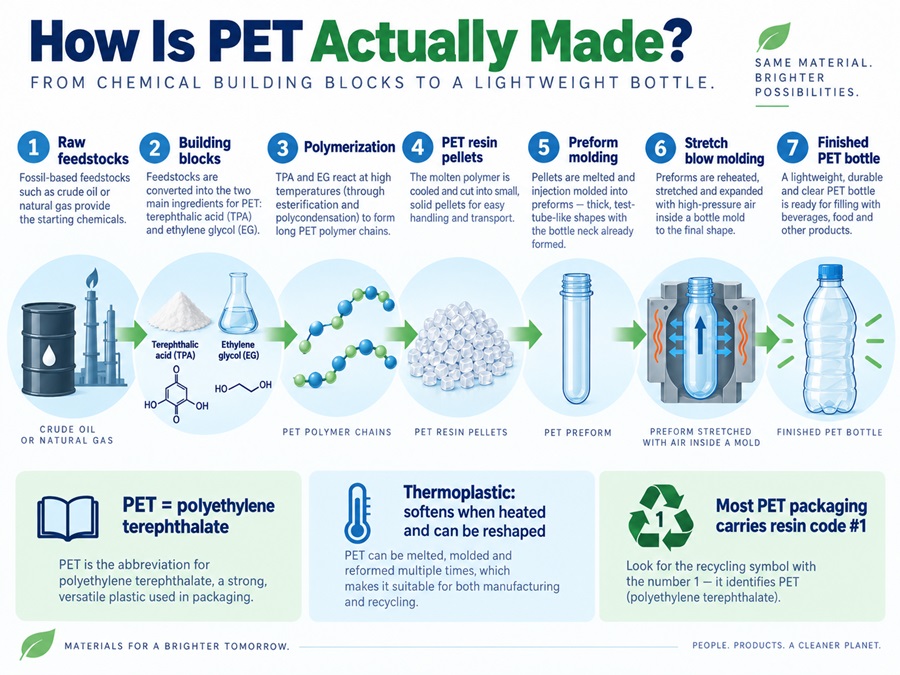
PET is a thermoplastic polyester built from two main chemicals: terephthalic acid and ethylene glycol. When these react during manufacturing, they form long polymer chains that can be shaped into rigid bottles, clear food trays, thin films, or fine textile fibers.
“Thermoplastic” is the key word here. Unlike thermoset plastics, which harden permanently once processed, PET softens when you heat it. That’s exactly why it can be melted down and reshaped — and it’s the whole reason mechanical recycling of PET works at all.
You’ll usually find it marked with resin code #1. Older packaging sometimes uses “PETE” instead of “PET” — same material, different abbreviation.
Where you’ll run into PET:
- Water and soft-drink bottles
- Juice and cooking-oil bottles
- Food trays and clear containers
- Personal-care packaging
- Polyester clothing and carpets
- Packaging films
Bottles get all the attention, but they’re really just one slice of a much bigger picture.
Is PET the Same Thing as Polyester?
Basically, yes. The polyester in your gym shirt is usually made from the exact same polymer as your water bottle — polyethylene terephthalate. What changes is how it’s processed. Stretch it into fiber and people call it polyester. Mold it into a bottle and it’s PET.
This distinction actually matters for recycling. When a bottle gets turned into polyester fiber for clothing or carpet, that’s technically recycling — but the material is leaving a mature, well-built recycling system and entering one that’s much harder to recycle again. A bottle becoming a new bottle keeps things circular. A bottle becoming a shirt is closer to a one-way trip.
How Is PET Actually Made?
Most PET today starts life as a fossil fuel product, built from terephthalic acid (or a close chemical relative) and ethylene glycol. Once those react and form the polymer, it gets processed into resin pellets that manufacturers ship out and turn into finished products.
For bottles specifically, it’s a two-step process. First, the resin gets heated and injection-molded into a “preform” — a small, thick, test-tube-shaped piece with the bottle’s neck and threads already formed. Then that preform gets reheated, dropped into a mold, and blasted with compressed air that stretches and expands it into the familiar bottle shape. This is called stretch blow molding, and it’s how manufacturers get a strong container out of a surprisingly small amount of plastic.
Quick Glossary
A few terms come up constantly in PET conversations. Here’s what they actually mean:
- Thermoplastic — softens when heated, hardens when cooled, can be reshaped repeatedly.
- rPET — PET made from recycled material instead of new (virgin) resin.
- Virgin PET — PET made entirely from new raw materials, no recycled content.
- Closed-loop / bottle-to-bottle recycling — a bottle gets recycled into another bottle.
- Open-loop recycling — a bottle gets recycled into something else, like a carpet or a shirt, that has fewer recycling options at its own end of life.
- Depolymerization — breaking PET back down into its original chemical building blocks so they can be purified and rebuilt.
- Resin identification code (RIC) — the numbered symbol (1–7) that tells you what type of plastic something is made from. It’s not a recyclability guarantee.
- Microfiber shedding — tiny synthetic fibers that shed off polyester textiles during manufacturing, wear, and washing.
Why Did PET Take Over Packaging?
It’s not just because it’s cheap — it genuinely checks a lot of boxes at once:
| Property | Why it matters |
| Lightweight | Less material, less to ship |
| Strong | Thin walls still hold up under pressure |
| Transparent | Shoppers can see what they’re buying |
| Shatter-resistant | Far safer than glass in transit and at home |
| Moisture-resistant | Ideal for liquids |
| Good gas barrier | Keeps soda fizzy, protects certain foods |
| Moldable | Bottles, trays, films — all from the same base material |
| Thermoplastic | Can be reprocessed, which makes recycling possible |
That lighter weight really does cut down on transportation impact — more product moved per truck, less packaging mass overall. But don’t mistake “lighter” for “automatically greener.” Whether PET actually beats glass, aluminum, or a reusable system depends on the whole picture: how it’s made, how far it travels, how much of it actually gets collected back, and how many times a package gets reused before it’s done.
Where You’ll Actually Find PET
Drinks. Bottled water, soda, sports drinks, juice — all leaning on PET because it can handle carbonation pressure without the weight or breakage risk of glass.
Food. Salad trays, bakery containers, peanut butter jars, cooking-oil bottles, clamshell packaging. Worth noting: two products both “made of PET” can have totally different recycling odds depending on their color, labels, adhesives, and shape.
Household and personal care. Shampoo bottles, cleaners, cosmetics — though HDPE and polypropylene are just as common here, so you can’t tell by looking. Check the resin code.
Clothing and textiles. A huge amount of PET ends up as polyester fiber in sportswear, fleece, carpet, and upholstery. This introduces a problem bottles don’t have: microfiber shedding. Every wash cycle can release tiny plastic fibers, and while good wastewater treatment catches a lot of them, it doesn’t catch everything — especially in places without strong treatment infrastructure.
Industrial uses. Strapping, electrical insulation, laminates, industrial fibers — often a different grade or formulation than what’s in your water bottle.
Programs and Brands
California’s CRV program is one of the oldest deposit systems in the U.S., and it expanded in 2024 to cover wine and spirits bottles — adding roughly half a billion more containers a year into the system. MIT researchers estimate that a nationwide version of this kind of program could push U.S. PET recycling as high as 82%. That’s the difference a deposit makes.
EPR laws are the other lever. By late 2025, seven states — Maine, Oregon, Colorado, California, Minnesota, Maryland, and Washington — had passed Extended Producer Responsibility laws that shift packaging costs from cities onto the companies that make the packaging. Colorado’s version alone is projected to roughly double the state’s recycling rate by 2035 and bring curbside recycling to about 500,000 more homes. When brands pay more for packaging that’s hard to recycle, they start designing packaging that isn’t.
Actual bottle-to-bottle programs exist too. Coca-Cola’s bottling partners in India — SLMG Beverages and Moon Beverages — make rPET bottles using food-grade recycled material cleared by the FDA and EFSA. On the supply side, Indorama Ventures runs some of the largest vertically integrated PET recycling operations in the world, feeding high-quality rPET to major beverage and packaging brands, alongside reclaimers like Plastipak and Alpek.
Here’s the honest part, though: several major beverage brands have quietly walked back earlier promises on recycled content. That’s exactly why policy — deposit systems, EPR laws — is doing more heavy lifting right now than corporate pledges. Voluntary programs are real and they move material, but treat a company’s sustainability announcement and an actual law with the same skepticism you’d apply to any other claim: check what’s binding and what’s just a goal.
What Does the #1 Recycling Symbol Actually Tell You?
Not as much as you’d think. That number just identifies the resin type — it says nothing about whether your local recycling program will actually take it.
A clear PET beverage bottle usually has a solid recycling market behind it. A heavily colored PET tray or a multilayer package with the same #1 stamped on the bottom might be nearly impossible for your local facility to process. Same number, very different fate.
So, Is PET Actually Recyclable?
Yes — and PET bottles have one of the best-established recycling systems of any common plastic. But “is it recyclable” is the wrong question. The better one is: will this specific item actually get collected, sorted correctly, and turned into something useful?
The numbers tell the real story. The U.S. hit a 30-year high of 32.5% PET bottle collection in 2023, then slipped to 30.2% in 2024 — still a bit above the 10-year average of 29.5%, but nowhere close to where the technology could take it (Packaging Dive, “4 insights on the state of PET recycling and rPET in packaging”).
The bottleneck isn’t the science. Manufacturers want recycled PET. Reclaimers know how to process it. The weak link is simply getting enough used bottles into the system in the first place. Deposit-return programs prove this — when there’s a small cash incentive attached to a bottle, people return it through a clean, dedicated stream instead of tossing it in general trash or littering it.
What Actually Happens During PET Recycling
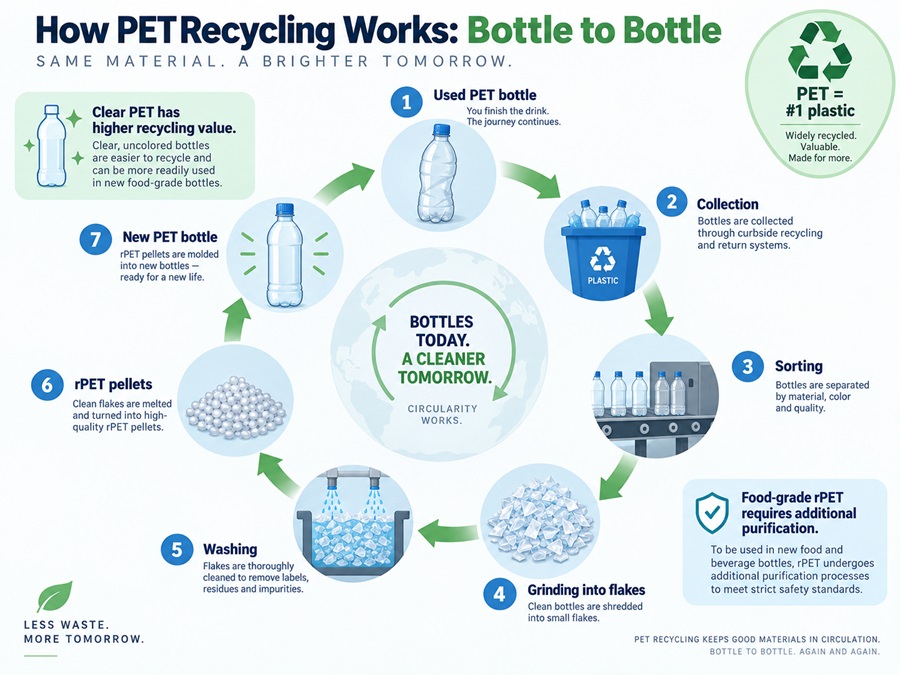
- Collection. Bottles come in through curbside pickup, drop-off sites, commercial recycling, or deposit-return systems. Material coming from a deposit-return stream tends to be much cleaner than stuff mixed in with regular household trash.
- Sorting. At a materials recovery facility, screens, magnets, air jets, and near-infrared optical sensors sort plastics by type — and then further by color. Clear and light-blue bottles are the most valuable because they can become almost anything.
- Baling. Sorted bottles get compressed into bales for transport. These bales still carry labels, caps, adhesive residue, dirt, and the occasional wrong-plastic-in-the-wrong-bin situation — which is exactly why smart packaging design matters upstream.
- Grinding. Bottles get shredded into small flakes, which are much easier to wash and process than whole bottles.
- Washing. Flakes get cleaned of food residue, labels, and adhesives. Caps are usually a different, less dense plastic (polypropylene or polyethylene), so they separate out fairly easily. Adhesives are the real troublemaker — if they don’t wash off cleanly, they can discolor the whole batch.
- Reprocessing. Clean flakes become pellets or other feedstock. Anything headed for food-contact use needs extra purification. The final product is called rPET — recycled PET.
- Remanufacturing. rPET becomes new bottles, food containers, thermoformed sheets, clothing, carpet, or industrial fiber. Turning it back into a bottle keeps it in a loop with solid collection infrastructure already built around it. Turning it into something rarely recycled — like carpet — extends its life, but breaks that loop.
What Is rPET, and Why Does It Matter More Every Year?
rPET is just recycled PET — material made using previously used plastic instead of starting from scratch with virgin resin. Demand for it isn’t just a marketing story anymore; it’s becoming a legal requirement in some places.
The EU now mandates that PET beverage bottles contain at least 25% recycled plastic on average, a number that jumps to 30% by 2030, under its Single-Use Plastics Directive. Broader EU packaging rules are also rolling out in phases starting August 2026, pushing hard toward recyclability and recycled content across the board.
That shift changes the economics entirely. Recovered PET isn’t just a nice-to-have anymore — it’s becoming a raw material manufacturers legally need.
Bottle-to-Bottle vs. Bottle-to-Fiber: Not the Same Thing
Bottle-to-bottle recycling — turning an old bottle into a new one — is the closest thing PET has to a true closed loop. And it’s working: bottle applications made up more than 60% of recycled PET used across U.S. and Canadian markets in 2024, with average recycled content in U.S. bottles hitting 15.9% (Waste Dive, “4 insights on the state of PET recycling and rPET in packaging”). That’s recycled material going back into packaging, not just being absorbed somewhere cheap.
Bottle-to-fiber recycling — turning bottles into clothing, carpet, or upholstery — is still genuinely useful, but it’s a one-way street in most places. A bottle has decent recycling infrastructure behind it almost everywhere. A polyester shirt usually doesn’t. It extends the material’s life without keeping it in circulation.
PET Recycling Is Expanding Past Bottles
For years, PET recycling basically meant bottle recycling. That’s shifting. In 2024, the U.S. and Canada collected 264 million pounds of PET thermoforms (trays, cups, clamshells) for recovery — a 52% jump from the year before.
That’s a big deal for supply, but it comes with new headaches: different labels, adhesives, colors, and constructions than bottles. Some recyclers accept thermoforms alongside bottles; plenty don’t. Which means two containers stamped with the same #1 can end up on completely different paths.
Why Some “PET” Products Recycle Better Than Others
- Clear bottles are the gold standard — recovered clear resin can become almost anything.
- Colored PET limits its own future. Once it’s tinted, it can’t go back to being clear rPET.
- Thermoforms (trays, clamshells) can sometimes ride along with bottles, but acceptance varies a lot by location.
- Shrink sleeves can actually confuse optical sorters, causing the whole bottle to get misrouted if the sleeve covers too much surface.
- Multilayer packaging — layers of different polymers bonded together for shelf life — can be a nightmare to separate and recycle, even if the main layer is PET.
The takeaway: you can’t judge a package’s recyclability just by its biggest ingredient.
Mechanical vs. Chemical Recycling: What’s the Difference?
Mechanical recycling — sort, grind, wash, melt, remake — is how almost all PET gets recycled today. It works well on clean material but struggles with contamination, mixed colors, stubborn adhesives, and the fact that plastic degrades a little every time it’s reheated.
Chemical recycling (depolymerization) takes a different approach: instead of melting PET, it breaks the polymer down into its original chemical building blocks through processes like glycolysis or hydrolysis. Those building blocks can then, in theory, be purified and rebuilt into fresh, high-quality PET — even from material too messy for mechanical recycling to handle.
It sounds like a silver bullet, but it isn’t automatically the greener choice. It depends heavily on energy use, chemical inputs, and how efficiently the plant runs. Still, it’s growing fast — U.S. and Canadian reclaimers processed nearly four times as much non-traditional PET feedstock in 2024 as they did the year before. Regulators are now wrestling with a genuinely tricky question: should chemically recycled content count toward legal recycled-content targets the same way mechanically recycled content does?
The Environmental Reality Check
PET doesn’t fit either of the easy narratives people like to reach for. “It’s recyclable, so it’s fine” oversimplifies things. So does “it’s plastic, so anything else must be better.” The truth lives in the details.
Still mostly fossil-based. Most virgin PET starts as fossil fuel-derived chemicals, so there’s an environmental cost before a single bottle is even filled. More rPET use directly reduces that.
Lightweight is a real advantage — less material per container, lighter shipments, fewer emissions per unit shipped. But that doesn’t automatically make it better than glass, aluminum, or reusable packaging. Glass can shine in short-distance refill systems. Aluminum has a strong recycling market despite its heavier upfront energy cost. Reusable containers can win outright if they’re actually reused enough times. The real question isn’t “which material is greenest” — it’s “which system makes sense for this specific use case.”
Littered plastic doesn’t care that it was recyclable. A bottle that ends up in a ditch, a river, or a landfill gets zero benefit from the fact that it theoretically could have been recycled. Keeping it out of the environment in the first place matters just as much as improving the recycling process itself.
Microplastics come from more than just broken-down bottles. Polyester clothing sheds fibers every time it’s washed. Good wastewater treatment catches a lot of that — but not all of it, and especially not in regions without solid treatment infrastructure.
Landfilled PET is a dead end. It doesn’t biodegrade in any meaningful timeframe, and once it’s buried with general waste, recovering it later just isn’t realistic.
Incineration destroys the material entirely. It shrinks landfill volume and can generate some energy, but it releases the carbon in the plastic rather than keeping it in a usable form. Recycling generally preserves more value than burning.
Food Safety, BPA, and Other Common Questions
Is PET food-safe? Yes, it’s widely approved for food-contact use — but safety depends on the finished product and manufacturing process, not just the base material. Recycled PET destined for food contact goes through extra decontamination and regulatory review; not every batch of recycled PET automatically qualifies.
Does PET contain BPA? No. BPA isn’t one of PET’s building blocks — PET comes from terephthalic acid and ethylene glycol. That’s a completely different chemistry than the plastics people usually worry about with BPA.
Can you reuse a disposable water bottle? You can, but it’s not built for it. Narrow bottles are hard to clean thoroughly, they scratch and wear down with reuse, and that creates room for bacteria to grow. If you want something for daily refilling, get a bottle actually designed for it.
Is PET biodegradable? No — not under normal environmental conditions, and not in a composting bin either. And here’s a common point of confusion: bio-based PET (made partly from plant-derived feedstock) is still chemically identical to regular PET. Same molecule, same non-biodegradable behavior. Renewable sourcing and biodegradability are two completely separate things.
Can PET be recycled forever? Not really, in practice. Every pass through mechanical recycling exposes the polymer to heat and stress, and contamination chips away at quality over time. That’s why recycled resin often gets blended with virgin PET to meet performance requirements. Chemical recycling might help extend this further since it rebuilds the polymer from scratch rather than reprocessing degraded chains — but no real-world system runs with zero losses at any stage.
How Better Packaging Design Fixes a Lot of This
Collecting more PET only gets you so far if the packaging itself works against recycling. A few design choices make a real difference:
- Keep it clear. Clear PET can become almost any recycled product; colored PET can’t.
- Skip unnecessary pigment. Every bit of color narrows the resin’s future market.
- Use labels that sorting equipment can see past. Full-body shrink sleeves that hide the bottle underneath can send the whole thing to the wrong stream.
- Choose washable adhesives. Glue that won’t release during washing contaminates entire batches.
- Avoid multilayer construction unless it’s genuinely necessary. Every extra material layer is another recycling obstacle.
- Design the whole package, not just the bottle. Caps, sleeves, inks, and liners all affect the final outcome.
What You Can Actually Do
You can’t redesign packaging or build a recycling plant, but a few habits genuinely move the needle:
- Check your local rules — the #1 symbol doesn’t guarantee your city accepts it.
- Empty containers before recycling — leftover product means more contamination.
- Rinse if your program asks you to — requirements vary.
- Leave caps on if your local program says to — check first, since guidance differs.
- Use deposit-return systems where they exist — they produce cleaner, more reliable streams.
- Don’t assume every clear container is PET — check the resin code.
- Go reusable when it actually replaces repeated single-use buying.
The Bottom Line
PET earned its spot at the top of the packaging world honestly — it’s light, strong, clear, shatter-resistant, and backed by one of the few genuinely mature plastic recycling systems out there. Bottle-to-bottle recycling works at commercial scale. Food-grade rPET is real. Demand for recycled content is only growing.
But none of that matters much when nearly 70% of U.S. PET bottles never even make it into the recycling stream. That’s the actual problem — not the technology, but the collection.
Going forward, PET’s story won’t be written by another recycling symbol on a bottle. It’ll come down to whether collection rates climb, whether packaging gets designed with real recycling systems in mind, and whether manufacturers keep pulling recovered PET back into new products instead of letting it disappear after a single use.
Leave a Reply