
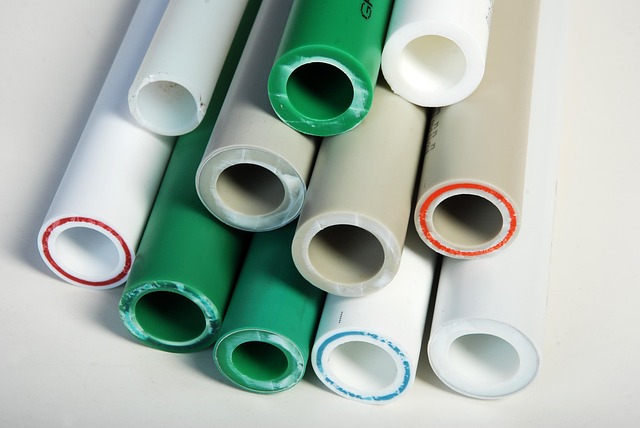
You probably touched PVC today without noticing. It could be the pipe behind your wall, the insulation on your phone charger, the floor under your feet, or the frame around your window. These products look nothing alike, yet they start from the same polymer.
PVC (polyvinyl chloride) is a synthetic thermoplastic made from chlorine and ethylene. It’s rigid in pipes and window frames, and flexible when plasticizers are added, as in cables, flooring and medical tubing. It’s one of the most widely produced plastics in the world and carries resin identification code #3.
The key point of this guide is that PVC is a family of formulations, not one material. A sewer pipe built to last a century raises completely different questions from a disposable flexible item with no recycling route.
Key takeaways
- PVC is about 57% chlorine by weight, which explains both its strengths and its end-of-life problems.
- Rigid PVC (uPVC) goes into pipes and windows. Flexible PVC contains plasticizers and goes into cables, flooring and tubing.
- Additives matter as much as the polymer. Two PVC products can have very different chemistry.
- PVC is recyclable, but only in clean, separated streams. The #3 code doesn’t mean your curbside program takes it.
- PVC isn’t biodegradable, which is an advantage in a buried pipe and a problem in a short-lived product.
What is PVC?
PVC is made of many vinyl chloride molecules linked into long chains. As a thermoplastic, it softens when heated and hardens as it cools, so it’s easy to extrude, mold and shape.
On its own, PVC is naturally rigid. Manufacturers change its behavior with plasticizers, stabilizers, impact modifiers, pigments and fillers, which is how one polymer becomes a pressure pipe, a vinyl floor, a cable jacket or synthetic leather.
| Property | PVC |
| Full name | Polyvinyl chloride |
| Resin identification code | #3 |
| Main elements | Carbon, hydrogen, chlorine |
| Chlorine content | About 57% by weight |
| Main forms | Rigid (PVC-U/uPVC) and flexible |
| Recyclable? | Yes, but collection and formulation differences make it hard in many systems |
Is PVC the same as vinyl? Usually, yes. On a product label, “vinyl” almost always means PVC: vinyl siding, flooring, wraps and upholstery. Vinyl records are made from PVC-based compounds, often copolymers. Strictly speaking, “vinyl” is a broader chemical term.
A quick history. German chemist Eugen Baumann prepared PVC in 1872. Commercial-scale production began in Germany in 1931, and Waldo Semon at B.F. Goodrich helped make plasticized PVC commercially useful in the 1930s.
What is PVC made of?
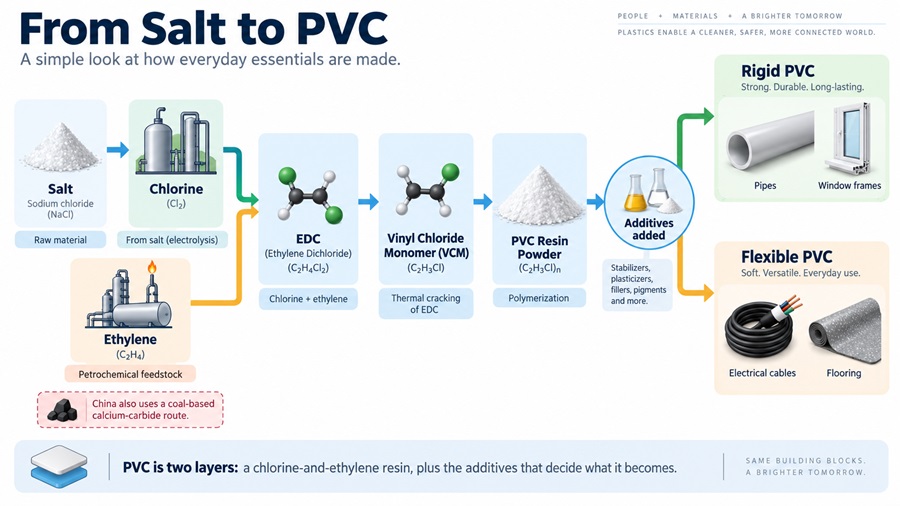
Think of PVC in two layers: the resin, and the additives blended into it.
The resin
Chlorine comes from salt (sodium chloride) via the chlor-alkali industry. Ethylene is traditionally made from natural gas or petroleum, and it’s what turns chlorine into a polymer:
Salt → chlorine + ethylene → ethylene dichloride (EDC) → vinyl chloride monomer (VCM) → PVC resin
The VCM is polymerized into a fine white powder. Most of it is made by suspension polymerization, while emulsion and bulk methods serve pastes and coatings.
China does it differently. The ethylene route dominates in Europe and North America, but in China, coal-derived calcium carbide remains a major feedstock. A 2025 material-flow study found that about 79% of China’s PVC capacity in 2020 (20.95 of 26.64 million tonnes) used that route, which is generally more carbon-intensive. Some producers also market bio-attributed or lower-carbon PVC through certified mass-balance systems.
The additives
Raw resin is rarely used alone. A finished product usually contains a mix of heat stabilizers (which stop degradation during processing), plasticizers (flexibility), fillers like calcium carbonate, impact modifiers (less brittleness), pigments like titanium dioxide, and UV stabilizers or lubricants.
| Component | Rigid PVC (pipe, profile) | Flexible PVC (cable, flooring) |
| PVC resin | roughly 85–95% | roughly 50–70% |
| Plasticizer | little or none | often around 20–50% |
| Filler | a few percent up to ~10% | varies widely |
| Stabilizer | 1–3% | 1–3% |
Treat these as illustrations, not specifications. Recipes are normally written in parts per hundred resin (phr), and flexible cable and footwear compounds can use roughly 40–80 phr of plasticizer.
Why so much chlorine?
Every repeating unit in the polymer carries a chlorine atom on its carbon backbone. Polyethylene and polypropylene, by contrast, contain only carbon and hydrogen. That chlorine helps explain PVC’s chemical resistance and fire behavior. It also means heating or burning PVC can release hydrogen chloride (HCl), a corrosive gas, which shapes how PVC is processed, recycled and incinerated.
Manufacturing follows three steps: compounding (blending resin with additives), forming (extruding pipes and cables, calendering sheets and flooring, molding fittings), and finishing.
Types of PVC
Rigid PVC (uPVC or PVC-U) has little or no plasticizer. It’s hard, stiff, dimensionally stable, and resistant to moisture and many chemicals. “uPVC” is the common term in the UK and much of Asia, and “PVC-U” is the European technical term. You’ll find it in water, drainage and sewer pipes, window frames, doors, siding, conduit and gutters.
Flexible PVC uses plasticizers that let polymer chains slide past each other. You’ll find it in cable insulation, vinyl flooring, hoses, tubing, roofing membranes, coated fabrics, synthetic leather, and some medical tubing and fluid bags.
The two behave almost like different material families, and that split explains most of the differences in safety and recycling later on. Rigid PVC recycles more easily from clean streams, while flexible PVC’s additives and mixed formulations complicate it.
| Variant | What it is | Typical use |
| CPVC | PVC with extra chlorine (roughly 63–69%). Handles water up to about 90 °C versus about 60 °C for standard PVC. Costs more, is less impact-resistant and is harder to recycle. | Hot and cold water plumbing, fire sprinklers |
| PVC-O | Molecularly oriented; stretched for higher strength | Thinner-walled, high-pressure water mains |
| PVC-M | Impact-modified for toughness | Water pipes, notably in Australia and New Zealand |
Properties of PVC
Values below are typical for a representative Type I rigid grade. Real figures depend on the formulation, so check the datasheet for your product.
| Property | Typical value or behavior |
| Density | About 1.42 g/cm³ |
| Yield strength | About 52 MPa |
| Vicat softening point | About 83 °C |
| Heat-deflection temperature | About 80–82 °C |
| Max continuous service temperature | About 60 °C for representative rigid sheet |
| Water absorption | Very low, about 0.06% |
| Flammability | Commonly rated self-extinguishing; depends on formulation |
What that means in practice:
- PVC doesn’t rust, rot or soak up water, which is why it suits buried pipes and outdoor building products.
- Many formulations tolerate acids, alkalis, oils and salts, though resistance varies with temperature and chemical.
- Flexible PVC combines electrical insulation, flexibility and abrasion resistance, hence its dominance in cables.
- Properly stabilized PVC handles sun and rain, though some grades yellow or turn brittle over time.
Heat limits. PVC has a narrow window. It softens around 80 °C and starts degrading at higher temperatures, releasing HCl. That’s why stabilizers are essential and why standard PVC isn’t used for hot water.
Fire behavior. Thanks to its chlorine, PVC is harder to ignite than polyethylene or polypropylene, and rigid PVC tends to stop burning when the flame is removed. But it isn’t fireproof. In a fire it produces HCl and dense smoke, and additives change how a product burns.
Additives and plasticizers
Each additive solves a problem, and together they’re why a drainage pipe, a cable and a vinyl floor shouldn’t be treated as the same material. They’re also at the center of PVC’s health and recycling debates.
Plasticizers sit between polymer chains and let them move. They can slowly migrate out of the material, which is why they come up in discussions of chemical exposure and recycling.
Phthalates are a family of chemicals, some long used as plasticizers in flexible PVC. Not all phthalates carry the same risk, and not all PVC contains them. Rigid PVC generally needs no plasticizer, and many flexible products now use alternatives. Under EU REACH Annex XVII entry 51, DEHP, DBP, BBP and DIBP generally can’t be placed on the market in articles at a combined concentration of 0.1% or more of the plasticized material, with listed exemptions. EU RoHS separately limits the same four in electrical and electronic equipment.
Stabilizers stop PVC breaking down when heated. Older PVC often used lead or cadmium. Since 29 November 2024, EU rules generally bar PVC articles containing 0.1% lead or more by weight (Regulation (EU) 2023/923). A time-limited exemption runs to 28 May 2033 for certain articles made with recovered rigid PVC containing under 1.5% lead, with conditions like encapsulation and marking. Calcium-based and organic stabilizers are now widely used in Europe, though practices differ elsewhere.
That history matters for recycling: old PVC still in service may contain stabilizers that are now restricted in new products.
Common uses of PVC
PVC shows up wherever products must resist water, chemicals or weather for a long time. Construction is the biggest market, taking around 70% of PVC used in Europe, according to the European Council of Vinyl Manufacturers.
| Product | Type | Typical service life | Recycling outlook |
| Water and sewer pipes | Rigid | 100+ years cited in industry-backed LCAs | Good where collected cleanly |
| Window frames, profiles | Rigid | Decades | Good; established schemes in some regions |
| Siding, gutters, fencing | Rigid | Decades | Moderate to good |
| Cable insulation | Flexible | Often decades | Feasible; must be separated from copper |
| Vinyl flooring | Flexible | Varies with traffic | Limited but growing take-back |
| Roofing membranes | Flexible | Decades | Some take-back schemes |
| Medical tubing, blood bags | Flexible | Often single use | Limited |
| Synthetic leather, coated fabrics | Flexible composite | Short to medium | Very difficult |
| Toys, cards, household items | Varies | Short to medium | Rarely collected |
Service lives depend on formulation, installation and exposure, so read these as broad descriptions, not guarantees.
Pipes are the most recognizable product: light, rust-proof and easy to install. Beyond them, many building products stay in place for decades, so their environmental balance looks very different from a disposable item’s. Medical uses (blood bags, IV tubing) rely on PVC being flexible, transparent and sterilizable, with formulations that differ considerably from construction grades.
Is PVC safe?
There’s no single answer, because several separate questions get bundled together.
Vinyl chloride monomer. The building block of PVC is a known human carcinogen and is mainly an occupational and industrial concern during production. As of August 2026, the U.S. EPA lists it as undergoing a TSCA risk evaluation, with the latest milestone being the draft scope published in January 2025. A finished pipe or window frame is not the same as exposure to the gas, and regulated products are made to control residual monomer.
Additives. Most concerns trace back to specific additives: some phthalate plasticizers, lead and cadmium stabilizers, and certain organotins. Many are restricted or phased out in various places, while others remain under review.
Drinking-water pipes. PVC has carried drinking water for decades, and plastic piping can be certified to NSF/ANSI 14 (system performance) and NSF/ANSI/CAN 61 (health effects of materials touching drinking water). The U.S. EPA limit for vinyl chloride in drinking water is 0.002 mg/L. Older pipes made with legacy stabilizers are a separate concern, so check local guidance if you don’t know the age or certification of your plumbing.
Everyday items. Soft PVC products such as some toys, shower curtains and inflatables can contain plasticizers, and new items may have a “new vinyl” smell from volatile organic compounds. It usually fades with ventilation, but it’s one reason some buyers look for phthalate-free options. Children’s products face stricter rules in many regions.
DIY safety.
- Pipe solvent cements and primers contain volatile solvents, so work somewhere ventilated.
- Wear a mask when cutting or sanding.
- Heating or welding PVC can release HCl and other fumes, so ventilate well.
- Never burn offcuts.
A better question than “is PVC safe?” is whether this specific formulation is appropriate and compliant for this use. For pipes and windows, regulation and certification exist to answer exactly that.
What critics and industry say
The European Chemicals Agency (ECHA) published its investigation report on PVC and its additives in November 2023. It looked at 63 additives and concluded that regulatory action is needed on certain ortho-phthalates, organotin stabilizers and flame-retardant emissions, and that PVC microparticle releases should be reduced. It stopped short of treating every PVC product as chemically identical.
Reactions split predictably. More than 60 environmental groups used the report to call for a PVC phase-out in the EU by 2030. Health and green-building organizations such as Habitable (formerly Healthy Building Network) also advise avoiding PVC where practical. The industry points to restricted additives, improved formulations, long service lives and established recycling programs. Much of the public recycling data is industry-reported, so it’s worth reading alongside regulatory and peer-reviewed sources.
Is PVC recyclable?
Yes. Both rigid and flexible PVC can be mechanically recycled. The more useful question is whether your specific product can be collected, identified, separated and recycled economically where it becomes waste.
Clean, uniform streams work well: window profiles, pipes, flooring, cables and manufacturing scrap. The process runs collection → sorting → cleaning → shredding and grinding → reprocessing, and it keeps the polymer largely intact rather than breaking it into chemical building blocks.
Why it’s difficult
- Formulations differ. A cable sheath and a window profile have very different additive packages.
- Rigid and flexible get mixed, making consistent recyclate hard to produce.
- Composites and contamination. PVC bonded to textiles, metal or foam has to be separated first, and adhesives, coatings and dirt add to the problem.
- Legacy additives. Decades-old products may contain lead or other now-restricted substances, so recyclers need to control where that material ends up.
- PVC contaminates PET recycling. It degrades at lower temperatures, releases HCl, and can discolor or damage recycled PET. That’s a big reason curbside programs avoid it.
Newer routes
Solvent-based recycling dissolves PVC so the polymer can be separated from additives and other materials. Solvay’s VinyLoop plant in Italy proved the approach at industrial scale but closed in 2018. Interest has returned, including INEOS Inovyn’s VinyLoop-derived work and a 2025 study that recovered over 95% of PVC polymer from tested rigid waste using biobased solvents. Chemical recycling (dechlorination followed by pyrolysis or gasification) is aimed at mixed or contaminated PVC. Both remain far less established than mechanical recycling.
How much PVC gets recycled?
There’s no single global rate. Europe offers a snapshot: VinylPlus, the European PVC industry’s sustainability program, reported almost 766,000 tonnes of PVC waste recycled in 2025, up 5.7% from 2024. Window profiles led at about 417,000 tonnes, followed by flooring (just under 120,000), cables (around 104,000) and pipes (around 41,000). That shows PVC recycling works at industrial scale, though it doesn’t mean every PVC product gets recycled, and it’s industry-program data.
Why won’t my curbside bin take it?
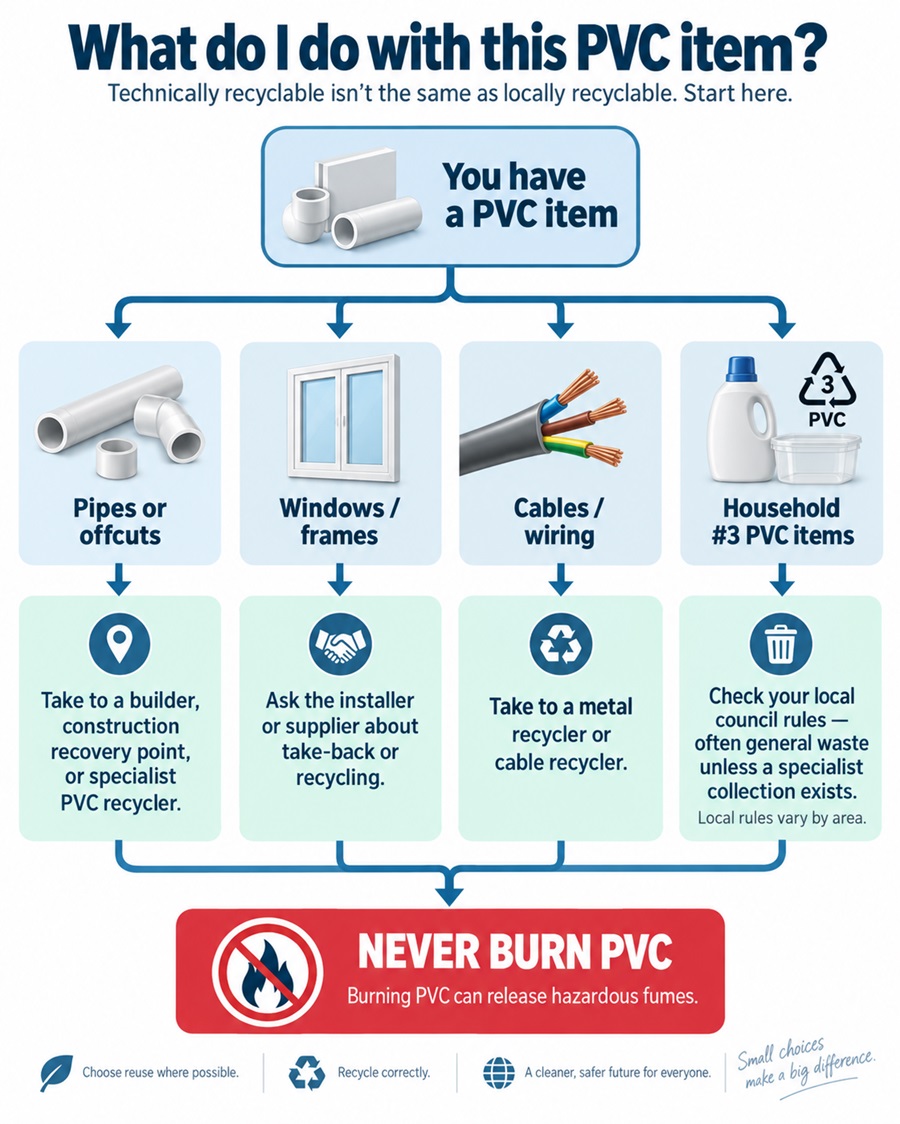
Curbside programs prioritize packaging streams that have established sorting equipment and end markets. PVC brings small household volumes, rigid and flexible types needing different handling, variable formulations, and difficulty telling it apart from other plastics. Technically recyclable doesn’t mean locally recyclable: a PVC pipe may have a specialist route even when a small #3 item doesn’t.
What to do with PVC waste
Identifying PVC. Look for the #3 symbol or “PVC” molded into the product, and think about what it is. Pipes, window frames, siding, vinyl flooring and cable jackets are usually PVC. A density test helps a little: PVC (about 1.4 g/cm³) sinks in water while polyethylene and polypropylene float, but PET sinks too. Don’t use a burn test.
What #3 means. Only the resin type. The standard behind the code, ASTM D7611, states that resin identification codes aren’t “recycle codes” and don’t imply that systems exist to process the article. It isn’t a ranking of safety or environmental performance either.
Practical checklist:
- Household #3 items: check your council or waste authority. Most curbside programs don’t accept them.
- Pipes and offcuts: ask your builder or contractor about separate collection. Many recyclers accept clean, sorted PVC.
- Old windows: ask the installer about take-back. Several countries run window recycling schemes.
- Flooring and roofing membranes: ask the supplier about take-back. In Europe, Recovinyl coordinates certified recyclers across multiple product streams, while schemes elsewhere are more limited.
- Cables: take them to a metal or cable recycler who can separate the copper from the plastic.
- Uncertain items: put them in general waste rather than contaminating a recycling bin.
Burning, landfill and biodegradability
Burning. Much of PVC’s chlorine forms HCl when it burns. Dioxins and furans can also form under some combustion conditions, though the link between PVC content and dioxin formation in mixed-waste incineration has been debated. The U.S. EPA’s I-WASTE guidance notes that facilities handling significant PVC loads need scrubbing and neutralization of HCl. So there’s a big difference between controlled incineration with modern flue-gas treatment and open burning, which should never be used for PVC. Never burn it in a household fire, backyard pile or open pit.
Landfill. Possible where nothing better exists, but it wastes the material’s value, and PVC doesn’t simply disappear. ECHA’s review called for measures to reduce PVC microparticle releases, particularly from recycling facilities and landfills.
Biodegradability. PVC isn’t biodegradable. It’s designed to resist moisture, microbes and weathering, so it can persist for a very long time and may eventually fragment into microplastics.
Environmental impact and sustainability
PVC doesn’t have one footprint, so you have to look across the lifecycle:
- Production. Chlorine and ethylene are both energy-intensive to make, and coal-based routes generally carry a higher carbon footprint. Vinyl chloride production needs strict emission control.
- Additives. These shape chemical exposure, recycling options, recycled-content quality and disposal emissions.
- Use. A pipe that stays in service for decades avoids the excavation, transport and materials that replacement would need. A disposable product gets no such benefit.
- End of life. PVC performs best where products are collected separately, sorted by composition and recycled. Otherwise it’s landfilled or incinerated, and its chlorine and additive mix make both options more complicated than for simpler polymers.
How it compares with alternatives. The answer depends heavily on application, service life, energy mix and end-of-life assumptions. A 2018 LCA of drinking-water pipes found PVC and HDPE had lower production impacts than ductile iron and steel in the cases studied, and a 2026 pipe study reported lower global-warming impacts for PVC than HDPE in a 50-year scenario. Window studies can point the other way: a 2016 comparison found long-lived, well-maintained aluminum frames least impactful. Because footprints vary so much with production route and system boundaries, a single kg-CO₂e figure for “PVC” would be misleading.
So, is PVC sustainable? It depends on four things: how long the product lasts, which additives it contains, whether it’s collected and recycled in a clean stream, and how it’s treated at end of life.
Verdict: PVC is neither simply sustainable nor unsustainable. The strongest case is long-life applications like pipes and windows with credible recovery systems. The weakest is short-lived products with no route back.
PVC vs other plastics
| Plastic | Code | Common uses | Key characteristic |
| PET | #1 | Beverage bottles, food packaging | Strong, often transparent |
| HDPE | #2 | Bottles, containers, pipes | Tough, chemically resistant |
| PVC | #3 | Pipes, windows, flooring, cables | Rigid or highly flexible |
| LDPE | #4 | Films, bags | Soft and flexible |
| PP | #5 | Food containers, automotive parts | Heat and fatigue resistance |
| PS | #6 | Packaging, insulation, disposables | Rigid or foamed |
A lower number isn’t a better environmental score. Application, lifespan, formulation and the local recycling system matter far more.
Quick answers
Is PVC toxic? It depends on the product. Vinyl chloride monomer is a known carcinogen, mainly relevant to production. Concerns about finished PVC focus on particular additives such as some phthalates and lead stabilizers, most of which are restricted in many regions.
Is PVC safe for drinking water? Certified modern PVC pipes are widely used and tested to standards like NSF/ANSI 61. Very old pipes may contain legacy stabilizers.
Can I put PVC in my recycling bin? Probably not. Check local rules.
How can I tell if something is PVC? Look for the #3 or “PVC” marking and consider the product type. Sinking in water is a hint but not proof, since PET sinks too.
How hot can PVC get? Standard rigid PVC is limited to about 60 °C in continuous service, softens around 80 °C and degrades from about 140 °C. Use CPVC for hotter water.
How long does PVC last? It varies. Buried water and sewer pipe is designed as long-life infrastructure, with an industry-backed LCA citing 100+ years, while flexible consumer products can have much shorter lives.
Is PVC environmentally friendly? Mixed. Durability helps in long-life uses, while chlorine content, additive chemistry and recycling difficulty need careful management.
Leave a Reply