Advanced recycling is the industry’s name for processes that go beyond shredding and remelting. They use heat, solvents, chemistry or enzymes to recover something useful from plastic that ordinary recycling can’t handle. Some of it runs at industrial scale. Some is stuck waiting for financing. And a few plants that were meant to prove the concept have shut down.
This guide is the practical map: which technology suits which plastic, which plants are really running in 2026, and where things are going wrong. For the mechanics of each process, see our Chemical Recycling guide. For the baseline all of this competes with, see Mechanical Recycling.
Key takeaways
- The label tells you nothing on its own. “Advanced recycling” covers very different processes with very different track records.
- Polyester is the clear success story. PET can be split into building blocks and rebuilt at commercial scale. Polyolefins (PE and PP) are much harder.
- Scale-up is the bottleneck. Plants that work on paper often run well below design capacity, or stall before they’re built.
- It complements mechanical recycling. Its job is the waste mechanical recycling rejects, not clean bottles.
What counts as advanced recycling?
“Advanced,” “chemical,” “molecular” and “feedstock” recycling are mostly used interchangeably in marketing. The US EPA sorts the field into three groups: thermal conversion (heating plastic until it breaks down), depolymerization (splitting polymers back into their building blocks) and purification (cleaning the polymer without breaking it).
That last group is debated, because solvent purification leaves the polymer chains intact, so some experts won’t call it chemical recycling at all.
What matters more than the name is three things: which plastic goes in, what comes out, and whether that output actually replaces virgin material.
Which technology fits which plastic?
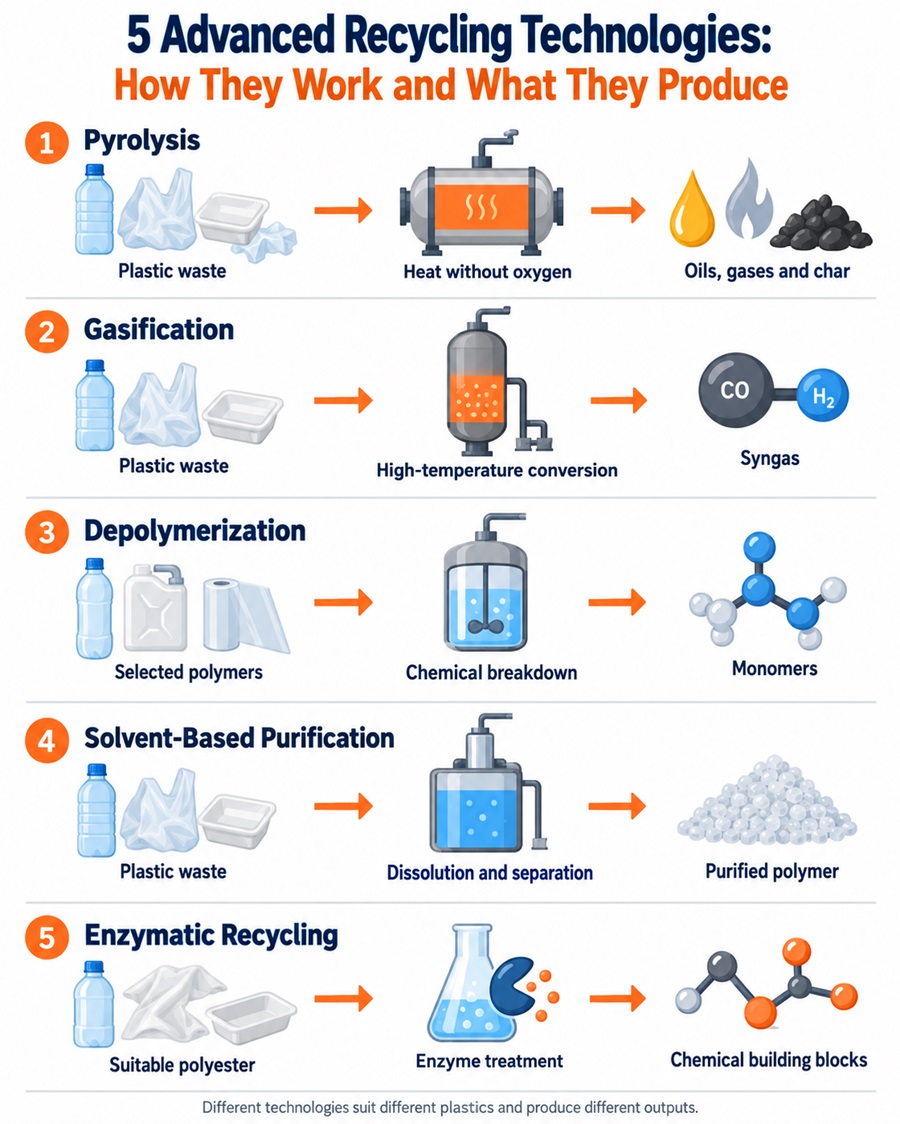
Start with the routes themselves:
| Route | What it does | What comes out | 2026 maturity |
| Depolymerization (methanolysis, glycolysis, hydrolysis) | Chemically splits PET and other polyesters into building blocks | Monomers for new polyester | Commercial (Eastman) |
| Solvent purification | Dissolves the polymer, filters out colour, odour and additives | Purified polymer | Early commercial, below design rate (PureCycle) |
| Pyrolysis | Heats plastic without oxygen | Oil, gas, char | Operating, but fragile; several shutdowns |
| Gasification | Converts carbon-rich waste to syngas | Syngas | Rarely a plastic-to-plastic route |
| Enzymatic | Enzymes cut PET chains apart | Monomers | Pre-commercial; first plant not yet built |
Now flip it. Most readers start with the plastic in front of them:
| Plastic | Best advanced route | The catch |
| PET and polyester (bottles, trays, textiles) | Depolymerization, enzymatic | Needs a fairly consistent PET stream. Blended textiles must be separated first. |
| PP | Solvent purification, pyrolysis | Grades and additives vary. The leading solvent plant is still ramping. |
| PE (HDPE, LDPE, films) | Pyrolysis, solvent purification | Dirty films lose a lot of material. Pyrolysis oil needs upgrading before it can become plastic. |
| PS | Depolymerization, pyrolysis | Small volumes and little collection, so economics are thin. |
| PVC | None that works well | Chlorine corrodes equipment and contaminates oil, so plants screen it out. |
| Multilayer and mixed packaging | Mostly pyrolysis | The hardest case, with the lowest yields. |
The pattern is simple: the cleaner and narrower the feedstock, the better the result. Nothing here removes the need for sorting.
Two routes worth a closer look: enzymes and textiles
Our other guides don’t cover these, and they may matter most over the next few years.
Enzymatic recycling uses engineered enzymes to break PET into its building blocks, typically under milder conditions than thermal processes. The catch is that it only works on PET and polyester. Don’t expect it to do anything for PE or PP.
Textiles are where this gets interesting. Clothing is full of polyester, often blended with cotton, elastane and dyes, and mechanical recycling copes badly with that mix. Depolymerization and enzymes are the main hopes for turning old garments back into polyester. CARBIOS reported in 2026 that it had validated its process on complex textile waste. That is a technical result, though. No commercial plant is running yet.
The 2026 reality check
Three companies show the range of outcomes.
| Company | Route | Where it stands |
| Eastman (Tennessee) | PET methanolysis | Running; took until late 2025 to reach full rate |
| PureCycle (Ohio) | PP solvent purification | Running at a fraction of design capacity |
| CARBIOS (France) | Enzymatic PET | Plant not built; construction on hold |
Eastman: the proof that depolymerization works, with caveats. The Kingsport plant has a design capacity of about 110,000 tonnes a year. Eastman’s CEO said in late 2025 that it had finally reached full production capability, so the ramp-up was slow. Its planned second plant in Longview, Texas, lost its US Department of Energy award when the department terminated a batch of clean-energy demonstration grants.
PureCycle: working, but far from its design number. The Ironton plant was designed for about 107 million pounds a year. Its Q1 2026 record was 8.4 million pounds of output from roughly 10 million pounds of feedstock. Annualised, that is about a third of design capacity (our arithmetic), though the company reports it is pacing production ahead of customer demand. Q2 output fell to 4.5 million pounds because of a planned turnaround, not a breakdown. The company also posted a $33.4 million net loss in Q1. The ratio of output to feedstock is a rare, concrete yield number, though it is company-reported. Early commercial customers include Procter & Gamble, with expansions planned in Thailand and Belgium.
CARBIOS: a technology that still needs its first plant. The Longlaville plant is estimated at €230 million, with production targeted for the first half of 2028. Construction was deferred in December 2024 over funding delays. The financing close, once aimed at Q3 2026, had not been completed by its half-year report in September, which describes the next step as resuming construction.
Where it’s stumbling
The bigger picture is less flattering, especially for pyrolysis:
- Freepoint (Ohio) and Braven (North Carolina) suspended operations, according to a July 2026 New York Times report. Freepoint had also failed to produce enough pyrolysis oil to meet Ohio’s legal definition of recycling.
- Brightmark (Indiana) filed for bankruptcy, having reportedly run at about 5% of capacity.
- Pryme (Netherlands) closed its only operating pyrolysis plant after persistent technical problems and financial pressure.
- Plastic Energy and Viridor were reported in May 2026 to be in administration and exiting European chemical operations respectively. This comes from a secondary source, so check it before citing.
The common thread is that pilot-scale success didn’t translate into reliable commercial operation. Technical problems, thin margins and contaminated feedstock hit pyrolysis hardest. Depolymerization of clean PET has fared better.
Where it fits next to mechanical recycling
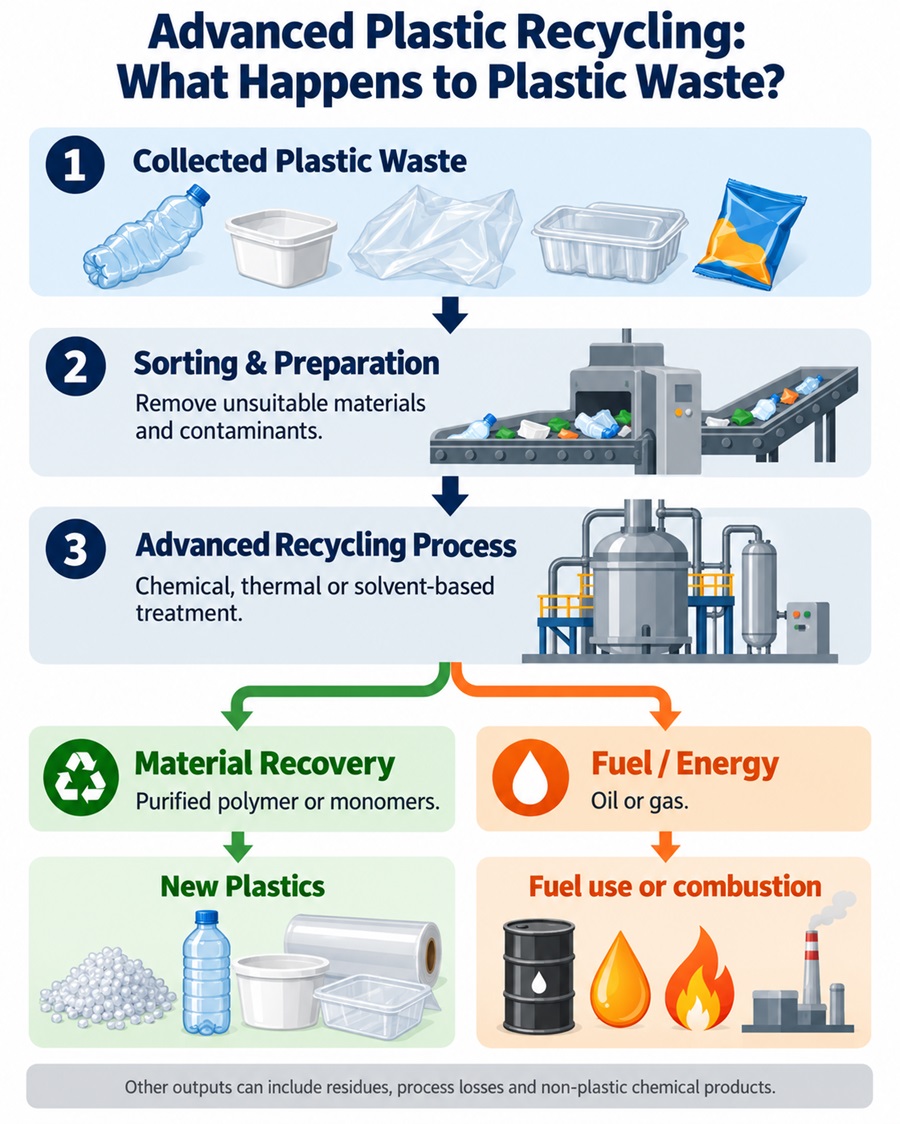
If a clean PET bottle or HDPE jug can be sorted and remelted, mechanical recycling is the better route. It uses fewer steps and less energy. Advanced recycling earns its place on what mechanical plants reject: contaminated or multilayer packaging, blended textiles and plastics that need very high purity. Diverting recyclable material into an energy-hungry process defeats the purpose.
The chemical recycling guide covers the harder questions of plastic-to-fuel outputs, mass-balance accounting and lifecycle emissions.
How to judge a project in 60 seconds
- Is it operating, and at what rate? A pilot or a groundbreaking is not a plant. Look for measured output over several quarters, not design capacity. PureCycle shows how far apart the two can be.
- Does the output become plastic? Oil that ends up as fuel is energy recovery, not recycling. Ohio’s definition of recycling shows regulators are starting to enforce that line.
- Is the financing closed? CARBIOS and Eastman’s Texas plant show how many announced projects stall here.
For a fuller checklist, use the five numbers to ask for in our chemical recycling guide.
Frequently asked questions
Is advanced recycling the same as chemical recycling?
Usually, in everyday use. Strictly, advanced recycling is the wider term and often includes solvent purification, which leaves the polymer chains intact.
Can it handle mixed plastics?
Some processes accept selected mixed streams, mainly pyrolysis. None handles every combination of polymers, dyes, adhesives and contaminants efficiently, and yields drop as the mix gets messier.
Can it make food-grade plastic?
Potentially. Depolymerization rebuilds polymers from purified building blocks, and solvent purification removes odours and additives. But the finished material still has to pass food-contact approval. Using advanced recycling doesn’t guarantee it.
Is it commercially viable?
Depolymerization of PET is operating commercially. Solvent purification of PP is selling product but still losing money. Pyrolysis is the most uneven, with several closures in the past two years. Viability depends on feedstock cost, plant uptime and whether customers will pay for recycled content.
Can plastic be recycled indefinitely this way?
In principle, depolymerization can return PET to its building blocks repeatedly. In practice, every cycle loses some material to contamination, residue and process losses, so “infinite” overstates it.
The bottom line
Advanced recycling is a real tool for a narrow job: recovering polyester and some polypropylene that conventional recycling can’t. Beyond that, the evidence is mixed, and the 2025–26 closures are a reminder that building the plant is the easy part. Judge any project by what it has actually processed, what that became, and whether the money is in place.
Leave a Reply