A reusable container that gets used twice is worse than a disposable one. One that gets used a hundred times is hard to beat. Almost everything worth knowing about reusable packaging sits in the gap between those two sentences.
This guide covers how reuse systems work, which materials suit which jobs, how to tell whether reuse is actually greener or cheaper, and what the new EU rules mean for businesses. If you’re comparing options, our guides to compostable packaging and biodegradable and compostable plastics cover the disposable side.
Quick answer
- Reusable packaging is designed to be used many times for the same purpose, and it only counts if a system exists to bring it back (or refill it) and clean it.
- The system matters more than the material. Return rate, trip distance, and washing method decide whether reuse wins.
- There is no universal break-even. Each container needs enough real trips to repay its heavier production footprint.
- Regulation is catching up. The EU’s Packaging and Packaging Waste Regulation (PPWR) sets reuse targets from 2030 and a takeaway reuse offer from 12 February 2028.
What counts as reusable packaging
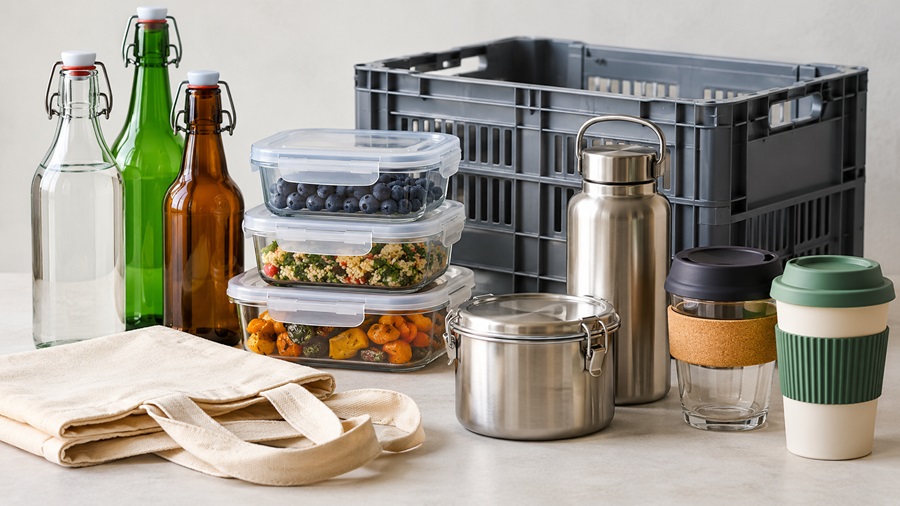
Reusable packaging is built to survive repeated handling and cleaning, and it moves through a defined loop: use, collect or refill, clean, use again. Think refillable bottles, returnable takeaway boxes, and the plastic crates that carry produce from farms to supermarkets.
The loop is what separates it from a washed-out yogurt tub in your cupboard. Reusing that tub is great, but it isn’t a packaging system. For businesses this distinction now has legal weight: under the PPWR, “reusable” means designed for multiple trips and operating within a reuse system, not just sturdier than average.
The four reuse models
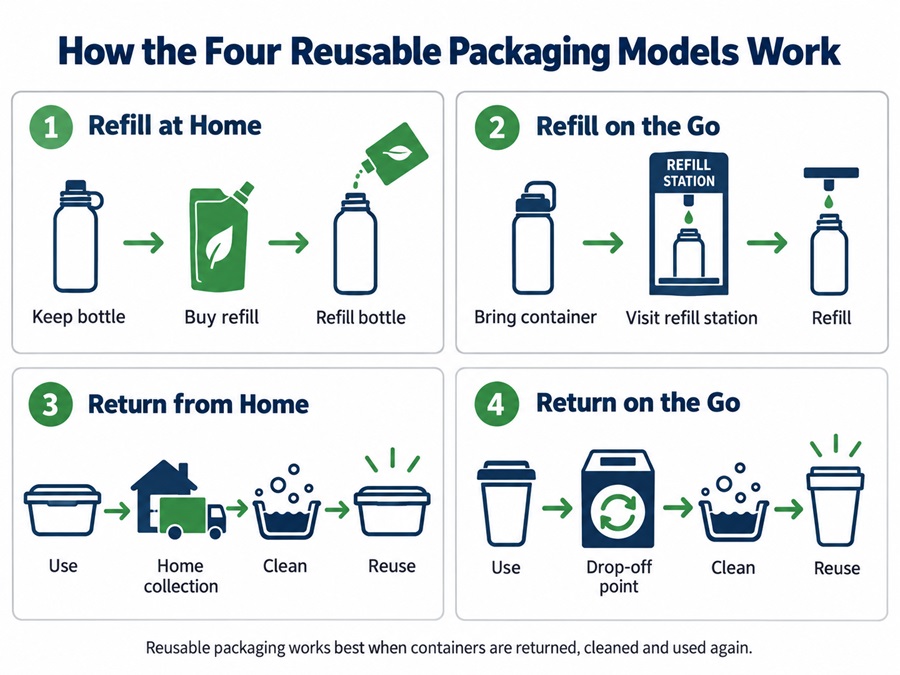
The Ellen MacArthur Foundation groups consumer-facing reuse into four models. Knowing which one you’re looking at tells you where it tends to break.
| Model | How it works | Example | Where it breaks |
| Refill at home | You keep the container; a refill (concentrate or pouch) is delivered or bought | Spray bottle plus cleaning concentrate | The refill packaging can cancel out the savings |
| Refill on the go | You bring a container to a store dispenser | Detergent, shampoo, dry goods | Hygiene and dispenser maintenance |
| Return from home | The company collects empties from your door | Milk bottles collected on delivery day | Pickup routes that add extra driving |
| Return on the go | You drop empties at a store, machine, or return point | Bottle deposit schemes, reusable takeaway cups | Inconvenient return points; forgotten containers |
A quick pattern: the two “return” models are far more dependent on human behavior. If customers don’t bring things back, nothing else in the system matters.
Materials at a glance
No material wins everywhere. Match it to the product, the trip distance, and the cleaning method.
| Material | Typical uses | Strength | Watch out for |
| PP (polypropylene) | Takeaway boxes, cups, storage | Light, durable, handles repeated washing | Heat limits vary; scratches and cracks end food-contact life |
| HDPE | Crates, pallets, refill bottles, totes | Tough and chemical-resistant | Fossil feedstock; needs end-of-life recycling |
| Refillable PET | Beverage bottles | Light and clear | Must be designed for refilling; ordinary single-use PET bottles are not |
| Glass | Bottles, jars | Barrier properties, no flavor transfer | Heavy and breakable, so it suits short, local loops |
| Stainless steel | Bottles, food containers | Very long life | High production footprint, so it needs many uses to pay off |
| Aluminum | Refillable bottles, containers | Light for a metal | Energy-intensive to produce; check linings |
| Fabric | Shopping bags, pouches | Washable, flexible | One thick cotton bag can outweigh dozens of thin plastic ones in impact; the best bag is the one you already own |
For plastic-specific detail, see our guides to HDPE and PET.
Two rules hold across the table. A scratched, cracked, or heat-warped plastic container should leave food service. And a heavier material only makes sense if it makes enough trips; a lighter one can win by default on transport alone.
Is reuse actually greener? The break-even question
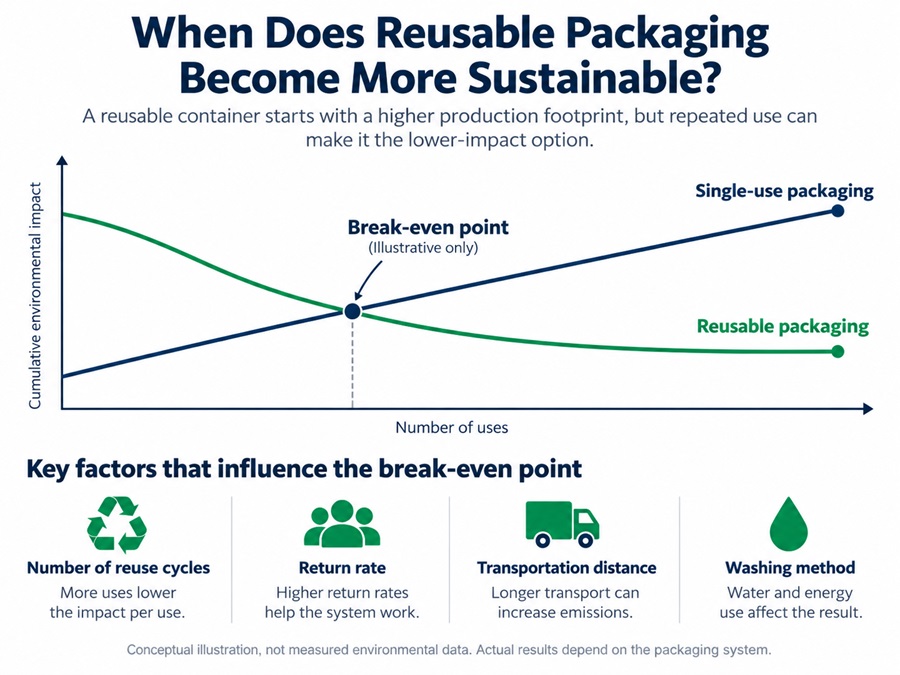
Not automatically. A reusable container is built heavier than its disposable equivalent, so it starts with a bigger footprint. Every trip then adds some washing, water, and transport. The container has to replace enough disposables to cover both.
At scale, though, the upside is real. UNEP’s Turning off the Tap report estimates that reuse options such as refillable bottles, bulk dispensers, and deposit-return schemes could cut plastic pollution by 30% by 2040, provided governments and businesses make reuse the more profitable choice.
Here’s a simple way to picture it. Say a reusable cup has the production footprint of 10 disposable cups, and each wash-and-return trip adds a small extra burden. Early trips are still paying off the “debt.” Somewhere after that, you break even. A cup used 5 times and then lost is a net loss. A cup used 200 times is a clear win.
What moves the break-even point:
- Weight and material of the container
- Real trips completed, not trips it was designed for
- Return, loss, and damage rates
- Distance to the washing site (heavy glass over long distances erodes the benefit fast)
- Washing method, including water and energy source
- What the disposable is made of, since replacing a heavy paperboard box is easier than replacing a thin film
One more caution: a life-cycle study can look good on climate and weaker on water use, or the reverse. Be wary of blanket claims like “glass is always greener” or “reuse cuts pollution by X%” unless the study matches the exact system. A container that’s lost after one use is the worst case, because it carries a larger footprint than the disposable it replaced.
What reuse really costs
Sticker price misleads. Use cost per completed use:
(purchase price ÷ real trips) + washing and handling + transport + replacement for losses
A worked example, using illustrative numbers:
- Container: $5
- Washing and handling: $0.08 per use
- Transport and collection: $0.02 per use
- Disposable alternative: $0.25
If the container completes 50 trips, cost per use is $0.10 + $0.10 = $0.20, a saving. If losses and damage cut real trips to 25, it becomes $0.20 + $0.10 = $0.30, and now the disposable is cheaper. Same container, same price, opposite outcome. That’s why the number to track is real trips per container, not trips on the spec sheet.
Don’t forget the fixed costs: washing equipment or a contract washer, storage, a tracking method, and enough extra stock to keep serving while containers are out in circulation.
When reuse works (and when it doesn’t)
| Reuse tends to work when… | Reuse tends to struggle when… |
| Customers return in a closed setting: campus, office, stadium, dine-in | Items are shipped one-off across long distances |
| Deliveries run on regular routes, so empties ride back on the same truck | Return points are hard to reach, so people forget or give up |
| A deposit or discount rewards returns | There’s no washing capacity nearby |
| B2B flows repeat between the same sites (crates, pallets, totes) | The container is heavy and the trip is long |
| Products have long, stable shelf lives and simple cleaning | Items are hard to clean or easy to damage |
B2B is where reuse is most mature. Pallet and crate pools move goods on set routes with predictable returns, which is exactly why regulators started there.
If you’re a consumer, the practical move is simple: use the containers and bags you already own for as long as they last, and favor return or refill schemes that are convenient enough that you’ll actually use them.
What’s changing: 2026 to 2030
- PPWR (EU). The regulation applies from 12 August 2026. Reuse targets bite from 1 January 2030: 40% of certain transport and e-commerce packaging must be reusable and used within a reuse system, with a 70% goal for 2040, and 100% for B2B transport within the same member state. Targets differ by packaging type and the detail is still being filled in through secondary rules, so check the regulation text (Regulation (EU) 2025/40) for your category.
- Beverage reuse targets. The PPWR sets targets for reusable beverage packaging in 2030 and 2040. Published summaries vary by container type, so confirm the exact percentages that apply to you before you plan around them.
- Takeaway reuse offer. From 12 February 2028, businesses selling takeaway drinks and ready-to-eat food must let customers choose reusable packaging.
- Shared systems. Pooled reuse systems are allowed, but with limits on how many companies or brands can share one. Plan for that before you build a standardized shared-container scheme.
- Other markets. Several countries already require reusable options for takeaway or dine-in service, and US states are rolling out extended producer responsibility (EPR) rules that affect how reuse is counted. These change often, so check your local rules before committing.
- Greener claims are tightening too. Vague labels like “eco-friendly” are under growing legal pressure in the EU. A reuse claim should state what it’s based on: trips, return system, wash process.
Reusable vs recyclable vs compostable
These solve different problems, and they aren’t rivals. A reusable crate can be recycled after years of service.
| Type | After use | What it needs to work |
| Reusable | Cleaned or refilled and used again | A durable design and a working return system |
| Recyclable | Processed into raw material | Collection and recycling infrastructure |
| Compostable | Breaks down under defined conditions | A facility that accepts it |
For the other two paths, see compostable packaging and oxo-degradable plastics, which is a different story entirely.
How to spot a weak reuse claim
Be skeptical if you see:
- A “reusable” label with no stated return, refill, or wash process
- No number for how many times the container is meant to be used
- A thin, single-use-style container sold as reusable
- A deposit or return program with no convenient drop-off points
- A green claim that covers “the packaging” but can’t say what happens after the first use
Starter checklist for businesses
- ☐ Pick one use case where collection is predictable (dine-in, regular delivery routes, B2B)
- ☐ Choose a material that fits cleaning, food-contact, and temperature needs
- ☐ Decide who collects, who washes, and who removes damaged containers
- ☐ Set a deposit or incentive, and make returns easier than throwing away
- ☐ Track average trips per container, return rate, loss rate, and cost per completed use
- ☐ Compare against local recyclable and compostable alternatives
- ☐ Check which EU or local rules apply to your product category and dates
FAQ
What’s an example of reusable packaging? Returnable glass bottles, refillable cleaning-product bottles, durable takeaway boxes, and plastic crates used to ship produce.
Is reuse better than recycling? Generally, reuse ranks higher because it avoids making a new container each time. But that holds only when the container is used often and returned reliably. A container used a handful of times can lose to a well-recycled disposable.
Can plastic packaging be reused safely? Yes, if it was designed for repeated use, suits the product, and is cleaned properly. Single-use plastic packaging shouldn’t be assumed safe for repeated heating, washing, or food storage.
What’s the difference between reusable and returnable? Reusable is the broad term. Returnable means it goes back to a business for inspection, cleaning, and redistribution. A refillable bottle you keep at home is reusable, but not part of a returnable system.
Glass or plastic for reuse? Both can work. Glass offers strong barrier properties but weighs more and breaks, so it suits local loops. Durable plastic is lighter to ship. The best choice depends on trip distance, return rate, and cleaning, not the material alone.
The bottom line
Reusable packaging pays off when the container makes enough real trips, and that depends on convenient returns, short routes, and safe, efficient cleaning far more than on what the container is made of. For consumers, that means using what you already have. For businesses, it means designing the return loop first, measuring trips per container, and knowing which rules apply to you.
For wider context, explore our plastic alternatives guide and our comparison of paper vs plastic.
Leave a Reply