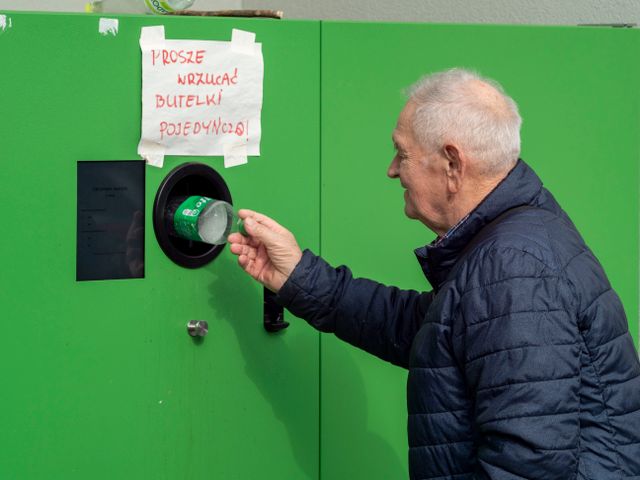
Deposit return systems give empty beverage containers a financial value. When someone buys a bottled drink, they pay a small deposit. Return the empty container to an approved location, and they get that money back.
It sounds simple, but the system behind it is more involved. Retailers need to collect deposits, consumers need convenient return locations, and someone must organize the collection and handling of returned containers.
When those parts work together, deposit programs can recover large quantities of bottles and cans that might otherwise enter household waste or become litter.
But results vary. Some programs achieve return rates above 90%, while others recover a much smaller share of eligible containers.
Understanding why reveals what deposit return systems can accomplish—and what they cannot.
Quick Answer: What Is a Deposit Return System?
A deposit return system (DRS) is a program that charges consumers a refundable deposit when they purchase certain beverage containers. The deposit is returned when the empty container is brought to an approved collection point. These programs encourage people to return bottles and cans for recycling. Their success depends on deposit amounts, convenient return locations, clear rules, and reliable collection infrastructure.
What Is a Deposit Return System?
A deposit return system is a method of collecting used beverage containers through a refundable payment.
Consumers pay a deposit when buying a covered drink. After finishing it, they can return the empty container to a participating retailer, redemption center, or another authorized collection point.
The deposit creates an incentive to bring the container back rather than discard it.
Deposit return systems are also known as deposit return schemes, container deposit schemes, or bottle bills. The terms vary by country, but the basic idea is similar.
Most programs focus on selected single-use beverage containers, including plastic bottles, aluminum cans, and sometimes glass bottles.
They operate alongside ordinary recycling services rather than replacing them.
For a broader explanation of how materials reach collection facilities, see our guide to plastic waste collection methods.
The Difference Between a Deposit and a Recycling Fee
A refundable deposit is not the same as a recycling fee.
A recycling fee helps cover waste-management expenses and usually is not returned to the buyer.
A deposit works differently. Consumers can recover the payment by returning the eligible container.
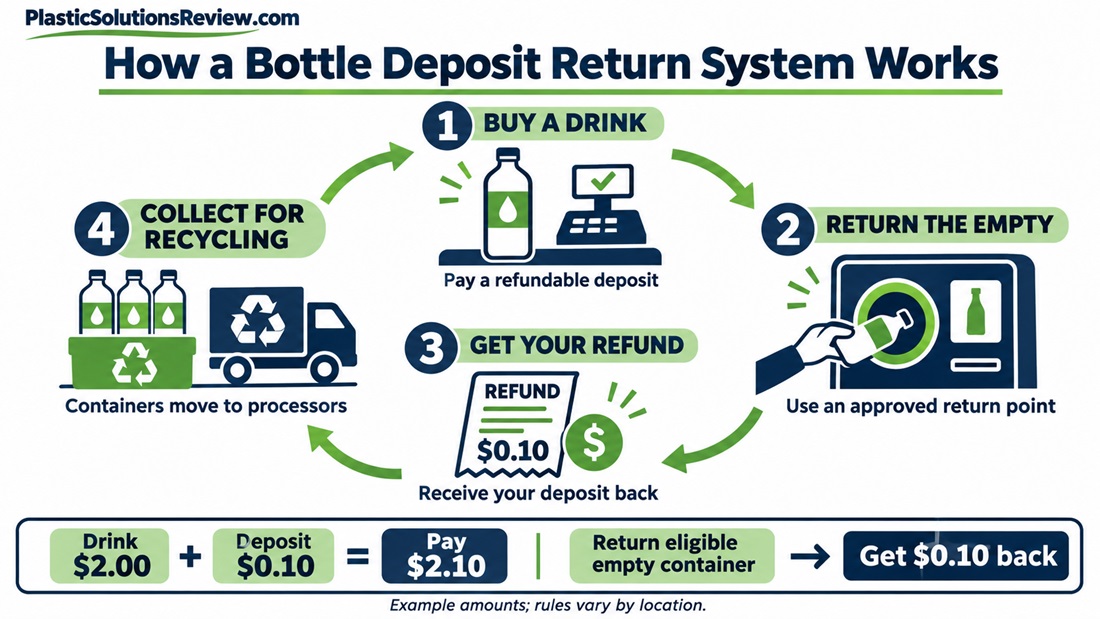
For example, a drink priced at $2 with a $0.10 deposit costs $2.10 at checkout. If the empty container is returned correctly, the consumer receives $0.10 back.
The deposit is intended to influence what happens to the container after the drink is consumed.
Some countries also use deposits for reusable bottles that are cleaned and refilled. Those programs serve a different purpose from collecting single-use containers for recycling.
This article focuses mainly on deposit programs for single-use beverage packaging.
How Does a Bottle Deposit Return System Work?
A deposit return system connects the purchase of a drink with the return of its empty packaging.
The process usually involves four stages.
Step 1: Consumers Pay a Deposit When Buying a Drink
The deposit is added when an eligible beverage is sold.
Its value depends on the program. Some jurisdictions use one deposit amount for most covered containers. Others vary the amount by container size or type.
The payment is normally identified separately from the drink’s price.
For example, Germany applies a €0.25 deposit to most covered single-use beverage containers.
In Oregon, consumers pay a refundable 10-cent deposit on eligible beverages.
These amounts are set through the relevant legal or administrative system, not independently by each shop.
Step 2: Empty Containers Are Returned
After consuming the drink, the buyer brings the empty container to an authorized return location.
There are several ways this may work.
Retailer returns: Participating shops accept eligible containers. Some use automated equipment, while others handle returns manually.
Redemption centers: Dedicated facilities receive containers and provide refunds. These may accept larger quantities than ordinary retail return points.
Reverse-vending machines: Consumers insert containers into a machine that checks their eligibility and records the refund.
Eligibility checks may involve barcodes, container shape, material, and other identifiers.
Not every machine accepts every container carrying a recycling symbol. The item must qualify under the specific deposit program.
Step 3: Consumers Receive Their Refund
Once the returned containers are accepted, the consumer receives the applicable deposit amount.
Refunds may be provided as cash, store vouchers, electronic transfers, or account credits, depending on the system.
Some programs also let consumers donate the value of returned containers to charities or community groups.
A person returning 20 containers with a $0.10 deposit would receive $2, provided all 20 containers qualify.
The refund is not a recycling reward added on top of the deposit. It is the return of money paid when the drink was purchased.
Step 4: Returned Containers Move to Recycling
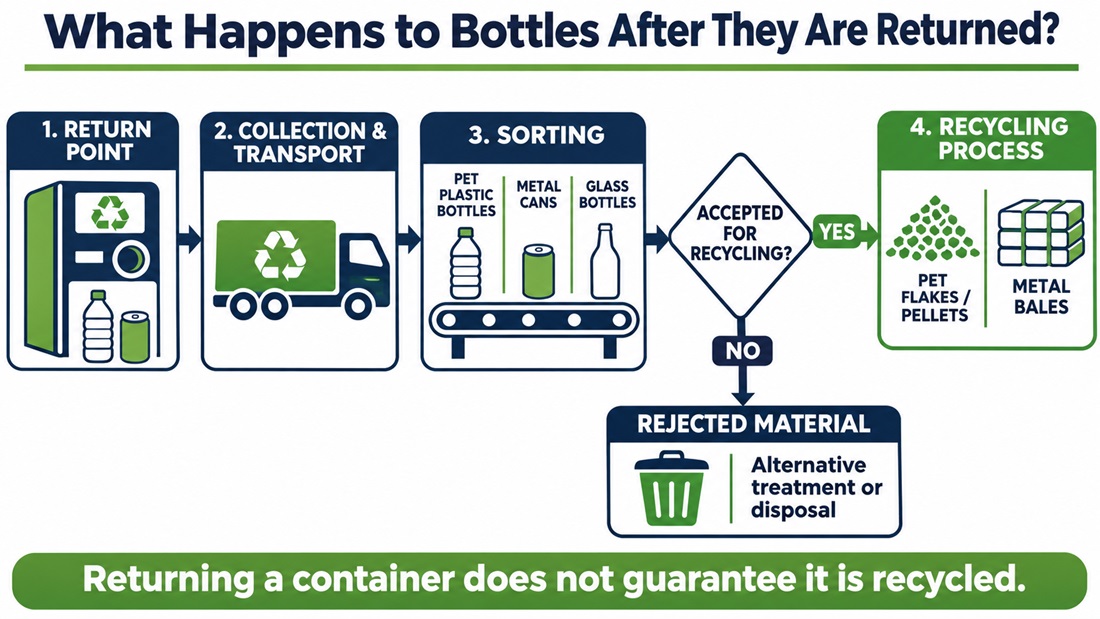
After redemption, containers are gathered, counted, and transported through the program’s collection network.
Some are compacted or sorted by material before shipping.
Plastic bottles may then be sent to specialized recycling processors, while metal and glass containers follow their own recovery routes.
The important difference from mixed household recycling is that deposit programs can collect eligible beverage containers in more controlled material streams.
That can help preserve material quality, although successful recycling still depends on the facilities and markets receiving the material.
Deposit return does not mean that every returned container automatically becomes a new bottle or can.
Which Bottles and Containers Are Covered?
Deposit return systems usually cover a defined range of beverage packaging.
Common examples include PET plastic bottles, aluminum cans, steel cans, and certain glass bottles.
The exact rules vary considerably.
Plastic, Metal, and Glass Beverage Containers
PET bottles are among the most common plastic containers covered by deposit programs. They are widely used for water, soft drinks, and other beverages.
You can read more about the material in our guide to PET plastic.
Metal beverage cans are also frequently included, while glass-container eligibility depends on local rules.
Some programs accept drink cartons or other packaging formats, but these are not universally covered.
Container size matters, too.
For example, Queensland’s Containers for Change program generally covers eligible beverage containers between 150 milliliters and 3 liters.
Why Some Containers Are Excluded
A bottle made from recyclable plastic is not necessarily eligible for a deposit refund.
Programs may exclude certain beverages, materials, container sizes, or packaging formats.
Milk containers, for example, are excluded from several deposit schemes even where similar-looking beverage bottles qualify.
Other exclusions may reflect hygiene considerations, collection arrangements, or the original scope of the legislation.
Consumers should therefore check the deposit marking or official eligibility list rather than relying on the recycling symbol.
A deposit symbol indicates participation in a particular return program. A resin identification code does not.
How Effective Are Deposit Return Systems?
Deposit return programs can achieve high container return rates, but their results differ across countries and jurisdictions.
Some have well-established return networks, meaningful deposits, and simple consumer rules.
Others have fewer redemption locations, smaller financial incentives, or more complicated procedures.
These differences can affect whether people return their containers.
Return Rates: What the Evidence Shows
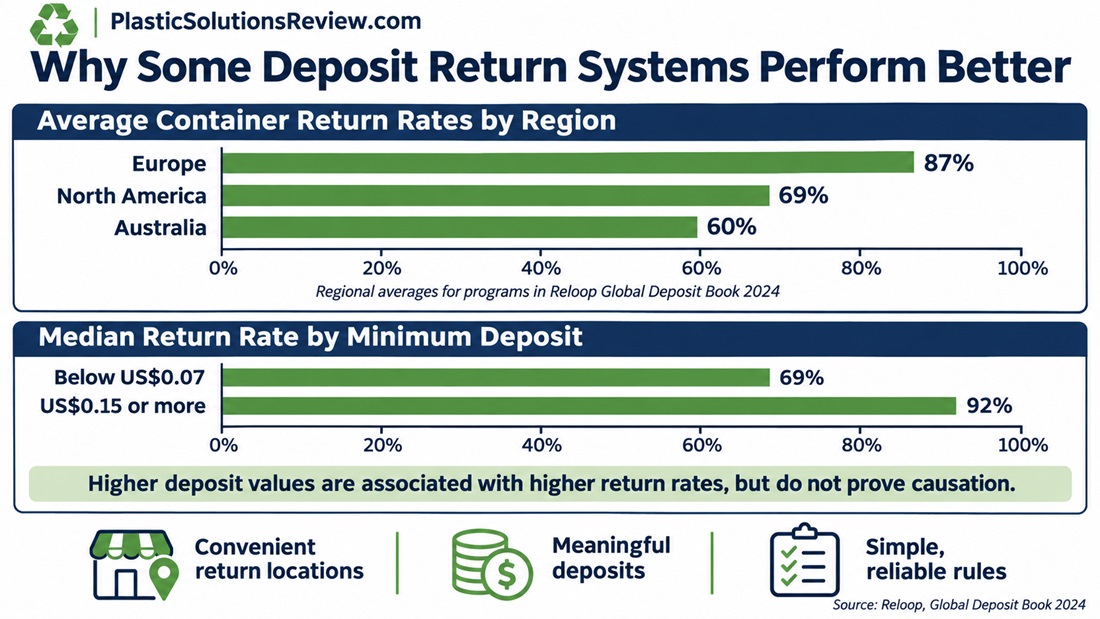
Reloop’s Global Deposit Book 2024 compares deposit return programs around the world.
Its regional findings show substantial differences in average return rates.
| Region | Average container return rate |
| Europe | 87% |
| North America | 69% |
| Australia | 60% |
Source: Reloop Global Deposit Book 2024. These are regional averages for the deposit programs included in the analysis, not recycling rates for all beverage containers sold in each region.
Europe’s higher average reflects the performance of several mature programs, but not every European scheme reaches the same level.
Likewise, some North American programs outperform their regional average.
The figures show why deposit return systems should not be described as automatically achieving 90% collection.
Program design matters.
Why Deposit Amounts Matter
The deposit must be valuable enough for people to consider returning the container worthwhile.
A very small refund may have limited influence, particularly when returning containers requires a special trip.
Reloop’s comparative findings illustrate this relationship.
Jurisdictions with minimum deposits below US$0.07 had a median return rate of 69%.
Those with minimum deposits of at least US$0.15 had a median return rate of 92%.
This suggests that higher deposits are associated with stronger return performance.
However, the relationship is not proof that deposit value alone causes higher returns.
The countries and states being compared also differ in return-point availability, consumer habits, program coverage, and enforcement.
A higher deposit may encourage participation, but people still need a practical way to reclaim it.
Return Rate vs. Recycling Rate
Return rates and recycling rates are often used interchangeably, even though they measure different things.
A deposit return rate generally measures the share of eligible containers returned through a program relative to the number placed on the market, according to the program’s reporting method.
A recycling rate measures how much material is actually recycled under the relevant accounting rules.
Consider a hypothetical program that sells one million eligible containers and receives 900,000 back.
Its container return rate is 90%.
But the returned containers still need to be transported and processed. Some material may be lost, rejected, or otherwise not recycled.
The final recycling result can therefore differ from the return rate.
For this reason, performance reports should explain exactly what their figures measure.
A high return rate is valuable evidence of successful collection, but it is not proof that every returned item has been turned into a new product.
Examples of Deposit Return Systems
Deposit programs operate in many countries, but they are not organized in exactly the same way.
Germany, the United States, and Australia provide useful examples of how different systems approach refundable containers.
Germany: An Established Return-to-Retail System
Germany introduced its mandatory deposit on certain single-use beverage containers in 2003.
The system has since become a familiar part of everyday shopping.
Most covered single-use beverage containers carry a €0.25 deposit.
Consumers can return eligible bottles and cans through participating retailers, often using reverse-vending machines.
A machine typically checks the container, records the deposit value, and issues a voucher that can be redeemed according to the retailer’s procedures.
An important feature is the extensive use of retail locations as return points.
People can bring empty containers back when they shop, reducing the need for separate journeys.
Germany’s system also illustrates the importance of recognizable packaging markings and standardized return arrangements.
The country’s Federal Environment Ministry explains the deposit obligations and the development of its beverage packaging system.
Germany’s experience suggests that refundable deposits work particularly well when returning containers becomes a normal part of shopping.
United States: Different Bottle Bills in Different States
The United States does not have one nationwide beverage container deposit program.
Instead, bottle bills operate in certain states, each with its own rules.
Oregon is one of the longest-running examples.
Its Bottle Bill began in 1971, initially addressing beverage-container litter.
Today, Oregon charges a 10-cent deposit on eligible beverage containers.
Consumers can return them through participating retailers and the BottleDrop network.
According to the Oregon Beverage Recycling Cooperative, more than 2.09 billion containers were returned through Oregon’s system in 2025.
Oregon’s reported redemption rate for 2025 was approximately 87.7%.
The figures reflect a mature program with established return infrastructure, although performance has varied across years.
California uses a different approach through its California Redemption Value (CRV) program.
Most eligible beverage containers carry a 5-cent refund value when smaller than 24 ounces and 10 cents when 24 ounces or larger. Certain beverage packages have different refund amounts.
California also uses certified recycling centers and other authorized redemption arrangements.
These differences show why U.S. bottle bills cannot be assessed as though they were one uniform system.
Deposit amounts, accepted containers, redemption locations, and program administration can vary significantly.
Australia: Queensland’s Containers for Change
Queensland introduced Containers for Change in 2018.
The program offers a 10-cent refund for eligible beverage containers returned through approved collection points.
Most eligible containers fall within the 150-milliliter to 3-liter size range.
Consumers can use depots and other participating refund locations, with return options varying by area.
Queensland’s system also allows people to direct refunds to community groups and charities.
Program operator Container Exchange reported that more than 1.92 billion containers were returned during calendar year 2025.
That is a substantial volume of recovered packaging, but it should not be confused with a percentage return rate.
The figure shows how many containers were returned, not what proportion of all eligible containers sold were recovered.
Queensland also demonstrates the value of different return formats rather than relying on one collection method.
The state’s official Containers for Change program provides information about eligibility, refunds, and return locations.
Comparing the Three Approaches
| Program | Deposit/refund | Return infrastructure | Main lesson |
| Germany | Generally €0.25 for covered single-use containers | Extensive participating retail network | Convenient returns are central to program design |
| Oregon, USA | $0.10 per eligible container | Retailers and BottleDrop redemption services | An established program can maintain substantial container returns |
| Queensland, Australia | A$0.10 per eligible container | Depots and other approved refund points | Multiple return options can support participation |
These programs operate under different laws and cover different beverage products. Their results should not be compared without considering those differences.
What Makes a Deposit Return System Successful?
A deposit creates a reason to return a container. But that incentive only works when consumers can use the program without unnecessary difficulty.
Several design choices influence performance.
Convenient Return Locations
People are more likely to return containers when collection points fit into their normal routines.
A return machine inside a regularly visited supermarket can be easier to use than a distant recycling depot.
Opening hours also matter.
A redemption center that operates only during working hours may be difficult for some consumers to visit.
Reloop’s Global Deposit Book reports stronger median performance for return-to-retail arrangements than for depot-based or hybrid systems in its dataset.
The result suggests that convenient returns are an important part of effective deposit programs.
Deposit Values and Consumer Incentives
Deposit values should be considered alongside local prices, consumer behavior, and travel requirements.
A refund that feels meaningful can encourage consumers to save and return containers.
However, increasing deposits without improving redemption access may leave practical barriers unchanged.
Program designers need to consider both the financial incentive and the effort required to receive it.
Simple Rules and Reliable Refunds
Consumers should be able to tell which containers qualify.
Clear labels, consistent eligibility rules, and dependable refund procedures reduce confusion.
Problems arise when return machines frequently reject eligible containers, rules are difficult to understand, or collection points are unreliable.
A system that promises a refund but makes the process frustrating can discourage participation.
Transparent Program Management
Deposit return systems involve more than consumers and retailers.
Beverage producers, distributors, collection operators, administrators, and regulators may all have responsibilities.
A well-managed program needs clear rules for collecting deposits, funding operations, reimbursing return points, and handling unredeemed money.
Public reporting also matters.
Governments and program operators should publish meaningful performance information, including eligible containers sold, containers returned, and where possible, material recycling outcomes.
That makes it easier to judge whether the system is improving.
Benefits and Limitations of Deposit Return Systems
Deposit return systems offer clear opportunities, but their benefits should be evaluated alongside their limitations.
Potential Benefits
Higher container returns: Refundable deposits can encourage consumers to return eligible beverage packaging instead of discarding it.
Cleaner collection streams: Separately returned containers can be easier to manage than materials mixed with unrelated household waste.
Reduced beverage-container litter: Deposit incentives can discourage improper disposal, although the scale of litter reduction depends on the program and local conditions.
More consistent material supply: Recycling businesses can benefit from a predictable stream of collected beverage containers.
Community fundraising: Some programs let schools, charities, and community groups collect containers or receive donated refunds.
These benefits depend on effective collection and processing arrangements. A deposit alone does not guarantee them.
Costs and Operational Challenges
Deposit programs require infrastructure.
Return machines need installation and maintenance. Retailers may need storage space and staff time. Redemption centers must handle, count, and prepare containers for transport.
The program also needs systems for financial transactions, reporting, fraud prevention, and coordination between participants.
These expenses may be supported through producer contributions, material sales, unredeemed deposits, or other arrangements, depending on the scheme.
The financial burden is not identical across programs.
A system should therefore be evaluated using its full operating costs alongside its collection and recycling outcomes.
What Deposit Programs Cannot Solve
Deposit return systems usually cover only selected beverage containers.
They do not automatically collect food trays, household product bottles, plastic film, or other packaging outside the scheme.
They also cannot replace the facilities needed to process returned materials.
And although a refund encourages returns, it does not mean every resident has convenient access to a return point.
A person without transportation may still face difficulty using a distant redemption center.
These are reasons to treat deposit return programs as part of a wider waste-management system rather than a complete solution to plastic pollution.
How Deposit Return Policies Are Changing
Governments are increasingly examining deposit return systems as one way to improve beverage-container collection.
Changes often involve expanding eligible materials, increasing deposit amounts, or improving return infrastructure.
The European Union’s 2029 Collection Target
The European Union’s Packaging and Packaging Waste Regulation, Regulation (EU) 2025/40, began applying on August 12, 2026.
Under Article 50, EU member states must take measures to ensure at least 90% separate collection, by weight, of specified single-use plastic beverage bottles and metal beverage containers by January 1, 2029.
The rules generally require deposit return systems for those container categories, subject to defined exceptions.
The regulation also establishes minimum requirements for certain deposit programs.
An important distinction is that the 90% requirement is a future separate-collection target. It does not mean all EU countries already collect 90% of covered beverage packaging.
The full requirements are available in the EU Packaging and Packaging Waste Regulation.
Modernizing Existing Bottle Deposit Programs
Existing schemes are also changing.
California expanded its Beverage Container Recycling Program in January 2024 to cover additional beverages and packaging formats, including certain wine and distilled-spirit containers.
Oregon adopted changes in 2025 affecting aspects of redemption access and retailer requirements.
These examples show that deposit programs are not fixed once introduced.
Governments and administrators may adjust coverage, redemption arrangements, and financial responsibilities as technology, consumer behavior, and recycling needs change.
The challenge is to improve performance without making the system unnecessarily complicated for the people using it.
Frequently Asked Questions
What Is a Deposit Return System?
A deposit return system charges a refundable deposit when consumers buy eligible beverage containers. They receive the deposit back by returning the empty containers to an approved collection location.
Do You Get Your Bottle Deposit Back?
Yes, provided the container qualifies and is returned according to the program’s rules. Refunds may be issued as cash, vouchers, account credits, or other accepted payment methods.
Do Deposit Return Systems Increase Recycling?
They can improve the collection of eligible beverage containers and provide cleaner material streams for recycling. However, return rates and recycling rates are different. Successfully recycling the material still requires suitable processing infrastructure.
Which Countries Have Bottle Deposit Systems?
Deposit return systems operate in countries including Germany, Norway, Sweden, Denmark, Lithuania, and several others. Programs also operate in selected U.S. states, Canadian provinces, and Australian jurisdictions.
Are Deposit Return Systems Better Than Curbside Recycling?
They serve different purposes. Deposit programs target specific containers through refundable payments, while curbside recycling can collect a wider range of accepted household materials. Many communities use both systems.
What Happens to Unclaimed Bottle Deposits?
Unclaimed deposits are handled according to local program rules. They may be retained by producers or program operators, transferred to public funds, or used to support program operations and other approved purposes. There is no universal rule.
The Bottom Line
Deposit return systems give consumers a financial reason to return empty beverage containers. When refunds are meaningful, return locations are convenient, and program rules are clear, these schemes can collect large quantities of material for recycling.
Evidence from different countries shows that performance varies with program design. A deposit is only one part of what makes a scheme effective.
Deposit return systems work best as a complement to broader recycling services, not as a replacement for them. Their value lies in recovering eligible containers reliably while supporting the infrastructure needed to recycle those materials.
Leave a Reply