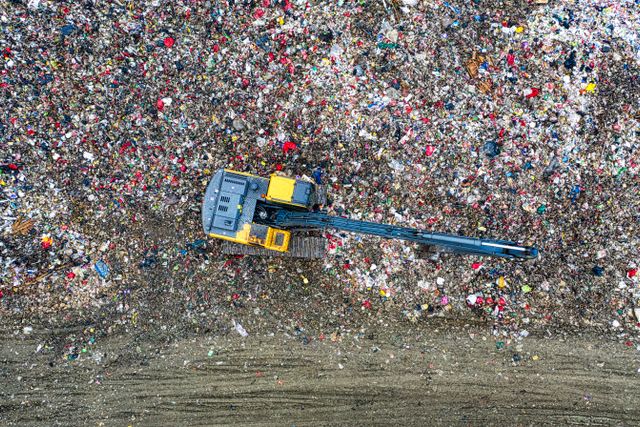
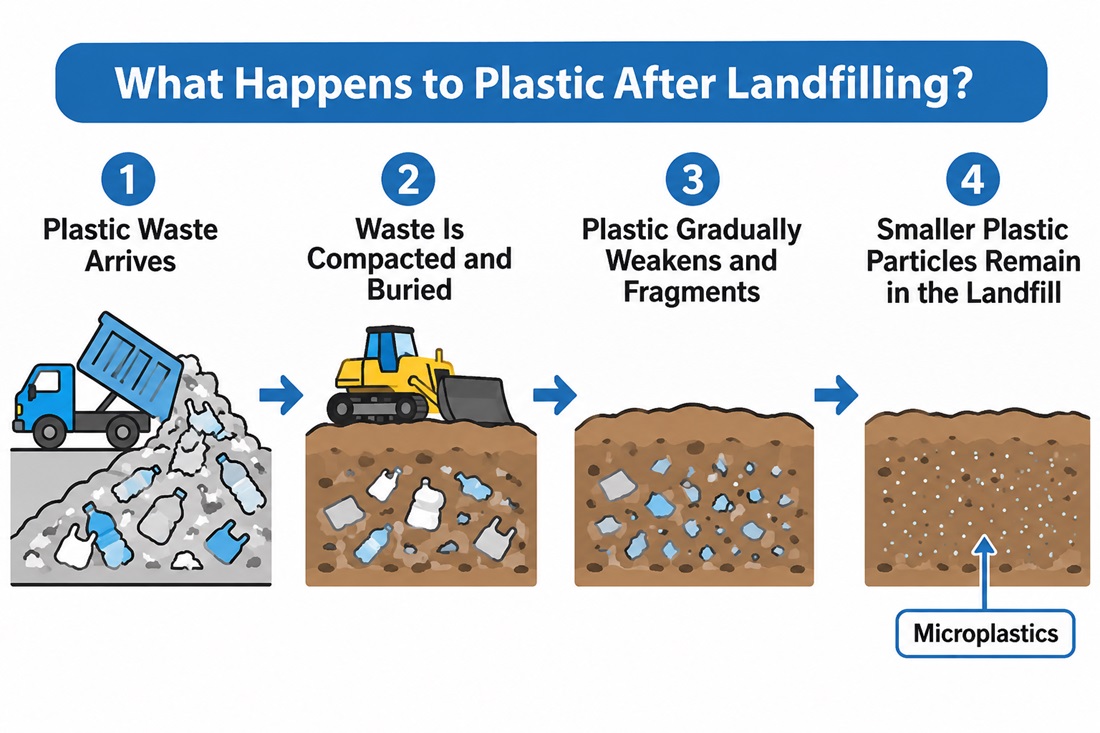
When plastic reaches a landfill, it gets compacted, buried, and covered. Here’s the reality: most plastics don’t biodegrade there. They stick around for decades or longer, and as they weaken, they break into smaller pieces—some so small they’re classified as microplastics. Modern engineered landfills use liners, leachate collection, and gas capture to limit pollution, but this just contains the problem. It doesn’t make plastic disappear. Landfills are a holding tank for leftover waste, not a fix for plastic pollution.
Global snapshot: The OECD estimated that the world generated 353 million tonnes of plastic waste in 2019. Around 49% was disposed of in sanitary landfills, 19% was incinerated, 9% was recycled, and 22% was mismanaged—such as through uncontrolled dumping, open burning, or leakage. These are historical global estimates, not current annual figures. OECD Global Plastics Outlook.
What Is a Plastic Landfill?
A “plastic landfill” isn’t a dedicated plastic dump—it’s just a regular landfill where plastic gets mixed in with everything else. But plastic shows up in huge quantities: in the U.S., plastics made up roughly 18–19% of landfilled municipal solid waste by weight (EPA, 2018).
What ends up there? Packaging, bags, films, food containers, bottles, broken household goods, construction debris, and plastics that can’t be recycled because they’re contaminated or made of mixed materials. Recycling facilities also send plastic to landfills when markets are weak or material is too dirty to process.
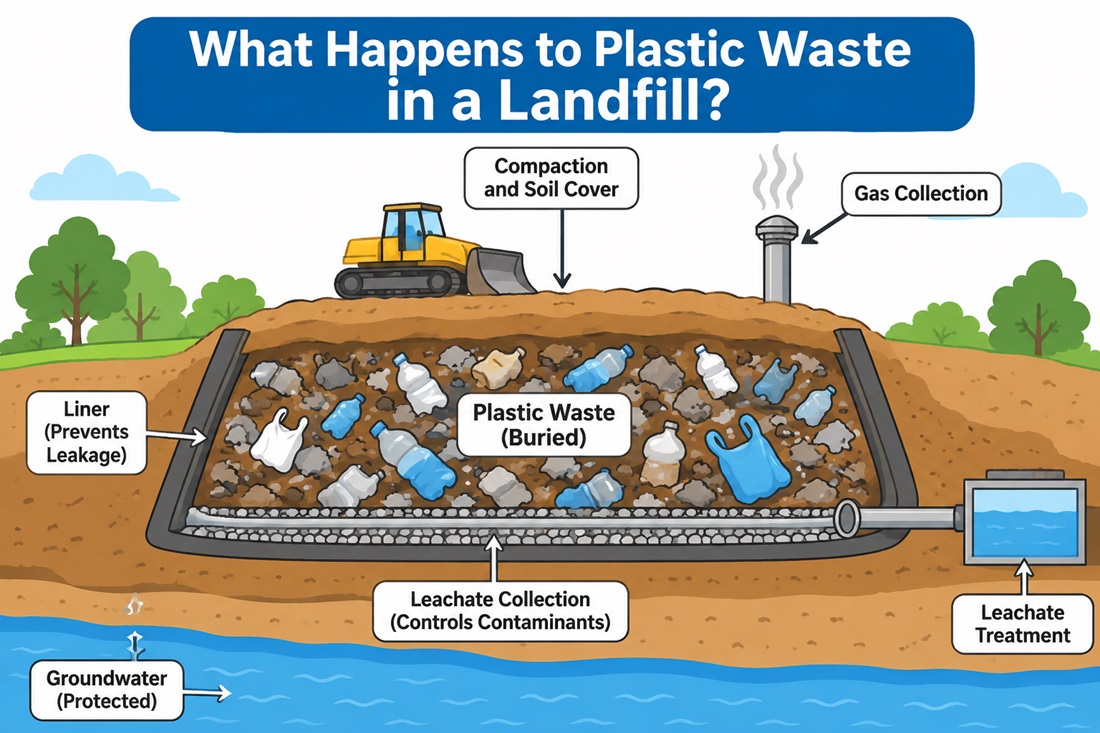
What Happens to Plastic Once It Is Buried?
Underground, plastic faces a very different environment than it does out in the sun. Little light, limited oxygen, variable moisture—these conditions slow down the weathering that normally breaks plastic down. And here’s the thing: most conventional plastics (polyethylene, polypropylene, polystyrene, PET, PVC) are designed to resist water and microbial attack. That’s a feature in products, but a problem in landfills—it means they don’t readily biodegrade.
Degradation vs. fragmentation
Don’t confuse these two. Plastic can weaken, crack, and break into smaller pieces. That’s fragmentation. But fragmentation isn’t the same as decomposition—the polymer chains are still there, just in tinier bits. When fragments drop below 5 mm, we call them microplastics, but the plastic material itself hasn’t gone anywhere.
How long does it take?
This is where things get fuzzy. You’ve probably heard “a plastic bottle takes 450 years to decompose.” That’s a rough estimate of persistence, not a measurement from an actual landfill. The real timeline depends on polymer type, thickness, additives, temperature, moisture, oxygen levels, and how the landfill is designed. Thin films fragment faster; dense bottles like PET and HDPE can last for ages.
Biodegradable and compostable plastics
Don’t assume these break down in a landfill. Many need industrial composting—sustained heat, moisture, and the right microbes—that a regular landfill doesn’t provide. Be especially wary of oxo-degradable plastics: they just fragment into smaller pieces without truly biodegrading. The EU has actually banned them because of this.
Environmental Risks and How Landfills Control Them
A landfill’s track record depends on where it’s built, how it’s engineered, how it’s run, and whether it’s monitored over time. Here’s what can go wrong and what sites do to manage it:
| Risk | What Happens | How It’s Controlled |
| Leachate | Rain percolates through waste and picks up dissolved contaminants—organics, salts, metals, chemicals. | Composite liners (clay or synthetic), drainage layers and pipes, leachate removal and treatment, groundwater monitoring. |
| Chemical leaching | Plastics contain additives like phthalates and bisphenols; landfills also receive PFAS-containing products. These can end up in leachate. | Leachate treatment (though PFAS are tough to remove), liners, monitoring. The real fix is reducing hazardous additives at the design stage. |
| Microplastics | Fragments have been detected in landfill leachate. This means landfills can be a source of microplastics entering the environment. Amounts vary widely by site and treatment performance. | Leachate collection and treatment reduces release, but small particles are hard to capture completely. |
| Methane and CO₂ | Most landfill methane comes from food, paper, and yard waste decomposing without oxygen. Conventional plastics contribute little directly, but they’re buried alongside organic waste that does. | Gas wells, flaring, or capture for electricity and heat. |
| Fires and litter | Plastic is flammable and fuels landfill fires. Light films blow off working faces. | Daily cover, litter fencing, fire prevention and monitoring. |
| Land use and long-term care | Landfills consume land. Closed sites need final cover, gas and leachate management, and monitoring—often for decades. | Closure plans, final cover, post-closure monitoring. |
These controls cut risk significantly, but they don’t eliminate it. Success depends on correct construction, proper operation, regular maintenance, and real regulatory oversight. Think of a landfill’s performance as the combination of design *and* management—the liner alone isn’t the story.
If you’re in the U.S., the EPA has detailed guidance on municipal solid waste landfills. Elsewhere, check your national or local authority—standards vary.
Landfills Around the World
The word “landfill” is deceiving. It covers very different operations, and the differences matter enormously for the environment.
Engineered sanitary landfill: Lined, with leachate and gas management, daily cover, and monitoring. This is the standard in wealthy countries.
Controlled dump: Some covering and access control, but limited or no lining or gas management.
Open dump: Uncontrolled. Waste is exposed, burned, or washed straight into soil and waterways. Open dumping and burning drive much of the roughly one-fifth of plastic waste globally classified as mismanaged.
In many lower-income and rapidly urbanizing regions, waste collection doesn’t cover everything, informal waste pickers recover much of the recyclable plastic, and engineered landfill capacity hasn’t kept up with waste growth. Upgrading open dumps to controlled or engineered landfills—and extending collection coverage—often has more impact than any other waste management step.
Can Buried Plastic Be Recovered?
Some landfills have been dug up through “” to recover metals, soil fractions, land, and sometimes plastic—usually when a site is being redeveloped or space is in short supply.
Recovering plastic is rough. It’s contaminated with soil and organic waste, mixed across different polymer types, often in unknown condition, and already degraded. It’s rarely suitable for recycling and requires expensive cleaning and sorting. makes sense in specific situations, but it’s not a reason to skip sorting and recycling before disposal.
Landfills vs. Other Options
Each waste management method has trade-offs. The right mix depends on local infrastructure, contamination levels, and regulation.
| Method | Key Trade-Off | How It Works |
| Landfill | Needs land and decades of monitoring; removes plastic from the material cycle. | Containment and long-term care. |
| Incineration | Large volume reduction, but combustion emissions and ash need control. | Burns waste; recovers energy or disposes of ash. |
| Waste-to-energy | Recovers energy, not material. | Burns waste to generate electricity or heat. |
| Mechanical recycling | Best outcome where feasible, but limited by contamination and mixed polymers. | Sorts, cleans, and reprocesses plastic into new products. |
| Plastic-to-fuel | Produces energy products, not new plastic. | Converts plastic into fuels. |
Policy: What Is Changing
Landfill methane rules are tightening
In the U.S., the EPA’s emission guidelines for existing municipal solid waste landfills (40 CFR Part 60, Subpart Cf) are being rolled out through state plans and a federal plan. Colorado adopted Regulation 31 in December 2025; Canada registered its Landfill Methane Regulations (SOR/2025-279) in December 2025. These mainly target gas from organic waste, but they’re raising the overall standard of landfill management.
Diversion targets and taxes
The EU Landfill Directive requires member states to landfill no more than 10% of municipal waste by 2035. Landfill taxes (like the UK’s) make disposal pricier than recovery. Extended producer responsibility (EPR) schemes make producers pay for collection and recycling, pushing manufacturers toward reusable and recyclable designs.
Negotiations hit a wall in Geneva in August 2025, but they’re not dead. A new chair took over in February 2026, an Aid to Negotiations document was released in August 2026, and more rounds are planned for late 2026 or early 2027. Campaigners say the latest text has weakened on key measures. Since the treaty debate centers on production, design, and waste management, its outcome will shape how much countries have to rely on landfills.
What Can You Do?
- Reduce single-use and unnecessary plastic first. It’s the only way to prevent waste entirely.
- Sort correctly using your local recycling rules. Contaminated recyclables often end up in landfill anyway.
- Choose reusable and recyclable products. Be skeptical of vague “biodegradable” claims.
- Dispose properly: never burn or dump plastic. Use official collection where available.
- Support policies that expand collection, EPR, and landfill diversion in your area.
Frequently Asked Questions
Does plastic ever completely decompose in a landfill?
Most conventional plastics don’t readily biodegrade under landfill conditions. They weaken and fragment, but fragmentation isn’t decomposition.
Do landfills prevent plastic pollution?
Engineered landfills reduce pollution risk, but the result depends on design, operation, and monitoring. Poorly managed sites and open dumps let plastic escape.
Can plastic be recycled after being buried?
Sometimes, through . But contamination, mixed polymers, and degradation make it difficult and costly. Recycling before disposal is far more practical.
Do plastic landfills produce methane?
Mostly from organic waste like food and paper. Conventional plastics generate little methane on their own, though they’re buried alongside material that does.
Are biodegradable plastics better in landfills?
Not necessarily. Many need industrial composting conditions and won’t break down in a regular landfill. Oxo-degradable plastics only fragment.
Conclusion
Landfills hold plastic that can’t be reused or recycled right now, and engineered ones manage the main hazards well. But the plastic stays put, some of it fragments, and the land needs monitoring for decades. The real priority: reduce unnecessary plastic, improve collection and sorting, recover material where practical, and manage what’s left safely.
Leave a Reply