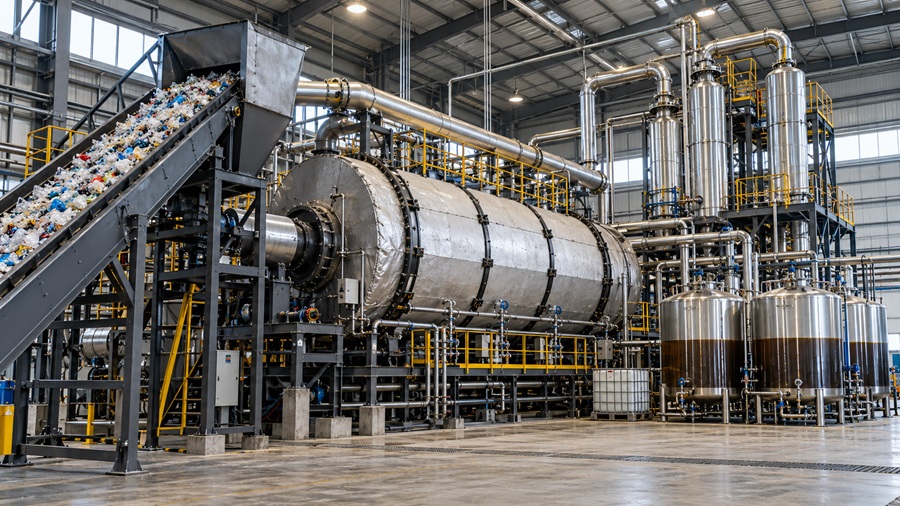
Plastic pyrolysis heats plastic waste in a sealed, oxygen-free reactor until the long polymer chains snap into smaller molecules. What comes out is oil, gas and a solid residue. With cleaning and upgrading, some of that oil can feed a petrochemical plant and end up in new plastic.
The catch is in that last sentence. Making oil from plastic is not the same as recycling plastic into plastic, and the gap between the two is where most pyrolysis plants either succeed or struggle. This guide covers how the process works, which plastics suit it, what the oil is actually good for, and what the 2025-26 plant news tells us. For the wider technology landscape, see our advanced recycling guide; for emissions, mass balance and economics, see chemical recycling.
Key takeaways
- It works best on PE, PP and PS. PVC and PET cause serious problems.
- The oil needs more work. Raw pyrolysis oil usually has to be cleaned and upgraded before a petrochemical plant will take it.
- Lab yields are not plant yields. Published oil yields swing from roughly 66% to over 97% by mass in clean lab tests, and real waste does worse.
- Keeping a plant running is the hard part. Several plants have stalled or closed in the past two years, while a few smaller ones have operated for nearly a decade.
How plastic pyrolysis works
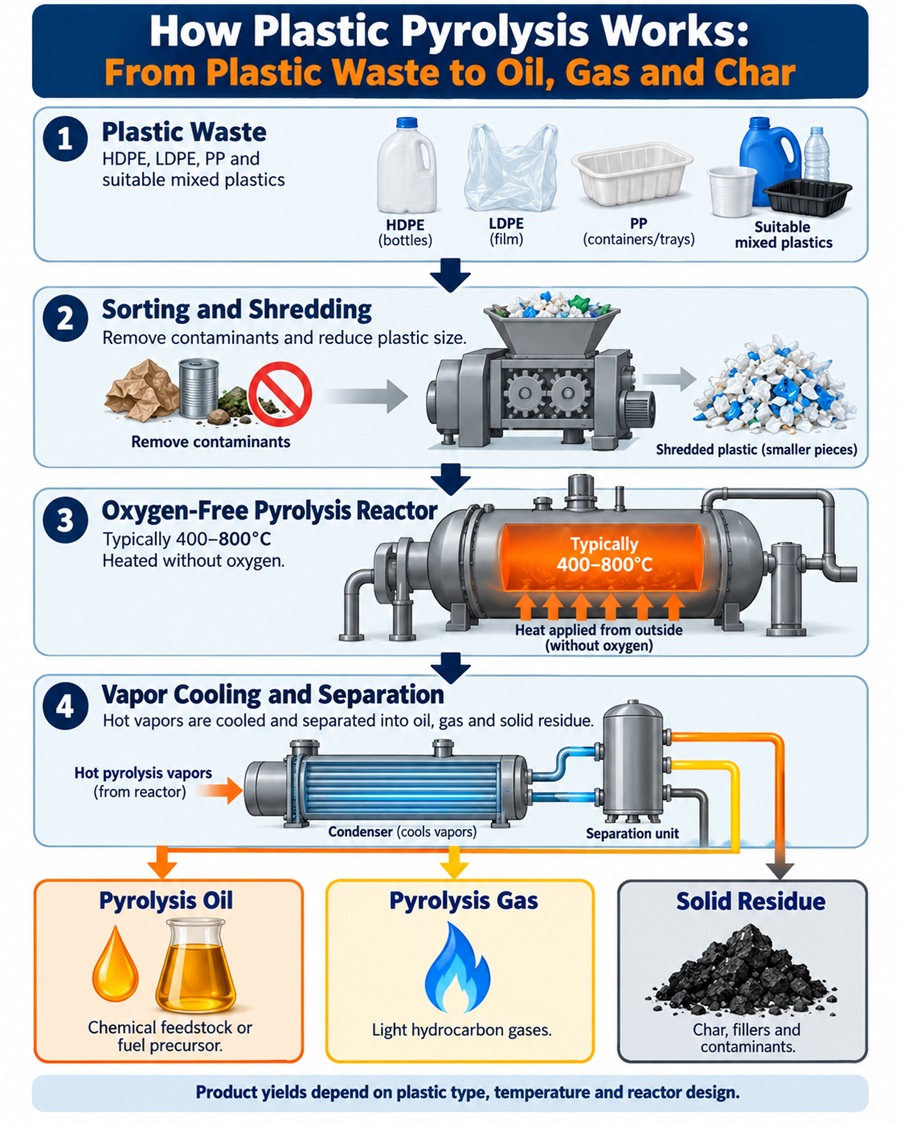
Most plants follow the same five steps, though the equipment varies.
- Prepare the feedstock. Plastic is sorted, shredded, and often washed and dried. Metals, glass, food waste and especially PVC have to come out. Sorting doesn’t go away just because the process is called advanced.
- Heat it without oxygen. The reactor typically runs between 400 and 800°C, per the US EPA. Plants aiming for oil often stay at the lower end, around 400-550°C. No oxygen means the plastic doesn’t burn inside the reactor, though the heat itself usually comes from burning something outside it, often the process’s own gas.
- Crack the polymer chains. Heat breaks the chains into smaller hydrocarbons. This is called thermal cracking. Temperature, heating rate, how long vapors stay in the hot zone, catalysts and the plastic itself all shift what you get. Hotter and longer generally means more gas and lighter products.
- Cool and separate. Vapors leave the reactor and cool. The part that condenses becomes pyrolysis oil, and what stays gaseous is collected separately. Solid residue is removed from the reactor.
- Clean up the oil. Filtration, distillation and chemical treatment remove contaminants such as chlorine so the oil can meet a buyer’s specification.
What comes out
Oil is a mixture of hydrocarbons of different weights, not one clean chemical. Its quality tracks the quality of what went in, and heavily contaminated mixed packaging gives a very different oil than clean polyethylene. One more practical wrinkle: a 2024 catalytic pyrolysis study found that HDPE and LDPE processed without a catalyst gave waxy oil with a melting point around 38°C, and that oil instability from wax formation is a barrier to marketing the product.
Gas contains light hydrocarbons and hydrogen. Plants often burn it to heat the reactor, which cuts external fuel use but still produces combustion emissions that need controls.
Solid residue (char) can hold carbon, mineral fillers, pigments, metals and other contaminants. Some may find an industrial use after testing, and some has to be disposed of as waste. Don’t assume it’s a revenue stream.
Before oil reaches a steam cracker or refinery, it generally has to be cleaned of chlorine and other contaminants that damage equipment, and it is usually blended with fossil feedstock. That upgrading step costs energy and loses some material, which is why oil output and finished plastic output are different numbers.
Which plastics work
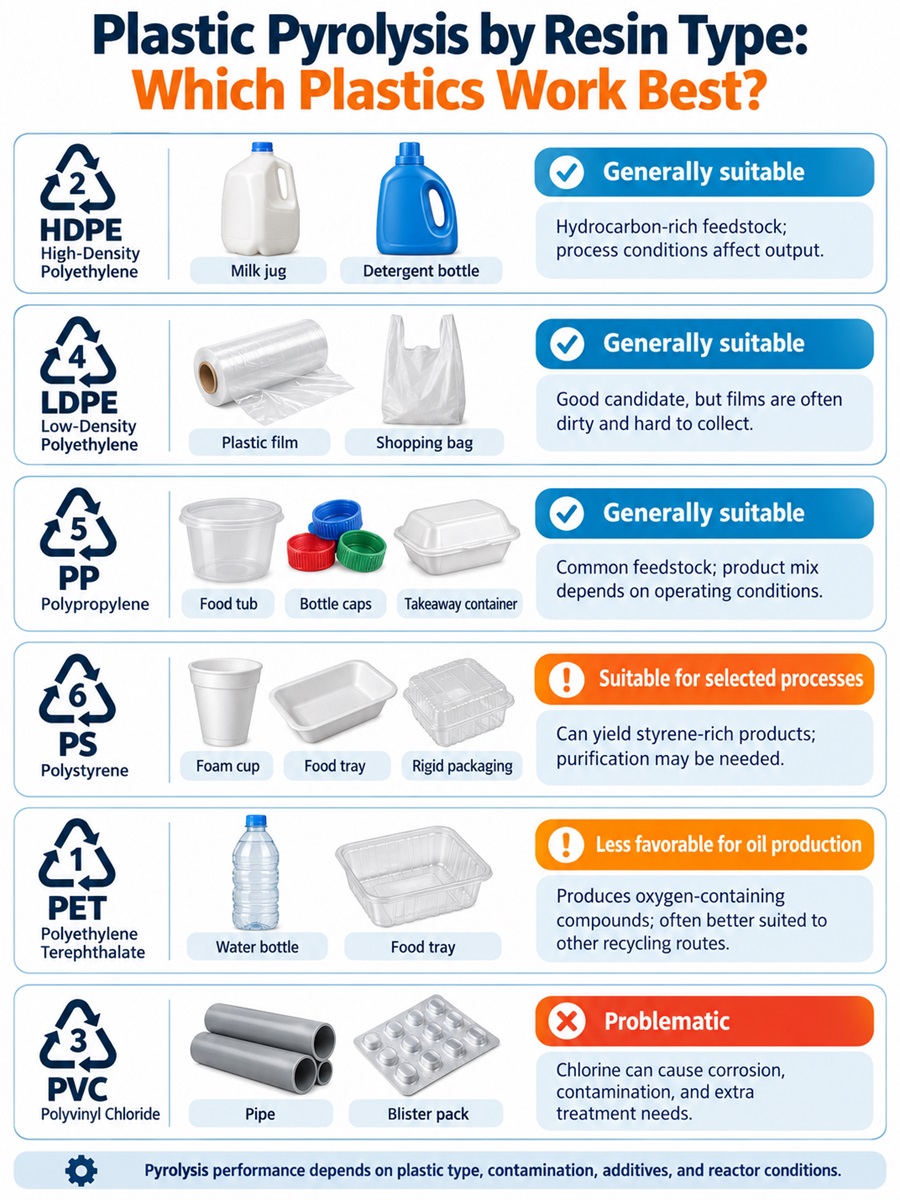
Plastics made only of carbon and hydrogen crack into hydrocarbons easily. Plastics containing chlorine or oxygen don’t.
| Plastic | Suitability | Main catch |
| HDPE, LDPE | Good | Waxy oil without a catalyst; films are dirty and hard to collect |
| PP | Good | Oil composition varies with grade and additives |
| PS | Good in selected processes | Produces styrene-rich products that need purification |
| PET | Poor | Oxygen in the polymer creates compounds that complicate the oil. Depolymerization suits it better. |
| PVC | Problematic | Releases hydrogen chloride, which corrodes equipment and contaminates oil. Plants screen it out. |
| Mixed packaging | Depends on the mix | Inconsistent output and lower yields |
PET can technically be pyrolysed. It’s just usually the wrong tool, since PET has better routes through mechanical recycling and depolymerization, as covered in our advanced recycling guide.
Reactor and technology choices
There’s no single pyrolysis design. These are the choices that matter most:
| Design choice | What it does | Trade-off |
| Thermal (no catalyst) | Relies on heat alone | Simpler, but a broader mix of products, including waxes |
| Catalytic | Steers which molecules form | Can improve oil quality, but catalysts foul and need replacing. In the study above, catalysts also lowered liquid yield and raised gas yield for PS, PP and LDPE. |
| Batch reactor | Processes one load at a time | Simple and common in small systems; interrupts production |
| Continuous (screw, fluidized-bed) | Feeds and discharges while running | Better for industrial scale, but feeding, heat transfer and residue removal are hard |
| Microwave-assisted | Heats via microwaves | Mostly experimental; many plastics absorb microwaves poorly |
How much oil you actually get
Oil yield is reported as a percentage of the feedstock’s mass. A 60% yield means 100 kg of plastic gives 60 kg of oil. It does not mean 60 litres, because volume depends on density. That is also why the popular claim that 1 kg of plastic gives 1 litre of oil doesn’t hold up.
Lab results run high and vary widely. The 2024 study above reported 97.6% for PS, 77.7% for LDPE, 75.0% for PP and 65.8% for HDPE. Other experiments rank the plastics differently, because temperature, catalysts, reactor and feedstock cleanliness all change the result.
Commercial plants run on dirtier, more variable waste. Some of the input becomes gas, wax or residue, some is rejected during preparation, and more is lost during upgrading. So treat any lab figure as an upper bound, and ask a plant for three separate numbers: waste in, oil out, and plastic made from that oil. Our chemical recycling guide explains why those numbers rarely match.
Where pyrolysis makes sense, and where it doesn’t
It makes sense when:
- the waste is polyolefin film or flexible packaging that mechanical recyclers reject
- the realistic alternative is incineration or landfill, not mechanical recycling
- the oil goes to a cracker as feedstock for new plastic, not to fuel
It makes little sense when:
- the plastic is clean PET or HDPE that mechanical plants can already recycle
- the feedstock carries a lot of PVC
- the output is burned as fuel. EU waste law doesn’t count that as recycling, as we explain in our chemical recycling guide.
The same guide also covers lifecycle comparisons with incineration, which depend heavily on energy source and what the oil replaces.
Why plants struggle
A reactor that works in a short test can still fail over a full year. The usual culprits:
- Melting and cracking leave waxy deposits and carbon build-up that block lines and hurt heat transfer.
- Chlorine, additives and moisture damage equipment and degrade the oil.
- Oil that doesn’t meet spec. Upgrading adds cost, energy use and losses.
- Thin economics. A plant needs reliable feedstock contracts and a buyer who will pay for the oil. Producing oil isn’t the same as being commercially competitive.
Real plants in 2026
| Plant | Location | Output and use | Where it stands |
| Plastic Energy (Almería, Seville) | Spain | Oil (TACOIL) for new packaging | Operating since 2016 and 2017 |
| TEPEAR | Grandpuits, France | Oil via Plastic Energy’s TAC technology | Operational since March 2026; 15,000 t/yr |
| Brightmark Ashley | Indiana, USA | Fuel and wax | Chapter 11 in 2025; ran at about 5% of capacity |
| Freepoint | Ohio, USA | Pyrolysis oil | Stopped operating |
Plastic Energy. Its Spanish plants are the long-running example of plastic-to-plastic pyrolysis. The company says its TACOIL has been used in products including Magnum ice cream tubs. An older source puts each plant at about 5,000 tonnes a year, so verify that against a current company figure. The company’s UK entities entered administration in May 2026 after cash-flow trouble, and the Spanish plants were not affected. It emerged in August under returning founder Carlos Monreal, and the company handed its stake in TEPEAR to TotalEnergies, which now owns and runs the plant under a technology licence.
Brightmark’s Ashley plant. It was designed for about 100,000 tonnes a year of mixed plastic, turned into fuels and wax. In March 2025 its subsidiaries filed for Chapter 11 and reported operating at about 5% capacity, against roughly $178 million of debt. It’s a plastic-to-fuel plant, so it shows how pyrolysis fails commercially, not what recycling looks like.
Freepoint and Braven. A July 2026 New York Times report, syndicated here, said both US plants suspended operations. Freepoint had violations for unreported equipment malfunctions and illegal emissions, and it didn’t produce enough oil to meet Ohio’s definition of recycling.
Pryme. The Dutch company closed its only operating pyrolysis plant after persistent technical problems and financial pressure.
One pattern is worth noticing. The plants that have run longest are small, a few thousand tonnes a year. The giants have struggled. That doesn’t prove scale is the cause, but it’s a reason to treat design capacity as a promise and not a result.
Permits, definitions and the “is it recycling?” test
Pyrolysis plants need permits for air emissions, waste handling and chemical safety, and the rules differ by country and, in the US, by state. The Ohio case matters because it shows regulators can set a minimum on how much oil a plant must produce before it counts as recycling at all. Whether a plant’s oil counts toward recycled-content targets also depends on whether it becomes plastic or fuel. The EU’s recycled-content rules are still being worked out on how to count pyrolysis-derived feedstock, so watch for the implementing rules.
What to watch next
- TEPEAR’s output under TotalEnergies. It’s the clearest test of whether newer pyrolysis plants can run reliably.
- Plastic Energy after restructuring. Whether the Spanish plants keep running steadily and whether new partnerships follow.
- EU rules on counting pyrolysis feedstock. They decide how much of this oil can count toward recycled-content targets.
- Cost parity. The July 2026 European Commission JRC report on chemical recycling economics is summarised in our chemical recycling guide.
Frequently asked questions
What temperature does plastic pyrolysis need?
Typically 400-800°C, with many oil-focused systems at 400-550°C. The right number depends on the plastic, the reactor and whether a catalyst is used.
How much oil comes from 1 kg of plastic?
There’s no fixed answer. Clean lab tests report 66-97% of the feedstock’s mass as oil, depending on the plastic and conditions, and contaminated mixed waste gives less. Oil volume also differs from oil mass.
Is pyrolysis the same as burning plastic?
No. Pyrolysis heats plastic without oxygen, while burning uses oxygen. But the products can be burned afterwards as process heat or as fuel.
Is pyrolysis considered recycling?
Only when the products become new materials. When the oil is burned as fuel, it is energy recovery, not recycling.
Can PVC go through pyrolysis?
It can decompose, but the chlorine it releases corrodes equipment and contaminates the oil. Most plants try to remove PVC first or add special chlorine treatment.
Is pyrolysis profitable?
Sometimes, narrowly. It depends on feedstock cost, plant uptime, oil quality and whether someone will pay for the oil. Plenty of plants have lost money or closed, as the case studies above show.
The bottom line
Pyrolysis can turn some polyolefin and polystyrene waste, the stuff mechanical recycling rejects, into oil that may become new plastic. A few plants have done that for years. But the process is energy-hungry, sensitive to contamination, and has a poor record of scaling up reliably.
So judge a project by what it has actually run, what the oil became, and whether it holds up over years rather than weeks. For the foundations, see mechanical recycling, which should still take first pick of anything clean and sortable.
Leave a Reply