
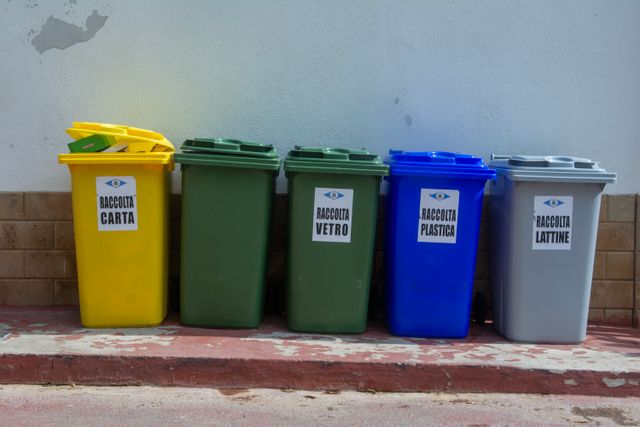
Single-stream recycling makes recycling easier for households. Paper, plastic bottles, metal cans, and other accepted materials go into one bin. Multi-stream recycling takes a different approach. Residents separate materials before collection, which can help keep them cleaner but requires more effort.
Both systems aim to recover valuable materials and keep waste out of landfills. The difference lies in where sorting begins and who takes responsibility for it.
That choice affects collection costs, contamination, material quality, and how much recyclable material can eventually be recovered.
So, which system works better? The answer depends on more than how much material a recycling truck collects.
Quick Answer: Single-Stream vs. Multi-Stream Recycling
Single-stream recycling allows households to place all accepted recyclables into one container, making collection simpler and often improving convenience. Multi-stream recycling keeps materials separated, which can reduce cross-contamination and improve material quality. Single-stream systems may lower collection costs but require more sorting afterward. Multi-stream systems can produce cleaner materials but may involve more complex collection. The better option depends on local infrastructure, participation, processing costs, and recycling markets.
What Is Single-Stream Recycling?
Single-stream recycling, also called commingled recycling, allows residents to place different accepted recyclable materials into one container.
A typical single-stream recycling bin may contain cardboard, paper, plastic bottles, metal cans, and glass containers, depending on local rules.
Residents do not need to separate these materials into different categories. Instead, a collection truck gathers the mixed recyclables and transports them to a sorting facility.
The facility then separates the material into streams suitable for recycling.
This arrangement shifts much of the sorting responsibility away from households and onto the recycling system.
Why Single-Stream Recycling Became Popular
Convenience is the main attraction.
When people have one recycling bin instead of several, they have fewer decisions to make. This can make recycling easier to fit into everyday routines.
Single-stream collection can also simplify operations for municipalities and waste haulers.
A truck can collect one mixed recycling stream instead of managing several separate compartments or collection schedules.
That can reduce some collection expenses, particularly where automated carts and large collection routes are already in place.
These advantages helped single-stream recycling expand across many U.S. communities.
However, collecting more recyclable material does not necessarily mean recovering more usable material.
The mixed contents still need to be separated, and some may be lost during processing.
What Is Multi-Stream Recycling?
Multi-stream recycling requires recyclable materials to be separated into different categories before or during collection.
Instead of putting everything into one bin, households may use separate containers for paper, cardboard, glass, plastic, or metal.
The number of categories depends on the local program.
Some systems require several containers. Others use just two streams, making them less complicated for residents.
Dual-Stream Recycling: A Common Middle Ground
Dual-stream recycling separates materials into two main groups.
One container usually holds paper and cardboard. The other holds accepted containers, such as plastic bottles, metal cans, and sometimes glass.
This approach keeps paper away from materials that can introduce moisture, broken glass, or food residue.
At the same time, residents do not have to separate every material individually.
Dual-stream collection therefore offers a middle ground between fully mixed recycling and more detailed source separation.
Fully Separated Collection
Some programs go further by collecting specific materials individually.
For example, a community might have separate containers for glass, paper, plastics, and metals.
This can preserve material quality because fewer incompatible items are mixed together.
The trade-off is additional collection complexity.
Households need enough space for separate containers, and collection operators must manage different material streams.
Fully separated systems can work well where residents have clear instructions, convenient collection points, and access to reliable services.
But separation alone is not enough. Materials still need appropriate processing and buyers.
Single-Stream vs. Multi-Stream Recycling: Key Differences
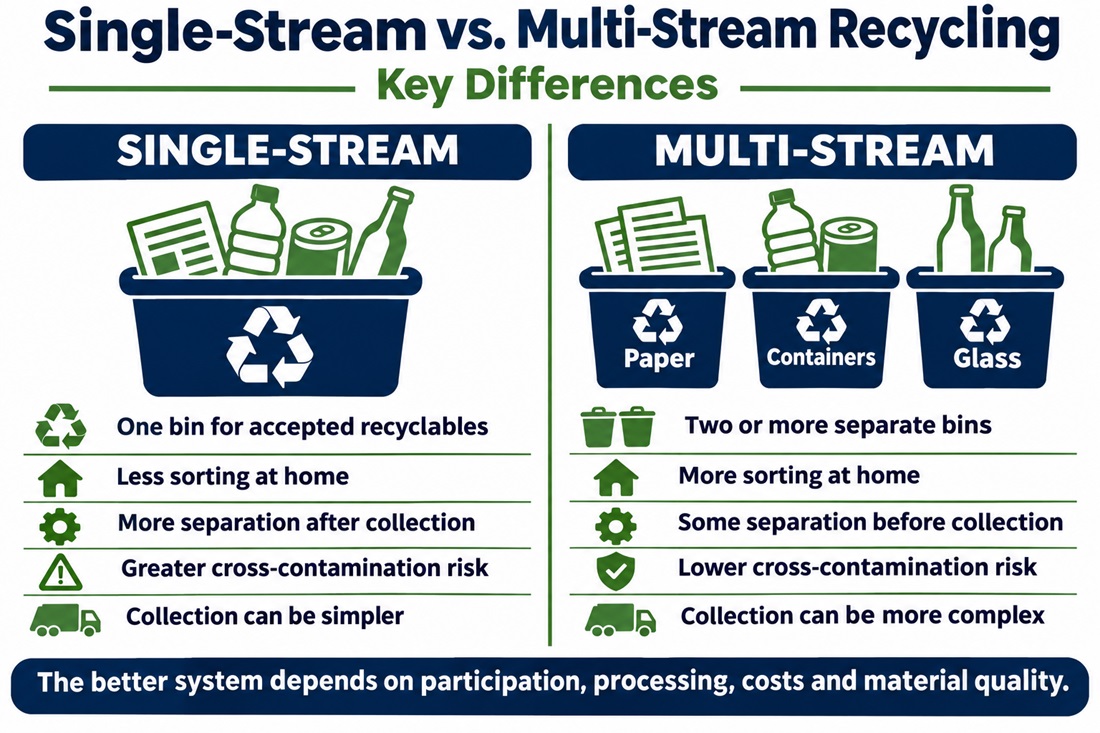
The main difference is simple: single-stream recycling mixes accepted recyclables before collection, while multi-stream recycling keeps some or all materials separate.
That decision affects the entire recycling process.
| Feature | Single-Stream Recycling | Multi-Stream Recycling |
| Household sorting | All accepted recyclables in one container | Materials separated into two or more categories |
| Convenience | Generally easier for households | Requires more sorting |
| Collection process | One mixed recyclable stream | Two or more separate streams |
| Collection costs | Can be lower with efficient routes and equipment | May require more collection resources |
| Contamination risk | Greater potential for cross-contamination | Usually lower when separation works well |
| Material quality | Depends heavily on downstream sorting | Often cleaner at collection |
| Processing requirements | More separation needed after collection | Some separation completed beforehand |
| Space requirements | Usually one recycling container | May require several containers |
| Main limitation | Mixing can reduce recoverable material quality | Additional effort and collection complexity |
Neither system should be judged on one factor alone.
A municipality might prefer single-stream recycling because it simplifies collection. A paper recycler might prefer materials collected separately because they are cleaner.
Those priorities can lead to different conclusions about which system performs best.
Why Single-Stream Recycling Can Increase Participation
The strongest argument for single-stream recycling is that it reduces the effort required from households.
People do not have to remember which container holds paper or whether a metal can belongs in a separate bin.
They only need to know which items their recycling program accepts.
This can make recycling more convenient, particularly in households with limited storage space or busy routines.
Convenience can also help municipalities introduce recycling services to more households.
But the relationship between convenience and actual recycling performance is more complicated.
What Research Shows About Participation
A 2018 study published in Resources, Conservation and Recycling examined changes after a community converted from dual-stream to single-stream collection.
Researchers found that the amount of recyclable material set out for collection increased by 25.8%.
However, some of that increase came from incorrectly sorted materials.
The study also found improvements in certain measures of recycling efficiency, showing that a system change can produce both benefits and drawbacks.
The important lesson is that more material collected does not automatically mean the same increase in usable recyclables.
Programs need to measure what happens after collection, not just the weight placed at the curb.
Convenience Does Not Eliminate Confusion
A single recycling bin is easier to use, but it can also create uncertainty about what belongs inside.
Some residents assume that anything made from plastic, paper, metal, or glass is acceptable.
That is not how most recycling programs work.
A facility might accept rigid plastic bottles while excluding plastic bags, foam packaging, or certain food containers.
If residents misunderstand those rules, the recycling bin can fill with unwanted materials.
Simpler collection therefore needs clear communication.
A one-bin system still requires residents to understand what the program can actually process.
How Collection Design Affects Contamination
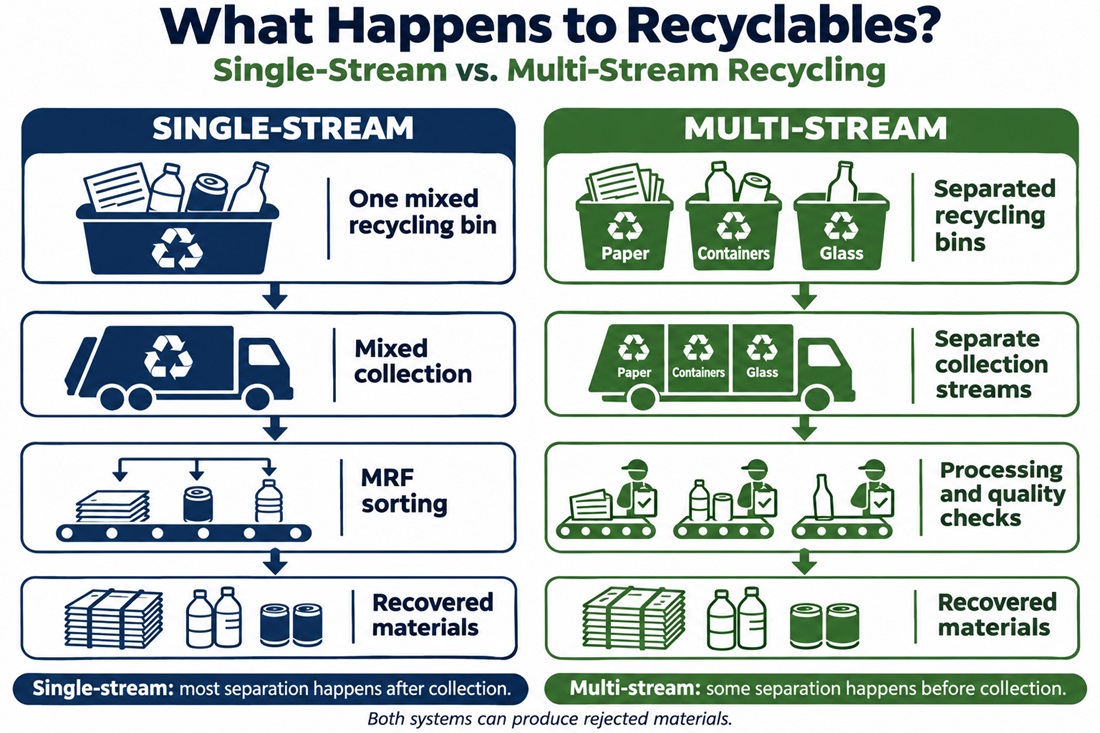
Contamination is one of the biggest differences between single-stream and multi-stream recycling.
When different materials share a container, they can affect one another before reaching a recycling facility.
A leaking beverage container can wet paper. Broken glass can mix with cardboard. Food residue can spread onto packaging that would otherwise be suitable for recycling.
These problems may occur during household storage, collection, transportation, or unloading.
Why Mixed Recycling Can Become Contaminated
Consider a recycling bin containing clean cardboard, plastic bottles, aluminum cans, and glass jars.
If a jar breaks during collection, glass fragments can become mixed with the other materials.
If a container contains leftover liquid, nearby paper may absorb moisture.
The plastic bottles and cans may still be recoverable, but the mixed material stream becomes more difficult to separate.
Not all contamination results from residents putting the wrong materials in a bin.
Some quality problems arise because accepted materials are collected together.
This distinction matters when evaluating recycling programs.
How Multi-Stream Collection Reduces Mixing
Separating materials before collection can prevent certain types of cross-contamination.
Keeping paper apart from glass and containers reduces the opportunity for broken glass or liquids to affect paper quality.
Separately collected glass may also be easier to manage as a distinct material stream.
However, multi-stream recycling is not automatically contamination-free.
Residents can still place incorrect items in containers. Outdoor bins may collect rainwater or debris. Poor collection practices can mix materials that were originally separated.
The benefit depends on how well the program operates.
For a closer look at how contamination is measured after collection, see our guide to MRF contamination rates.
Single-Stream vs. Multi-Stream Recycling Costs
Single-stream recycling is often promoted as a less expensive collection method.
There is some logic behind that claim.
Collecting one mixed stream can simplify routes, reduce the need for separate vehicle compartments, and make automated collection easier.
But collection is only one part of the cost.
Recyclables must still be sorted, prepared, and sold. Unusable material also has to be managed.
A program that saves money during collection may spend more during processing.
Collection Costs vs. Processing Costs
Single-stream systems can reduce some collection expenses because households use one recycling container and trucks can gather materials without keeping every category separate.
Multi-stream collection may require additional containers, vehicle compartments, handling, or collection trips.
Yet separate collection can reduce work later in the process.
If paper arrives separately from containers, a processing facility may need fewer steps to recover a clean paper stream.
The overall financial result depends on whether collection savings outweigh sorting expenses and material losses.
A 2015 study in Resources examined data from 223 municipalities in Ontario, Canada, over a ten-year period.
The researchers found that collection costs differed by only about 3% between single-stream and multi-stream systems in the municipalities studied.
Processing costs showed more substantial differences, and single-stream programs generally received lower revenues from recovered material.
These findings challenge the assumption that simpler collection always produces a cheaper recycling system.
They do not mean every multi-stream system is cheaper. Costs depend on local wages, route design, equipment, collection volumes, and processing arrangements.
The Hidden Cost of Material Quality
Recovered recyclables have economic value only when someone can use them.
Manufacturers need materials that meet their specifications.
Paper mixed with glass fragments, for example, may require extra cleaning or sorting before it can be sold.
Contaminated materials may receive lower prices, require additional processing, or be rejected.
That affects the economics of recycling beyond the collection truck.
For municipalities, a useful cost comparison should include collection, transportation, sorting, rejected materials, and revenue from recovered commodities.
Looking only at the price of collecting one ton of recyclables can hide important downstream expenses.
Our article on MRF economics and profitability examines the financial pressures faced by sorting facilities.
Which System Recovers More Recyclable Material?
This is where the comparison becomes especially important.
A recycling program can collect a large volume of material without recovering all of it.
Some items may be incorrectly placed in recycling bins. Others may become too damaged or contaminated to process economically.
The meaningful question is how much material is ultimately recovered for recycling compared with how much recyclable material is generated.
Collection Rate Is Not the Same as Recycling Rate
Imagine two communities.
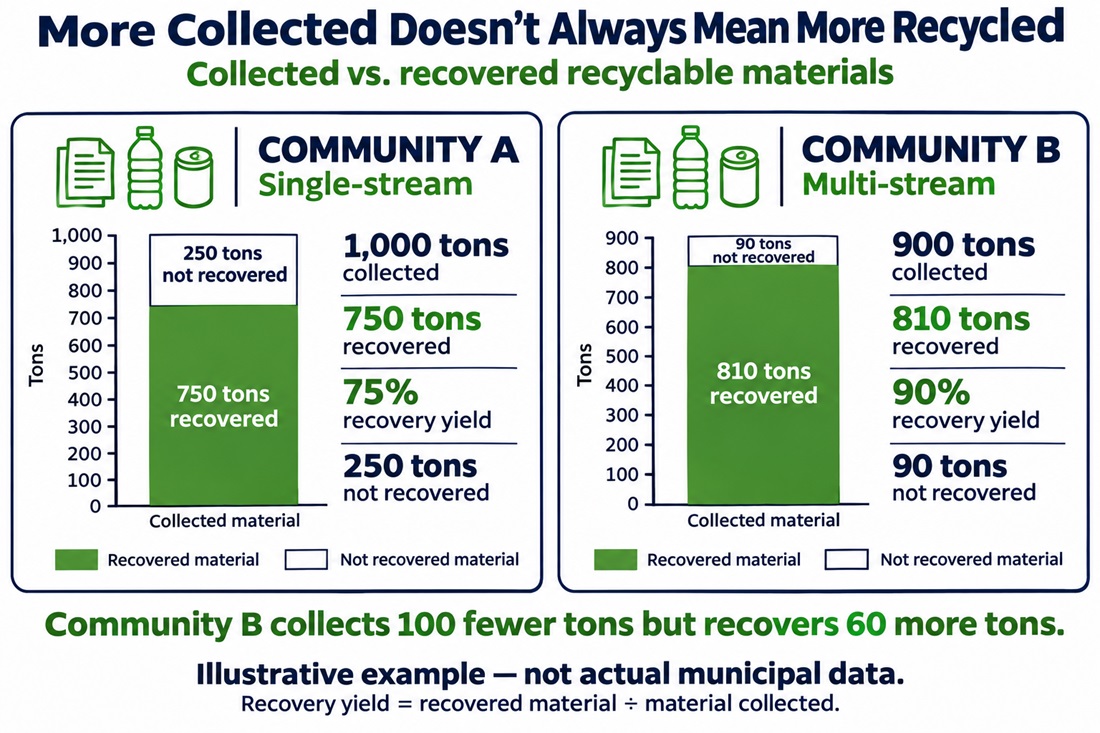
Community A collects 1,000 tons of mixed recyclables. Community B collects 900 tons of materials that residents have separated.
At first glance, Community A appears more successful.
But suppose Community A recovers 750 tons of usable material after sorting, while Community B recovers 810 tons.
Despite collecting less material, Community B has recovered more.
These figures are hypothetical, but they illustrate why collection weight alone is not a reliable measure of recycling success.
A proper comparison needs to consider the amount collected, the amount rejected, the quality of recovered materials, and the amount actually recycled.
What Independent Research Suggests
A 2024 study published by the European Commission’s Joint Research Centre examined environmental and economic outcomes across 65 dry-recyclable waste-management practices.
The study found that collecting all dry recyclables together in one stream generally performed worse environmentally and economically than more selective separation arrangements.
Systems using three or four streams performed comparably, while certain dual-stream arrangements also performed well.
An important finding was that more separation was not always better.
Keeping paper and cardboard apart from other materials could preserve much of the benefit without requiring every recyclable material to be collected individually.
The study supports a practical principle: separate materials where separation creates meaningful value, but avoid unnecessary complexity.
These findings apply to the scenarios examined in the European study. They should not be treated as proof that every municipality worldwide would get the same results.
Why Multi-Stream Recycling Is Not Always the Better Choice
Cleaner material is a strong advantage, but recycling systems must also work for the people using them.
A technically efficient collection model may perform poorly if residents cannot participate.
Space and Storage Limitations
A household may have room for one recycling cart but not four separate containers.
The problem can be more difficult in apartment buildings, where residents share limited waste-storage areas.
Additional containers may create practical difficulties for property managers and collection operators.
If bins overflow or are poorly labeled, even a source-separated system can experience contamination.
Collection Logistics
Separate material streams need appropriate collection arrangements.
Some programs use trucks with divided compartments. Others collect different materials on different days or use separate routes.
These arrangements can work well, but they may increase operational complexity.
In rural areas, long collection distances make additional trips particularly challenging.
Municipalities need to consider whether the expected improvement in material quality justifies the collection arrangements required.
Participation and Communication
Multi-stream recycling relies more heavily on residents following sorting instructions.
Clear labels, consistent rules, and reliable services can make that manageable.
But if the system is confusing, residents may put materials in the wrong containers or stop participating.
A simpler system with high participation may sometimes achieve better overall results than a more demanding system that few households use correctly.
That is why successful recycling programs must evaluate both material quality and public participation.
Can Hybrid Recycling Systems Offer a Better Balance?
The choice does not have to be between putting everything together and separating every material.
Hybrid systems combine elements of both approaches.
A community might collect paper and cardboard separately while allowing accepted plastic and metal containers to share another bin.
Glass may be collected through a different service where separate handling improves material quality.
Some communities also use deposit return programs to collect eligible beverage containers outside ordinary household recycling.
These arrangements recognize that different materials have different collection needs.
Why Keeping Paper Separate Matters
Paper and cardboard can lose quality when exposed to moisture, food residue, or broken glass.
Keeping fiber materials separate from containers can reduce some of these problems before sorting begins.
This does not mean every paper product must have its own bin.
Collecting paper and cardboard together may still be practical, depending on the processing system.
The objective is to prevent unnecessary mixing that makes materials harder to recover.
Why Glass May Need Special Handling
Glass can break during collection and transportation.
Small fragments may mix with other materials, creating additional separation challenges.
Separately collected glass can avoid some of those problems, although the benefits depend on local collection and glass-processing infrastructure.
Communities should consider both material quality and the availability of facilities capable of accepting the collected glass.
Why Hybrid Systems Deserve More Attention
Hybrid collection can preserve household convenience while keeping sensitive materials apart.
It also allows municipalities to tailor their programs to local conditions.
A dense city with an advanced sorting facility may choose a different system from a rural municipality that relies on regional drop-off centers.
Neither needs to copy the other’s arrangement.
The best design is the one that delivers usable material reliably at a manageable overall cost.
What Should Municipalities Consider Before Choosing a System?
Changing a recycling collection system is a major decision.
It can affect residents, collection companies, sorting facilities, public budgets, and recycling markets.
Before switching from multi-stream to single-stream collection—or the other way around—municipalities should examine several questions.
First, what materials are being collected?
The answer affects storage, handling, processing, and market opportunities. A program focused on bottles and cans has different needs from one collecting paper, cardboard, glass, and multiple plastic products.
Second, what processing facilities are available?
Single-stream recycling depends on downstream facilities capable of separating mixed materials. A collection system should match the capacity and requirements of the facilities receiving its material.
Third, how will collection affect participation?
The number of bins, pickup frequency, available storage space, and clarity of instructions all influence whether residents can use the service.
Fourth, what happens to the recovered materials?
Local and regional recycling markets matter. Collecting a material has limited value if it cannot be processed or sold for further use.
Finally, what is the total system cost?
Municipalities should compare collection, transportation, processing, contamination management, and material revenues rather than focusing on collection contracts alone.
The U.S. EPA’s guidance on source separation recognizes that communities need to design recycling systems around local conditions and that both separate collection and mixed-material processing can have roles.
A good decision therefore starts with evidence about the community’s existing system, not a general claim that one collection model is always superior.
How Can Households Improve Recycling in Either System?
Residents do not control how their municipality designs recycling collection, but their actions can influence the quality of material entering the system.
The most useful step is to follow the local accepted-material list.
In a single-stream program, that means putting only accepted items into the recycling container, even if other products display a recycling symbol.
In a multi-stream program, it means placing materials in the correct containers.
A few practical habits help both systems:
- Empty bottles, cans, and food containers before recycling. Follow local instructions about rinsing.
- Keep food waste and household trash out of recycling containers.
- Do not put plastic bags or flexible film in curbside recycling unless the program specifically accepts them.
- Keep paper and cardboard dry where possible.
- Check local guidance for glass, lids, and unusual packaging.
Residents should not assume that adding more items to a recycling bin is always helpful.
The goal is to collect materials that the local system can actually process.
Good household sorting cannot solve every infrastructure problem, but it can support a system that is already designed to recover the materials being collected.
Frequently Asked Questions
Is Single-Stream Recycling Better Than Multi-Stream Recycling?
Single-stream recycling is generally more convenient for households and can simplify collection. Multi-stream recycling often produces cleaner material because different recyclables are kept apart. Neither is automatically better in every community. Performance depends on participation, collection costs, sorting capability, and material markets.
Does Single-Stream Recycling Cause More Contamination?
Single-stream recycling can increase the risk of cross-contamination because paper, plastic, metal, and sometimes glass are collected together. However, contamination levels vary among programs. Clear instructions, appropriate accepted-material lists, and effective sorting can help manage the problem.
Is Multi-Stream Recycling More Expensive?
It can be more expensive to collect materials separately, especially if additional containers, vehicles, or collection trips are required. However, cleaner materials may reduce processing costs and improve revenue. A fair comparison needs to include the entire collection and processing system.
What Is the Difference Between Dual-Stream and Multi-Stream Recycling?
Dual-stream recycling separates accepted materials into two groups, often paper and cardboard in one stream and containers in another. Multi-stream recycling is a broader term for systems that collect materials in two or more separate streams. Dual-stream collection is therefore one form of multi-stream recycling.
Why Do Some Cities Use Single-Stream Recycling?
Cities may choose single-stream recycling because it is convenient for residents, compatible with automated collection, and can simplify collection routes. It can also encourage households to set out recyclable materials. The decision depends on available sorting facilities, funding, and local operating conditions.
Can a City Switch From Single-Stream to Multi-Stream Recycling?
Yes. A municipality can redesign its collection program, but the change may require new bins, collection vehicles, contracts, public instructions, and processing arrangements. The expected benefits should be assessed against the cost and disruption of making the switch.
The Bottom Line: Which System Works Better?
Single-stream recycling makes participation easier by allowing households to place accepted recyclables in one container. Multi-stream recycling requires more separation but can protect material quality and reduce some forms of contamination.
Research shows that the trade-off extends beyond collection. Lower pickup costs do not always offset higher processing expenses, while cleaner materials are only valuable if the collection system remains practical for residents.
For many communities, a well-designed dual-stream or hybrid system may offer a useful balance.
The best recycling system is not necessarily the one that collects the most material or uses the fewest bins. It is the one that reliably recovers the greatest amount of usable material while remaining accessible, affordable, and practical to operate.
Leave a Reply