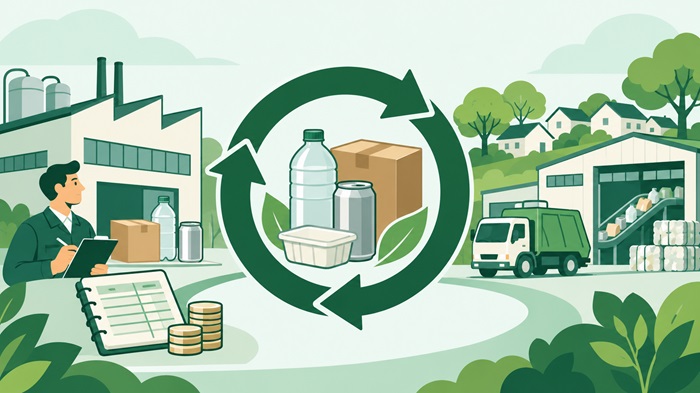
Every day, people throw away plastic bottles, food containers, wrappers, and other packaging. Local waste services collect some of this material, recycling facilities sort what they can, and the rest may end up in landfills or incinerators. All these activities cost money.
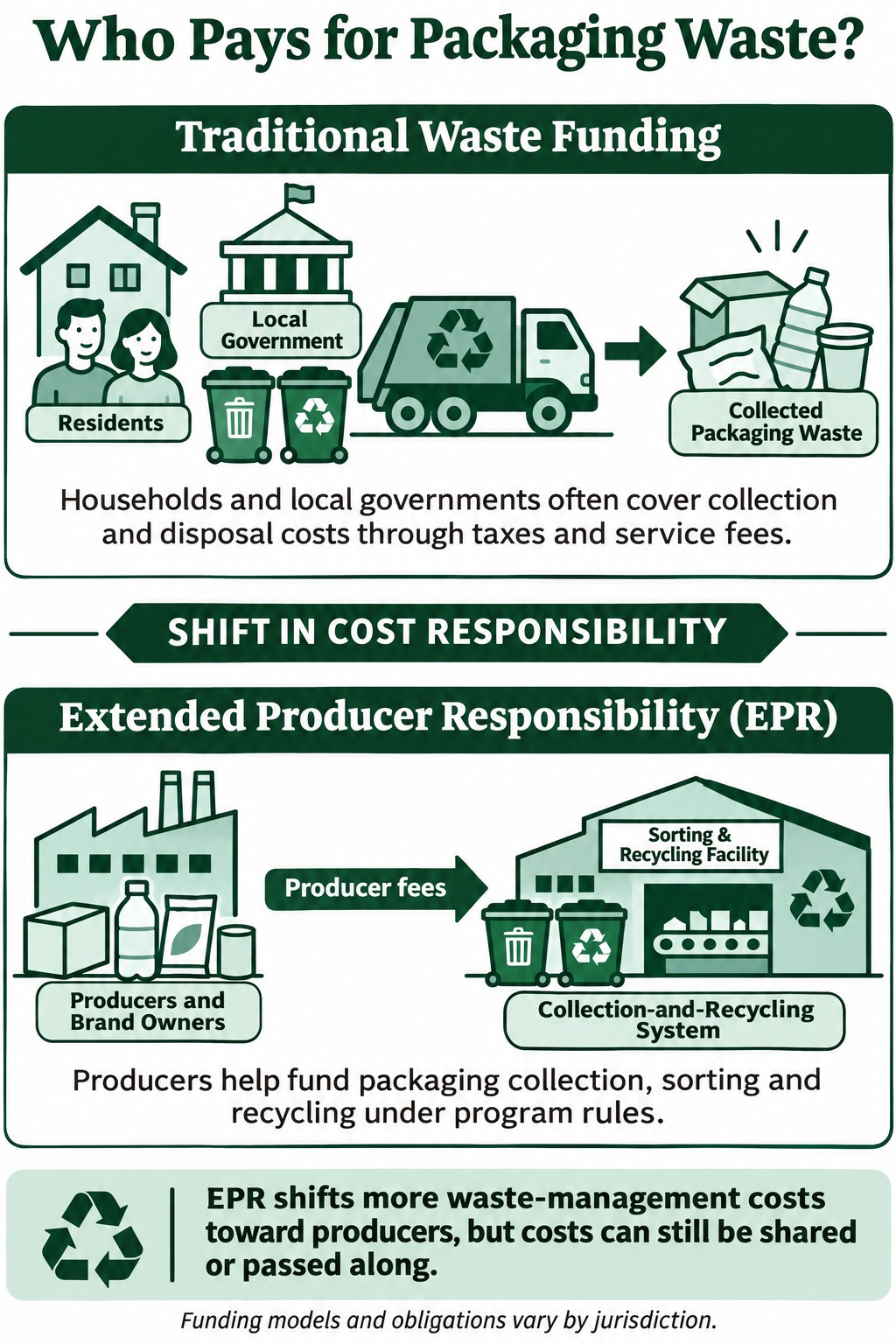
Traditionally, much of the cost has fallen on local governments, residents, and businesses that pay for waste services. Extended Producer Responsibility (EPR) changes that arrangement by making companies that place products and packaging on the market responsible for some or all of the costs of managing them after use.
But making producers pay is only part of the story. The real question is whether EPR can improve recycling, reduce unnecessary packaging, and create a waste-management system that works better.
This guide explains how EPR works, who pays, where the money goes, and what the policy can—and cannot—achieve.
Quick Answer: What Is Extended Producer Responsibility?
Extended Producer Responsibility (EPR) is a policy that makes producers financially or operationally responsible for products and packaging after consumers discard them. For plastic packaging, EPR programs can require companies to fund collection, sorting, recycling, and related waste-management activities. The goal is to shift responsibility toward producers while encouraging better packaging design.
What Is Extended Producer Responsibility?
Extended Producer Responsibility extends a company’s responsibility beyond the point of sale.
Under a traditional waste-management system, a manufacturer’s involvement may largely end when a product reaches the customer. Once the packaging becomes waste, local authorities, waste contractors, and residents handle its collection and disposal.
EPR changes this relationship.
Companies may be required to register with a government authority, report how much packaging they place on the market, and contribute money toward managing that packaging after use.
The idea follows the polluter-pays principle: those responsible for creating environmental burdens should contribute to managing their costs.
According to the Organisation for Economic Co-operation and Development (OECD), EPR extends producer responsibility into the post-consumer stage of a product’s life.
EPR is not limited to plastic packaging. Similar programs cover products such as electronics, batteries, tires, and certain other materials. However, packaging receives particular attention because it is often used briefly before becoming waste.
How Is EPR Different From Traditional Waste Management?
The main difference is who carries the financial responsibility.
In a traditional system, municipalities commonly pay for public recycling services using taxes, service charges, and other revenue. Packaging manufacturers may have little direct responsibility for those costs.
Under EPR, producers contribute to the system through legally required payments or other obligations.
| Factor | Traditional Waste Management | Extended Producer Responsibility |
|---|---|---|
| Main funding | Municipal budgets, waste charges, and other revenue | Producer fees, sometimes alongside public funding |
| Producer responsibility | Often limited after sale | Extends into post-consumer waste management |
| Waste collection | Usually municipalities or contractors | May continue through the same operators |
| Recycling costs | Often shared by residents, businesses, and local authorities | Producers cover costs defined by the EPR program |
| Packaging design | Limited direct connection to waste costs | Fees may encourage easier-to-recycle packaging |
| Accountability | Mainly waste-service operators and public authorities | Additional reporting and financial duties for producers |
EPR does not necessarily replace existing recycling services. A city may continue collecting household recyclables while receiving producer-funded support for the service.
How Does EPR Work for Plastic Packaging?
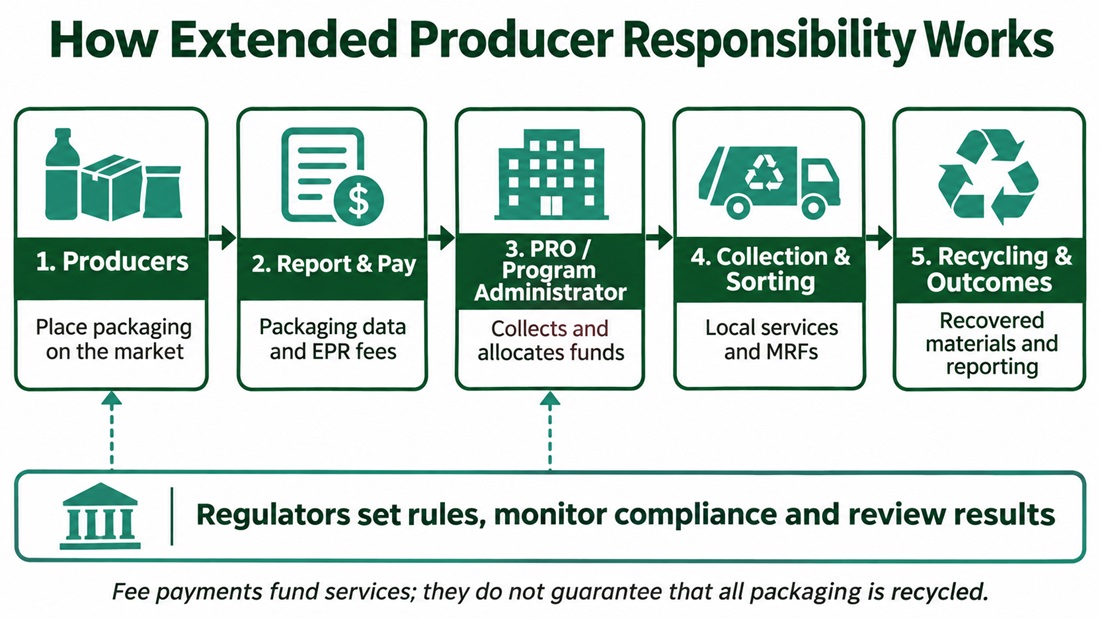
Most packaging EPR systems follow a similar principle: companies report the packaging they supply, contribute to its management costs, and operate under government oversight.
The details differ between jurisdictions, but the process can be explained in five steps.
Step 1: Producers Place Packaging on the Market
Consider a company selling bottled drinks.
The company purchases or manufactures plastic bottles, fills them, and sells the finished products through supermarkets and other retailers.
When consumers finish the drinks, the empty bottles become packaging waste.
Under an applicable EPR law, the company may be considered a producer responsible for those bottles.
The legal definition of a producer matters. Depending on the jurisdiction, responsibility may fall on a brand owner, importer, manufacturer, or another business placing packaged goods on the market.
Being a producer does not always mean physically manufacturing the plastic packaging.
Step 2: Producers Register and Report Packaging Data
Companies covered by an EPR program usually need to identify themselves and provide information about the packaging they supply.
Required information may include:
- Total packaging weight
- Packaging material, such as PET, HDPE, or PP
- Packaging categories and quantities
- Recyclability characteristics
- Relevant sales or distribution information
For example, a beverage company might report the total weight of PET bottles and plastic caps supplied during a reporting period.
This information helps administrators determine producer obligations and estimate the amount of packaging entering the waste system.
Accurate reporting also matters for fairness. A company supplying large amounts of packaging should not avoid its obligations while competitors contribute to the system.
Step 3: Producers Pay EPR Fees
Once the relevant packaging data is established, the producer pays fees according to the program’s rules.
Fees may depend on the weight and type of packaging, the cost of managing that material, and whether the packaging meets particular recyclability criteria.
A company placing more covered packaging on the market will generally have greater obligations than an otherwise comparable company supplying less.
However, EPR fees are not calculated using one universal formula. Each program establishes its own categories, exemptions, cost calculations, and payment arrangements.
Step 4: Funds Support Waste Collection and Recycling
Producer contributions can help finance activities that take place after consumers discard packaging.
These may include household recycling collection, sorting, transportation, recycling infrastructure, public education, and program administration.
For example, producer funding could help a municipality expand recycling access or support improvements at a sorting facility.
That connection matters because collected recyclables do not immediately become new materials.
As explained in our guide to how material recovery facilities work, mixed recyclables usually pass through sorting equipment and quality-control processes before they can be sold to recycling markets.
Those activities require labor, equipment, energy, and maintenance.
EPR can provide an additional source of funding for these services, although the amount and permitted uses depend on the program.
Step 5: Regulators Monitor Compliance and Results
Government authorities establish the legal requirements and oversee compliance.
Depending on the system, they may review producer registrations, approve operating plans, monitor recycling targets, examine financial reporting, and take enforcement action.
Some programs also require independent audits or verification of where recovered materials go.
Oversight is essential because paying a fee does not prove that packaging was successfully recycled.
A credible EPR program needs reliable information about both the money collected and the waste-management activities it supports.
Who Pays for Plastic Packaging Waste Under EPR?
The short answer is that obligated producers pay the fees required by law.
The longer answer depends on how the packaging reaches the market and how the EPR program is organized.
Manufacturers, Brand Owners, and Importers
A manufacturer is not automatically the legally responsible producer in every country.
Consider three situations:
A domestic beverage brand: A company sells drinks in plastic bottles under its own name. It may be responsible for reporting the packaging supplied with those products.
An imported packaged product: A business imports goods already packed in plastic. Depending on local rules, the importer may carry the producer obligation.
A retailer’s private-label product: A supermarket sells products under its own brand. The retailer or another designated business may be responsible for the packaging.
These distinctions prevent every company in the supply chain from automatically paying the same obligation. They also help authorities identify who should report and finance packaging waste management.
Businesses must follow the producer definitions in the particular jurisdiction where their packaging is placed on the market.
What Is a Producer Responsibility Organization (PRO)?
A Producer Responsibility Organization, commonly called a PRO, helps companies meet their EPR obligations.
Instead of each manufacturer building a separate recycling system, multiple producers may participate in a collective organization.
A PRO can collect fees, maintain producer records, coordinate services, distribute approved funding, and report program results.
For example, Oregon’s packaging EPR system requires covered producers to register with an approved PRO, report packaging data, and pay membership fees unless an exemption applies. The state approved Circular Action Alliance as its PRO for the initial program period.
The Oregon Department of Environmental Quality explains these requirements for businesses supplying covered packaging, paper products, and food serviceware.
A PRO is not necessarily the organization that physically collects or recycles packaging. Its role may focus on financing, coordination, and compliance.
Do Consumers Ultimately Pay EPR Costs?
EPR laws generally place the legal payment obligation on producers. That does not mean consumers can never bear part of the economic cost.
A manufacturer may absorb the additional expense, reduce costs elsewhere, or increase its selling prices.
Whether consumers pay more depends on competition, pricing decisions, packaging costs, and the size of the EPR fees.
The distinction is important.
EPR determines who is legally responsible for financing waste management. It does not guarantee who ultimately bears every dollar of that cost.
It can also change how costs are distributed. Instead of relying mainly on local waste charges and taxes, some costs become linked to the products and packaging placed on the market.
How Are EPR Fees Calculated?
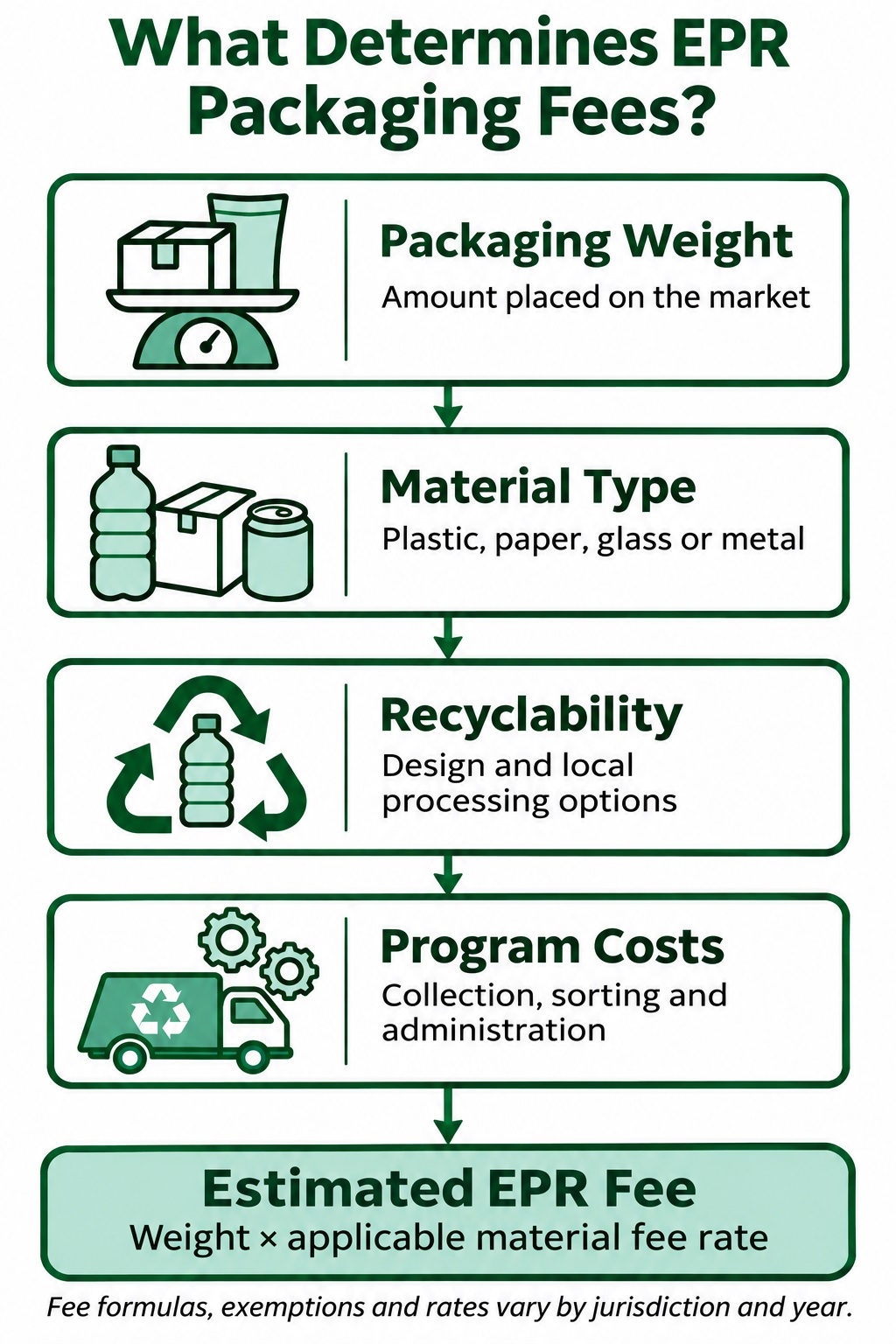
EPR fees help cover the costs of collecting, sorting, recycling, and managing packaging waste under a producer responsibility program.
Most programs calculate fees based on packaging weight and material type. Some also consider recyclability and packaging design, meaning materials that are harder to recycle may attract higher fees.
Businesses can use our EPR Packaging Fee Calculator to estimate their packaging costs by entering material weights and applicable fee rates. The tool supports multiple packaging materials and provides a breakdown of estimated fees.
Actual EPR charges vary by country, state, and program. The calculator provides planning estimates, not official compliance figures.
Packaging Weight and Material Type
A company supplying ten tonnes of covered packaging generally has a larger reporting and financing obligation than one supplying a tonne of comparable packaging.
But weight alone does not determine the actual cost.
Different materials require different collection, sorting, and recycling processes.
For example, PET bottles and flexible multilayer packaging present different challenges.
PET bottles can be recovered through established recycling processes when suitable collection, sorting, and end markets are available. Certain multilayer structures are more difficult to separate and recycle using conventional systems.
These differences can influence the costs that EPR programs seek to recover.
Recyclability and Eco-Modulated Fees
Some EPR programs use eco-modulated fees, meaning producers pay different rates according to specified environmental or packaging-design characteristics.
A system might provide a lower fee for packaging that meets defined recyclability standards or charge more for packaging that is difficult to manage.
The intention is to make packaging decisions financially meaningful.
Without such incentives, companies may pay fees based largely on material weight, even when one packaging design is substantially harder to recycle than another.
The OECD’s research on modulated EPR fees identifies this challenge. Differentiated fees can provide stronger design incentives, but they also make programs more complex to administer.
A Simple EPR Fee Example
Imagine a hypothetical program charging different rates for two packaging categories.
| Packaging | Quantity Supplied | Illustrative Fee | Total |
|---|---|---|---|
| Packaging A | 10 tonnes | $100 per tonne | $1,000 |
| Packaging B | 10 tonnes | $180 per tonne | $1,800 |
Both companies supply the same packaging weight, but the second pays more because its packaging falls into a higher-fee category.
These figures are illustrative, not actual government fee rates.
Real EPR programs may use more detailed calculations, exemptions, minimum thresholds, and additional charges.
The broader principle remains the same: packaging design and material choices can affect a producer’s waste-management obligations.
How Is EPR Being Used Around the World?
Packaging EPR is used in different forms across Europe, North America, and other regions.
Although the underlying principle is similar, governments differ in which companies are covered, how fees are collected, and what producers must achieve.
Three examples show how these arrangements work in practice.
European Union: Producer Responsibility Within Packaging Rules
The European Union has long used producer responsibility as part of its waste-management framework.
Packaging producers operate under national EPR arrangements, which must meet applicable EU requirements.
The Packaging and Packaging Waste Regulation, Regulation (EU) 2025/40, introduces a wider set of packaging requirements. Its general application began on August 12, 2026, with some provisions subject to different dates.
EPR remains an important part of the framework, including producer registration and responsibility for packaging placed on national markets.
However, the detailed administration of EPR schemes still involves national authorities.
The European Commission’s packaging waste guidance explains the broader regulatory framework.
EPR should not be confused with every other EU packaging obligation. Requirements concerning packaging reduction, reuse, and recycled content have their own legal provisions and compliance conditions.
United Kingdom: Producers Contribute to Household Packaging Waste Costs
The United Kingdom has introduced revised packaging EPR arrangements that require obligated businesses to contribute toward specified packaging waste-management costs.
The system includes packaging data reporting and fees for qualifying producers.
Under the revised arrangements, producer disposal fees began with the 2025–26 assessment year. The UK government also confirmed fees for 2026–27 in November 2026.
The amount owed depends on the applicable rules and the packaging a producer reports.
This approach creates a direct financial connection between supplying packaging and the cost of managing it after consumers discard it.
Official guidance is available through the UK government’s packaging EPR collection.
United States: EPR Is Developing at the State Level
The United States does not have a single nationwide packaging EPR program.
Instead, individual states have adopted producer responsibility laws with different requirements and implementation schedules.
As of November 2026, seven states have enacted packaging EPR laws: Maine, Oregon, Colorado, California, Minnesota, Maryland, and Washington.
Oregon offers a practical example of implementation.
Its Recycling Modernization Act began changing recycling operations in July 2025. Covered producers contribute funding through an approved PRO, while local governments and service providers continue performing important collection and recycling functions.
The state intends to use producer funding to support improvements such as wider recycling access, facility upgrades, and more consistent services.
California’s SB 54 takes a related but broader approach. Alongside producer responsibility, the law establishes source-reduction and other requirements for covered packaging and single-use plastic food serviceware.
These programs illustrate an important point: EPR is a policy framework, not one identical set of rules applied everywhere.
Businesses selling packaging across several states may face different reporting, registration, and financial obligations.
What Are the Benefits of Extended Producer Responsibility?
EPR can improve the way recycling systems are financed and managed. However, the benefits depend on program design, enforcement, and how the funding is used.
More Reliable Funding for Recycling
Collection and recycling services have ongoing costs.
Vehicles need fuel and maintenance. Workers must be paid. Sorting facilities need equipment, electricity, and repairs.
Meanwhile, the revenue from selling recovered materials can change with market conditions.
Our article on MRF economics and profitability explains why sorting facilities can face financial pressure even when they process valuable recyclable materials.
Producer contributions can help support parts of the system that recovered-material sales alone may not finance.
For communities, this funding may support better recycling access or improvements to existing services.
However, the result depends on whether the program collects sufficient funds and distributes them effectively.
Greater Accountability for Packaging Waste
EPR requires covered businesses to account for the packaging they supply.
This can improve information about packaging quantities, material categories, and waste-management responsibilities.
It also creates a clearer connection between packaging decisions and their consequences after use.
A producer cannot necessarily treat disposal as an issue that belongs entirely to consumers or local authorities.
Accountability is strongest when reporting is verified, legal obligations are enforced, and program results are publicly available.
Incentives for Better Packaging Design
Packaging decisions influence how materials move through recycling systems.
A package made from compatible materials may be easier to sort and recycle than one combining several difficult-to-separate layers.
EPR fees can encourage companies to consider these differences during product development.
For example, a company facing higher fees for difficult-to-recycle packaging might investigate a simpler design.
EPR can also complement efforts to reduce unnecessary packaging or develop reusable formats.
Our guide to reusable packaging explains how packaging can be designed for repeated use rather than immediate disposal.
Still, whether EPR actually encourages redesign depends on the financial incentives. Small differences in fees may have little influence on major packaging decisions.
What Are the Limitations of EPR?
Extended Producer Responsibility changes how waste management is financed, but it does not eliminate the physical and economic challenges of recycling.
Understanding these limits is essential when judging whether a program is working.
Paying EPR Fees Does Not Guarantee Recycling
A producer may pay all required fees while some of its packaging remains difficult or impossible to recycle through available systems.
Collection infrastructure, sorting technology, material quality, and recycling markets still determine what happens to discarded packaging.
For example, a recycling facility may identify a plastic item but still be unable to recover it economically.
If there is no suitable buyer for the material, collecting more of it does not automatically create a viable recycling market.
EPR can help finance solutions, but it cannot turn every packaging material into a recyclable product simply by collecting fees.
Weak Fee Structures May Not Change Packaging Design
A program that charges producers mainly by packaging weight may generate useful revenue without strongly discouraging problematic designs.
Companies could treat the fee as another operating expense.
More detailed fee systems may create stronger incentives, but they also require reliable data and clear standards.
This creates a policy trade-off.
Simple fees are easier to administer. More sophisticated fees can better reflect environmental and waste-management differences, but they may increase administrative complexity.
Enforcement and Reporting Can Be Difficult
An EPR system depends on knowing which companies are responsible and how much covered packaging they supply.
This becomes challenging when products move across borders, pass through online marketplaces, or involve multiple businesses in the supply chain.
Companies that fail to register or accurately report their packaging may avoid costs that compliant competitors pay.
These businesses are often described as free riders.
Weak enforcement can reduce program revenue and undermine confidence in the system.
Independent checks, clear producer definitions, and accessible reporting procedures help address these problems.
Recycling Markets Still Determine What Can Be Recovered
Recycling is an economic activity as well as an environmental service.
Recovered materials need buyers willing to use them in manufacturing.
Demand depends on factors such as material quality, processing costs, contamination, and the price of competing virgin materials.
A well-funded collection system can still struggle if the recovered materials have limited market value.
EPR programs therefore need to consider what happens after materials leave a sorting facility.
Funding more collection is useful, but measuring actual recycling outcomes is equally important.
Does EPR Actually Reduce Plastic Waste?
The answer depends on what the program is designed to achieve and how success is measured.
EPR can help finance collection, sorting, and recycling services. It can also improve producer reporting and encourage packaging changes when fees create meaningful incentives.
However, stronger financing does not automatically mean less plastic packaging is produced.
A program may collect more recyclable material without reducing the overall quantity of packaging entering the market.
That distinction matters.
Recycling improvements and waste prevention are related goals, but they are not the same.
For example, imagine that a packaging system improves its recycling rate while the total amount of packaging sold continues to increase. More material may be recycled, but the quantity requiring disposal could remain substantial.
A balanced evaluation of EPR should therefore examine several outcomes.
| Measure | What It Reveals |
|---|---|
| Producer participation | Whether obligated companies are joining and reporting |
| Funding collected | The financial resources available for the program |
| Recycling access | Whether more households and businesses can use recycling services |
| Material recycling rates | How much material is actually recycled |
| Packaging waste generated | Whether overall waste quantities are changing |
| Packaging design | Whether producers are adopting more recyclable or reusable formats |
No single measure tells the whole story.
The OECD has documented both the value of producer responsibility and challenges involving cost recovery, enforcement, governance, and program effectiveness.
Strong results depend on what governments require producers to do, not merely whether a program carries the EPR label.
What Does EPR Mean for the Future of Plastic Packaging?
Extended Producer Responsibility is changing the relationship between packaging companies and the waste systems that handle their products.
For producers, packaging is increasingly more than a design, manufacturing, or marketing decision. It can create reporting obligations and financial costs long after the product has been sold.
For recycling systems, producer contributions can provide resources for services that have traditionally depended heavily on local funding.
For governments, EPR offers a way to assign responsibility while setting expectations for recycling performance and accountability.
But EPR works best when the rules connect financial contributions to measurable outcomes.
A system that collects fees without improving recycling access, material recovery, or packaging design may shift costs without solving the underlying problems.
Likewise, recycling improvements alone cannot address every issue associated with increasing packaging consumption.
Reducing unnecessary materials, designing packaging for practical recovery, supporting reuse where appropriate, and maintaining reliable recycling markets remain important.
EPR is one tool for supporting these goals.
Its greatest value may be that it makes the costs of packaging waste harder to ignore.
When producers are responsible for managing what happens after their packaging is discarded, those costs become part of the decisions companies make before packaging reaches consumers.
Frequently Asked Questions
What does EPR stand for?
EPR stands for Extended Producer Responsibility. It makes producers responsible for managing or financing products and packaging after consumers discard them.
Who pays EPR fees?
Depending on local laws, manufacturers, brand owners, importers, or other designated producers pay EPR fees. The amount often depends on packaging weight, material, and recyclability.
Is EPR the same as a plastic tax?
No. EPR funds specified waste-management responsibilities, while a plastic tax imposes a charge under separate tax rules. Both can apply to the same packaging.
Does EPR guarantee plastic recycling?
No. EPR can fund recycling and encourage better packaging design, but actual recycling depends on collection systems, sorting capabilities, and market demand.
What is a Producer Responsibility Organization (PRO)?
A PRO helps producers meet EPR obligations by collecting fees, coordinating waste-management activities, and managing compliance reporting.
Does EPR apply to small businesses?
Sometimes. Requirements vary by location, and some programs exempt businesses below certain revenue or packaging-volume thresholds.
Is EPR mandatory?
Yes, for producers covered by applicable EPR laws. Requirements, exemptions, and deadlines vary between countries and states.
Final Takeaway
Extended Producer Responsibility changes a fundamental part of plastic waste management: who is responsible for paying for packaging after it has been used.
By requiring producers to help finance collection, sorting, and recycling, EPR can reduce pressure on public waste budgets and give businesses a greater reason to consider packaging’s end-of-life costs.
But collecting producer fees is not the final measure of success.
A successful EPR system must turn financial responsibility into better waste-management outcomes. That means improving recycling access, recovering materials effectively, encouraging practical packaging design, and showing where the money goes.
EPR cannot solve plastic pollution on its own. It can, however, make producers more accountable for the waste their products leave behind.
Leave a Reply