When you toss a plastic bottle into your recycling bin, it doesn’t magically transform into a new product. It travels through a complex system — and the starting point for that journey is a Material Recovery Facility, or MRF.
If you’ve ever wondered what happens to your recyclables after collection day, you’re about to find out. MRFs are the sorting powerhouses that separate mixed waste into usable materials. They’re not perfect, and they’re not the complete solution to our plastic problem — but understanding how they work reveals why they’re essential to any functioning waste management system.
What Is a Material Recovery Facility?
A Material Recovery Facility is a specialized industrial plant that receives mixed dry waste — mostly from curbside recycling programs — and sorts it into separate material streams: plastics, metals, paper, glass, and textiles. The goal is to extract as much recyclable material as possible and prepare it for sale to end-market buyers.
Think of an MRF as a high-volume sorting operation. A single facility might process hundreds of tons of mixed waste per day, using a combination of human workers and automated machinery to pull apart what residents mixed together in their bins.
Why do we need them? Many collection programs combine paper, containers and other accepted recyclables before they reach a facility. That makes collection simpler, but the mixed load still needs to be separated. MRFs perform that sorting so materials that meet buyer specifications can move to reprocessors.
The MRF Journey: From Tipping to Baling
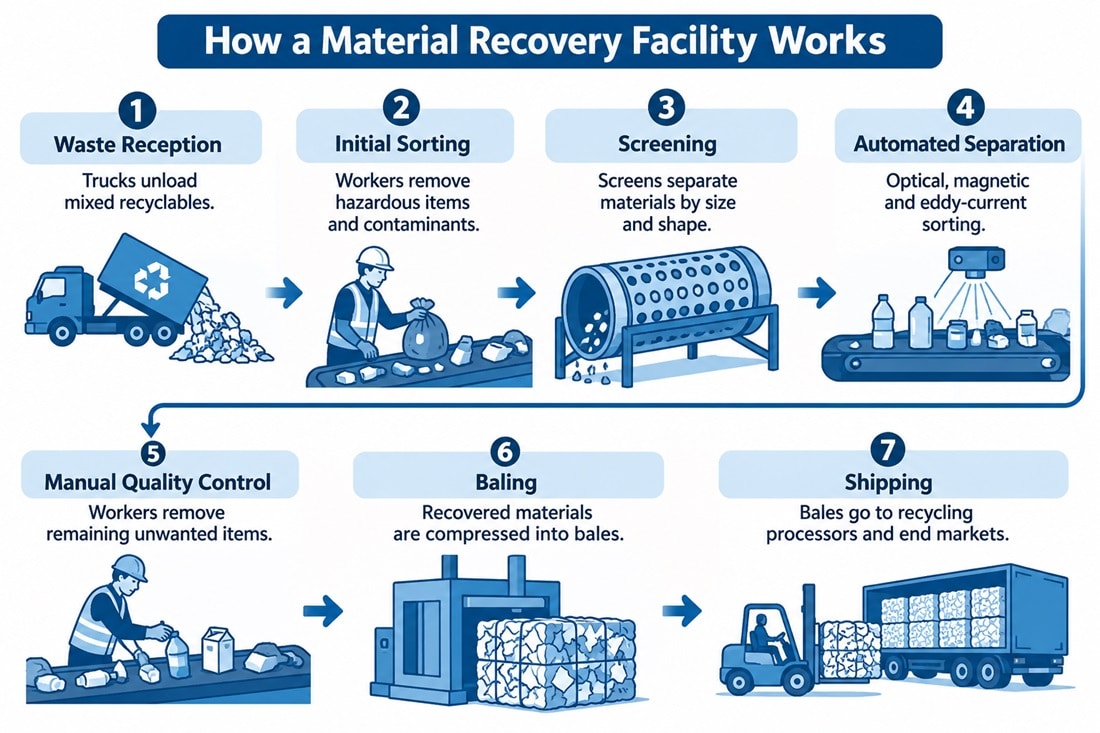
Step 1: Tipping and Initial Sorting
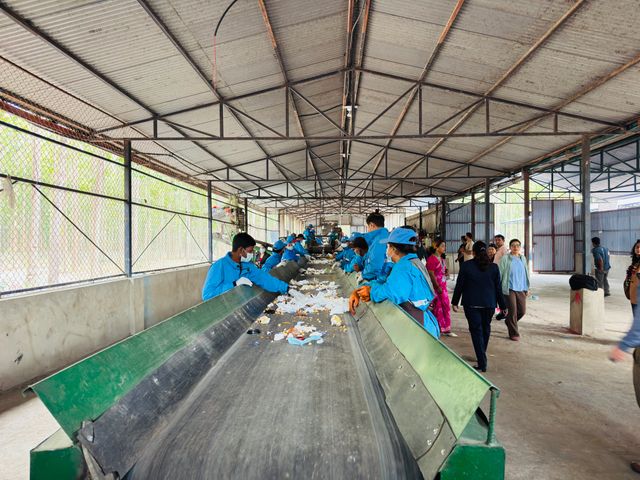
Your recyclables arrive at the facility by the truckload. When the truck tips its load onto the tipping floor, workers and machines spring into action. This is where the first contamination removal happens — manually.
Human sorters stand at the “tipping line” or along initial conveyor belts and pull out hazardous items and obvious contaminants: propane tanks, batteries, paint cans, holiday lights, and plastic bags (the worst offender for machinery). Anything tangled or oversized gets removed here to prevent equipment breakdowns. This step is labor-intensive but critical — a single plastic bag can jam an optical sorter or wrap around a rotating shaft, forcing a shutdown.
Step 2: Shredding and Separation
After initial inspection, the material moves through equipment selected for the facility’s incoming stream. Screens separate items by size and shape; some plants use bag openers or other equipment to release material from bags. Shredders are not a standard step in every MRF because they can damage materials that are intended for recycling.
Bag openers rupture sealed plastic bags to expose their contents. Screens and trommels (rotating drums with holes) separate heavy materials (metals, dense plastics) from light materials (paper, cardboard). Heavy items fall through; light materials continue down the line.
Step 3: Optical Sorting — The High-Tech Heart
Optical sorters help identify selected materials using cameras and sensors such as near-infrared (NIR). NIR systems can distinguish many common polymer types by their spectral signatures, but they do not reliably identify every item or every resin code. Dark pigments, multilayer packaging, labels, dirt, overlapping objects and unusual shapes can interfere with detection. The equipment is configured for the materials the facility is designed and contracted to recover.
When the optical sorter identifies a piece of plastic, compressed air jets shoot it into a chute designated for that specific type. It happens dozens of times per second.
Not all plastics can be identified this way, though. Dark or opaque plastics, film, and heavily contaminated items bypass optical sorting and either go to manual lines or to residue.
Step 4: Additional Sorting Technologies
Beyond optical sorters, MRFs use other tools to separate materials:
Magnetic separation pulls ferrous metals (steel cans) off the line. Eddy-current separation kicks out aluminum cans and other non-ferrous metals. Air classification uses air streams to blow light materials (paper, cardboard) away from heavier plastics and metals.
Manual pickers work station-by-station along conveyor belts, removing items that automated systems miss or misidentify. This is where contamination slips through — a piece of plastic film sticking to a cardboard box, or a food-soiled container masking its plastic type.
Step 5: Baling and Preparation for Market
Once separated, materials are compressed into dense bales — huge rectangular blocks of compacted plastic, metal, or paper, bound with wire or plastic straps. A baler can squeeze hundreds of pounds of loose material into a compact, stackable form that’s economical to ship.
Bales are weighed, labeled, and stacked by material type. A single MRF produces dozens of different bales per day: clear PET, colored PET, natural HDPE, colored HDPE, mixed plastics that couldn’t be separated, aluminum, steel, cardboard, and more.
Step 6: Loading and Shipping
Bales are loaded onto trucks or rail cars and shipped to end-market buyers — plastic processors, metal smelters, paper mills, and recyclers who buy these materials as feedstock for new products.
This is where the economic reality of MRFs becomes clear. A facility’s revenue depends partly on the grades and quantities of recovered materials it can sell, as well as the terms of its municipal or hauler contracts. Commodity prices can change even when the facility’s sorting performance stays the same.
MRF Types: Not All Are the Same
Clean MRFs
A clean MRF processes source-separated recyclable materials. The incoming stream may be single-stream (paper, containers and other accepted recyclables collected together) or dual-/multi-stream (some materials separated before arrival). The term clean refers to the fact that the facility receives recyclables separated from general household garbage; it does not mean the input is contamination-free.
Source-separated inputs can be more consistent than mixed household garbage, but contamination still occurs. Output quality depends on collection rules, sorting equipment, operating practices and buyer specifications.
Dirty MRFs (or Mixed-Waste MRFs)
A dirty MRF, also called a mixed-waste processing facility, receives mixed municipal solid waste that has not been separated into a recycling stream at the household or business. It attempts to recover recyclable materials from general garbage. This is different from a clean MRF that receives source-separated recyclables, including many single-stream collections.
Because the incoming waste contains food scraps, liquids, textiles and other non-recyclables, a dirty MRF faces a more difficult separation task than a clean MRF. Recovery quality and quantity depend on the waste composition, equipment, operating practices and local markets. Do not treat a single contamination percentage as representative of all facilities.
What Materials Get Processed?
Depending on its design and local collection rules, a clean MRF may process some of the following streams:
Plastics — PET (#1), HDPE (#2), LDPE (#4), PP (#5), and PS (#6); sometimes #7 (mixed/other)
Metals — aluminum cans, steel cans, tin
Paper — office paper, mixed paper, magazines
Cardboard — boxboard and corrugated cardboard
Glass — clear, brown, and green (though many U.S. MRFs now exclude glass due to contamination issues)
Textiles — some facilities sort clothing and textiles for donation or processing
RDF (Refuse-Derived Fuel) — non-recyclables and contaminated material compressed into fuel pellets for waste-to-energy facilities
The Equipment: Machines and People
Automated Systems
Optical sorters (identify plastic by resin code)
Magnetic separators (pull out steel)
Eddy-current sorters (extract aluminum)
Air classifiers (separate light from heavy materials)
Screens and trommels (sort by size and weight)
Balers (compress materials into bales)
Manual Labor
Tipping line workers — remove hazardous materials and obvious contaminants
Manual sorters — work conveyor lines to remove items machines miss
Equipment operators — run balers, scales, and sorting machinery
Loaders and movers — handle bales and prepare for shipment
Staffing varies with facility size, operating hours, incoming material, automation and the number of manual quality-control stations. Automation can change the mix of jobs, but facilities still need operators, maintenance technicians, safety staff and people who monitor output quality.
Safety Considerations
Working in an MRF is physically demanding and occasionally hazardous. Workers face:
Tangling hazards — rotating machinery can catch clothing or hair if proper safeguards aren’t in place
Fire risk — lithium-ion batteries in electronics can explode; propane tanks and other hazardous materials often slip into recycling loads
Needle stick injuries — hypodermic needles disposed of improperly end up in bins and can injure workers
Crush injuries — from equipment like balers and conveyor systems
Repetitive strain — from constant manual sorting and lifting
Modern MRFs invest heavily in safety training, guards on machinery, and proper PPE. Still, it’s one of the more hazardous jobs in waste management.
Where Does the Sorted Material Go?
Once baled and shipped, materials go to different end markets:
PET plastic → beverage bottle producers, food packaging manufacturers, textile makers (polyester fiber)
HDPE plastic → plastic lumber, containers, plastic bags
Mixed plastics → lower-grade applications or downcycling (used once more, then landfilled)
Aluminum → remelters that can turn recovered metal into new products; it can be recycled repeatedly, although collection and processing still cause material losses.
Steel → foundries for remelt into new products
Cardboard → paper mills for pulping into new cardboard
Mixed paper → paper mills for downcycling into lower-grade products
RDF → waste-to-energy plants for combustion and energy recovery
The Reality: Perfect Sorting Doesn’t Exist
No MRF recovers every item in its incoming load. The share sold as a usable commodity depends on what arrives, what the facility is equipped to sort, buyer specifications and whether a market exists. A single recovery-rate range should not be applied to every MRF or material stream.
MRF residueResidue must be managed after sorting. Depending on local infrastructure and contracts, it may go to landfill, waste-to-energy treatment or another permitted facility. Chemical recycling is not a universal route for mixed MRF residue.
The culprits:
Contamination from consumer confusion (food-soiled containers, plastic bags, non-recyclable items)
Mixed plastics that are too contaminated or have no economical buyer
Light materials (plastic films, labels) that get tangled or misidentified
Economic factors — materials with no viable end market
Quality mismatches — contamination rates exceed buyer specifications even after sorting
Why This Matters for Your Waste Management System
MRFs are an important part of many municipal recycling systems, especially where households place several accepted materials in one collection bin. Their performance depends on collection design, input quality, sorting equipment and reliable end markets. They are essential infrastructure, but they are not a complete solution.
Understanding how they work explains why:
What you put in the bin matters — contamination cascades through the entire facility and ruins batches of otherwise good material
Recycling rates plateau — even with perfect sorting, some materials end up in landfills anyway
Economics drive decisions — when commodity prices fall, facilities close and material goes to landfills regardless of sorting quality
Single-stream has limits — multi-bin systems produce higher-quality output, but most people won’t use them
An MRF is one piece of a larger waste management puzzle. Alone, it’s not enough. Combined with waste-to-energy, advanced sorting technology, and better consumer education, it can divert significant material from landfills — but the waste hierarchy still applies: reducing consumption and designing for recyclability are more effective than sorting after the fact.
Next Steps
Now that you understand how MRFs work, dive deeper into the challenges that make recycling harder than it looks:
Learn about contamination rates and why they undermine sorting efficiency
Explore MRF residue and where rejected material goes
Compare MRF economics and why facilities struggle with commodity price volatility
Recent developments and what they mean for MRFs
Recent developments: Recycling infrastructure is being treated as a system investment, not just an equipment purchase. The U.S. EPA’s 2024 infrastructure assessment estimated that modernizing the country’s recycling system would require $36.5–$43.4 billion across collection and processing infrastructure, including MRFs. That estimate is U.S.-specific, but it shows why collection access, facility capacity and end markets must be planned together.
The EPA’s Solid Waste Infrastructure for Recycling program continued making grant selections in 2026. These grants support local improvements to collection, sorting and materials management. The wider point for MRF operators is that facility upgrades are increasingly linked to collection-system design, local capacity and reliable markets—not simply installing faster sorters.
Sources and further reading
- EPA recycling infrastructure assessment
- EPA Solid Waste Infrastructure for Recycling programEPA Solid Waste Infrastructure for Recycling program
- EPA 2024 financial assessment of U.S. recycling infrastructure
Related guides on PlasticSolutionsReview
MRF contamination | MRF residue | mechanical recycling | waste-to-energy
Editorial note: Recovery rates, contamination levels, commodity prices and facility costs vary by location, date, material grade and contract. Where no comparable public dataset exists, this article avoids presenting a universal figure.
Leave a Reply