Paper feels like the greener choice. It comes from trees, it rots, and it doesn’t end up wrapped around a turtle. But when researchers actually measure the footprint of a paper bag against a plastic one, the answer gets uncomfortable fast.
Here’s the short version, and then we’ll get into the details.
Quick answer : Paper vs Plastic
Neither material wins everywhere. Per item, paper usually costs more to make and ship, while plastic causes far worse pollution when it escapes into the environment. Most life-cycle studies don’t fully price in that pollution, which is why the two can look closer than they should. UNEP’s life-cycle assessment review of plastic bags and alternatives
A rule of thumb that holds up in most situations:
- Shopping bags: use what you already own, as many times as you can.
- Dry foods and shipping: paper is usually the better pick.
- Wet, greasy or long-shelf-life food: plastic can waste less food, which sometimes matters more than the bag.
- Anything single-use: choose whichever your local system will actually recycle.
Paper vs plastic at a glance
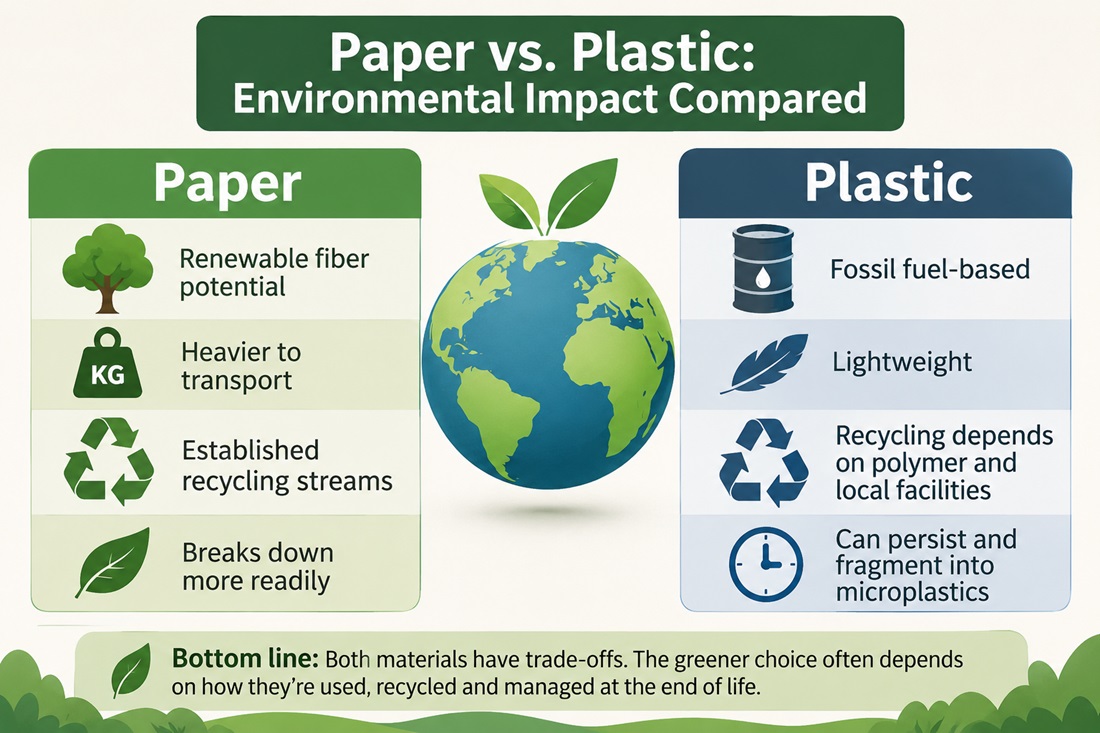
| Paper | Plastic | |
| Made from | Wood pulp or recycled fiber | Mostly oil and natural gas |
| Manufacturing | Energy- and water-intensive | Energy-intensive, fossil-based |
| Weight | Heavier, so more shipping emissions | Lighter, so fewer shipping emissions |
| Moisture and grease | Weak without coatings | Strong |
| Recycling | Well established, but fibers weaken over time | Depends on polymer type and local facilities |
| If littered | Breaks down relatively quickly | Persists and fragments into microplastics |
| Biggest concern | Forestry, water, energy, coatings | Fossil use, litter, microplastics |
How they compare on climate, water and land
Paper starts in a forest or plantation. Pulping and drying are where most of the energy and water go, and the footprint swings a lot depending on the mill, the energy source and how much recycled fiber is used. Paper is renewable in principle, but only when forests are managed well. Poorly sourced wood can mean habitat loss and released carbon. Look for credible forestry certification or recycled content rather than trusting a “natural” look.
Plastic starts with oil or gas. Making polymers like polyethylene (PE), polypropylene (PP) and PET takes energy and releases greenhouse gases. But plastic often needs much less material to do the same job, so a thin film can beat a heavier paper alternative on manufacturing and transport emissions.
Weight matters more than people expect. A heavier package takes more fuel to move, and the gap grows over long distances. Comparisons only make sense when both options do the same job, so a thin bag and a sturdy one aren’t a fair match.
What happens after you throw it away
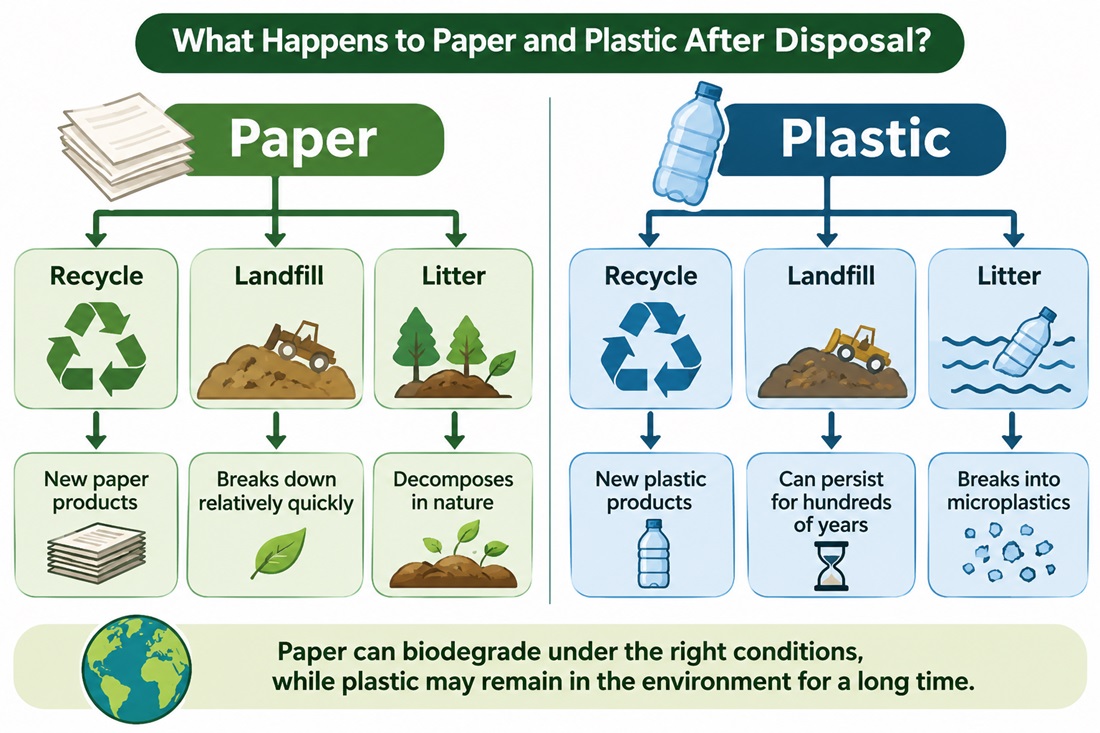
Paper can be recycled in most places, particularly cardboard and office paper. The catch is that fibers get shorter every cycle, so they can only be recycled roughly five to seven times before fresh fiber is needed. In landfills, paper can produce methane as it breaks down without oxygen, although many modern landfills capture part of it. See the EPA’s recycling guidance for more on recycling systems and material recovery.
Plastic recycling is more hit-and-miss. PET bottles and HDPE containers are widely accepted. Thin films, bags and multilayer packaging often aren’t, because they jam sorting equipment or aren’t worth the cost to process.
If either is littered, paper breaks down much faster, while plastic can stay for decades and fragment into microplastics. This is the one area where plastic’s footprint is clearly worse, and it’s the one most life-cycle assessments handle poorly.
Why “recyclable” paper often isn’t
Many paper products carry a thin plastic or foil lining. Coffee cups, drink cartons, “paper” mailers and some takeaway boxes are common examples. That lining makes them hard to recycle in ordinary paper streams.
Grease-proof paper can bring a second problem. Some food wrappers, cups and containers have used PFAS, long-lasting chemicals linked to health concerns, to resist oil and water. Several jurisdictions have restricted PFAS in food packaging, but it’s worth checking the labelling if you buy a lot of takeaway packaging.
The takeaway: a paper label doesn’t guarantee a paper-only product.
Paper vs plastic bags: how many reuses does it take?
This is where the numbers get interesting. Two widely cited studies measured how many times a bag must be reused to match the impact of a single-use plastic bag:
| Bag type | UK Environment Agency (2011), climate impact | Danish EPA (2018), all impact categories |
| Paper | about 3 uses | about 43 uses |
| Low-density plastic | about 4 uses | about 37 uses |
| Conventional cotton | about 131 uses | about 7,100 uses |
| Organic cotton | not assessed | about 20,000 uses |
The two studies used different methods, which is why the numbers are so far apart. The consistent message is that paper isn’t a magic fix after a single use, and that heavy “reusable” options only pay off after a lot of use.
A 2024 life-cycle study of carrying bags in the Philippines pointed the same way. Paper bags scored worse on its chosen impact categories, while plastic did worse on others. It’s a single-country study, so treat it as one data point rather than a universal ruling.
The practical conclusion is simple: the bag you already own is the greenest bag. Don’t buy a new “eco” bag if you have one that still works.
Food and takeaway packaging
Food is where swapping materials can backfire. Producing food has its own footprint, often bigger than the packaging around it. If paper lets moisture or oxygen in and food spoils sooner, the net result can be worse than plastic. UNEP also compares single-use food packaging with alternatives in its life-cycle assessment review.
- Dry goods, bread, produce: paper usually works well.
- Wet, oily or long-shelf-life foods: plastic barriers can extend shelf life and cut food waste.
- Hot takeaway: fiber containers can reduce plastic, but check for coatings and PFAS, and whether your local system can handle food-soiled packaging.
Shipping and e-commerce
Corrugated cardboard is easy to recycle and protects well, so it’s a sensible default for boxes. Plastic films and padding can be lighter and more water-resistant. The bigger win usually isn’t the material at all. Right-sized packaging, less filler and fewer damaged products (which mean returns, replacements and extra shipping) do more than any material swap.
What’s changing: regulation and policy
- Global Plastics Treaty: talks in Geneva ended without a deal in August 2025. A new chair was elected in February 2026, and a roadmap aims to restart negotiations around late 2026 or early 2027. A recent negotiating text has been criticised for being less ambitious on production limits, so expect the story to keep moving.
- EU Packaging and Packaging Waste Regulation (PPWR): it sets recyclability, recycled-content and reuse requirements for packaging sold in the EU, and its main rules begin applying in August 2026. It also restricts PFAS in food-contact packaging.
- Bag bans and fees: many countries now restrict or charge for plastic bags. Bangladesh was among the first to ban thin polythene bags, in 2002, although enforcement has been uneven. Bans often shift people toward paper, jute or woven bags, which makes the reuse numbers above especially relevant.
How to choose, in four steps
- Reuse first. Keep using the bags and containers you have. Replacing them costs more than it saves.
- Cut packaging, don’t just swap it. Skip extra layers and inserts where you can.
- Check your local rules. “Recyclable” only counts if your local system accepts it. Check whether it takes film plastic, coated paper or food-soiled cardboard.
- Match the material to the job. Pick the option that protects the product with the least material, and prefer recycled content or certified fiber when you can.
If you want to go deeper, see our guides to reusable packaging, compostable packaging, biodegradable and compostable plastics and glass vs plastic.
Final verdict
Paper is the better material when litter, persistence and renewable sourcing are your main concerns, and when it will really be recycled. Plastic is the better material when low weight, moisture protection or food preservation is the main concern. Either one gets far better when it’s reused, and either one gets worse when it’s bought just to replace something that still works.
FAQ
Are paper bags better than plastic bags? Not automatically. Paper bags are heavier and usually take more resources to make, so they need several reuses to compete. Their advantage shows up when bags end up as litter.
Which has a lower carbon footprint? It depends on the product, but a lightweight plastic bag often has the lower manufacturing and transport footprint. Paper can catch up with recycled fiber, efficient mills and repeated use.
Is paper easier to recycle? Often, yes. Paper recycling is well established. Plastic recycling depends on the polymer and local facilities, and thin films are rarely accepted. Coated or greasy paper is also harder to recycle.
Does paper break down faster than plastic? Yes, in most conditions. Coatings, moisture and landfill conditions all change that. Plastic tends to fragment into smaller pieces rather than fully break down.
Is plastic always worse? No. Where it uses less material or prevents food waste, it can come out ahead. Its main weakness is pollution when it isn’t collected.
Leave a Reply