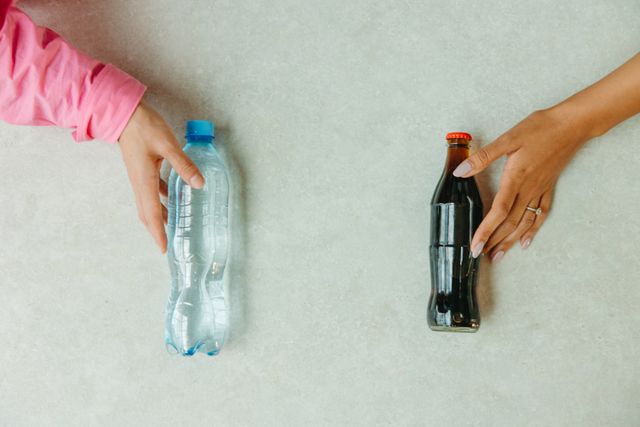
Glass vs plastic seems like an easy choice when you are holding a sturdy jar in one hand and a disposable bottle in the other. Glass feels built to last. Plastic feels easy to throw away. But those impressions tell you little about the energy used to make either container or what happens after you finish with it.
A glass bottle used once can have a higher carbon footprint than a lightweight plastic bottle. Return that glass bottle for repeated refilling, and the comparison can change. For food storage at home, the decision also involves heat, breakage, cleaning and how long you will keep the container.
The useful question is which container does the job well with the least waste over its working life.
Quick answer on glass vs plastic
Glass is a useful choice for repeated food storage because it resists stains and odors and provides a stable food-contact surface. Plastic is lighter and less likely to shatter, which helps during shipping and travel. Single-use glass often has higher greenhouse gas emissions than comparable plastic packaging. Refillable glass can reduce its impact per use, provided bottles are returned, washed efficiently and reused enough times. Local recycling options matter for both materials.
Glass vs plastic at a glance
| Factor | Glass | Plastic |
| Weight | Heavy for its capacity | Usually much lighter |
| Breakage | Can crack or shatter | Usually more impact-resistant |
| Food storage | Resists odors and staining | Performance varies by polymer and design |
| Heating | Requires a suitable heat-rated product | Requires a product rated for the heating method |
| Single-use carbon footprint | Often higher for comparable bottles | Often lower for comparable lightweight bottles |
| Reuse | Useful for jars and returnable bottles | Useful when designed for repeated use |
| Recycling | Can retain material quality through remelting | Depends on polymer, sorting and processing |
| Litter | Persistent and potentially sharp | Persistent and can fragment into microplastics |
| Cost | Often higher for production and transport | Often lower for high-volume packaging |
These are broad tendencies. Bottle weight, recycled content and the collection system can change the result.
What glass and plastic packaging are made from
Most bottles and jars use soda-lime glass, made from silica sand, soda ash, limestone and recycled glass. Manufacturers melt the mixture, shape it and cool it carefully. The high heat needed for melting accounts for a substantial part of glass production’s energy demand. Adding clean recycled glass reduces the need for virgin minerals and helps lower melting energy.
Most conventional plastics begin with oil or natural gas. Manufacturers turn chemical building blocks into polymers, then shape the resin into containers, films and other packaging. Resin production has its own energy and emissions costs, even though shaping plastic generally requires less heat than melting glass.
“Plastic” also covers many materials. PET plastic is common in clear beverage bottles, while HDPE plastic is used for milk jugs and many household-product containers. Their properties and recycling routes differ, so a claim about one plastic should not automatically be applied to all of them.
Which has the lower environmental impact
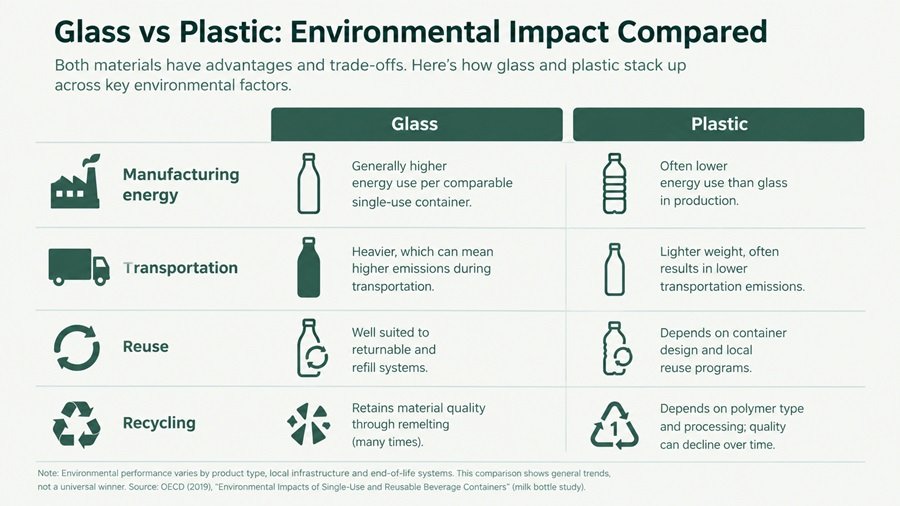
The answer depends on what you measure. Greenhouse gas emissions, resource extraction, water use and litter are separate problems. A package can perform well on one and poorly on another.
Life cycle assessment compares these impacts across production, transport, use and disposal. A fair comparison asks how much packaging is needed to deliver the same amount of usable product. Comparing a kilogram of glass with a kilogram of plastic misses the fact that the two weights may hold very different quantities of food or drink.
Manufacturing and carbon emissions
Glass needs substantial heat and usually more material per bottle than plastic. If the bottle is filled once, all those manufacturing impacts serve a single use. That helps explain why replacing a disposable plastic bottle with disposable glass does not guarantee a carbon saving.
The UNEP Life Cycle Initiative’s review of beverage bottle alternatives brings together life cycle studies rather than declaring one material the winner in every situation. Its findings underline the importance of packaging weight and the assumptions behind each comparison.
Recycled content can improve either material’s footprint. However, a recycled-content claim does not tell you the full impact of making, transporting and collecting the finished package.
Transport and product protection
Glass adds weight to a shipment. It can also require dividers or other protection against breakage. Over long road journeys, the extra load can increase fuel use and distribution costs.
Plastic’s low weight and resistance to impact are useful here. A lighter package can reduce transport burdens while protecting the product inside.
Protection matters as much as packaging weight. A container that leaks, breaks or allows food to spoil can waste the contents as well. The best design uses enough material to deliver the product safely without unnecessary layers or bulk.
Pollution and litter
Plastic creates a waste problem that a carbon comparison alone cannot capture. Escaped packaging can entangle wildlife, be swallowed by animals and gradually fragment into smaller plastic particles.
Glass does not create polymer-based microplastics. It still persists in the environment, and broken pieces can injure people and animals. Glass litter is not harmless simply because its ingredients are minerals.
Neither material belongs on a beach, in a river or beside a road. Preventing waste from escaping collection is part of the packaging decision, not an issue to leave until later.
Glass vs plastic recycling
Glass has a strong technical advantage: suitable container glass can be remelted repeatedly while retaining its basic material properties. Plastic recycling is more sensitive to polymer type, contamination and damage from processing.
But a material’s ability to be recycled tells you little about whether your discarded container will actually reach a suitable plant.
What happens to collected glass
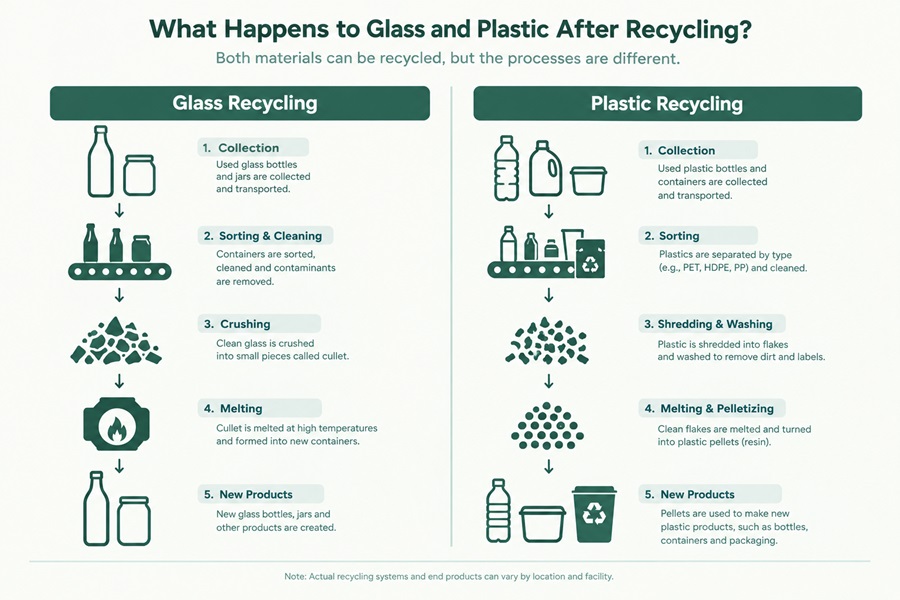
Recyclers sort glass, remove contaminants and crush it into cullet for use in manufacturing. Color and cleanliness affect whether it can become another bottle or jar.
Ceramics, drinking glasses and heat-resistant cookware can cause problems in container-glass recycling. Keep them out of the bottle-and-jar stream unless your local service explicitly accepts them. Follow local instructions for caps, lids and broken containers too.
The U.S. EPA’s glass recycling data illustrate the gap between technical potential and actual recovery: the United States recycled 31.3% of glass containers generated in 2018. That is a historical figure, not a current-year recycling rate.
What happens to collected plastic
Mechanical recycling generally involves sorting, washing, shredding and remelting plastic. Different polymers need separate processing, and packaging shape matters alongside material type. A bottle and a flexible pouch may have very different recycling options.
PET bottles and HDPE jugs have established collection and recycling routes in many regions. Multilayer packs, films and heavily contaminated items can be harder to handle economically. Repeated heat exposure and contamination can also affect the quality of recovered resin.
Some recovered plastic becomes new food-contact packaging through suitable, controlled processes. Other material becomes products with fewer options for another recycling cycle. Check the actual items your local service accepts rather than relying on a recycling symbol alone.
Glass vs plastic for food storage
For leftovers, sauces and foods that stain, glass is often convenient. Its nonporous surface is easy to clean and does not readily retain smells. You can also see what is inside without opening the lid.
Plastic has practical advantages for packed lunches and travel. It is lighter, easier to carry and less likely to shatter if dropped. Food-contact plastic can be suitable when used within the conditions it was designed for.
Heat and chemical migration
Food-contact materials are evaluated for particular uses. A container intended for cold storage should not be assumed suitable for cooking. Chemical migration depends on factors including temperature, contact time, the food and the material.
The USDA’s guidance on packaging and chemical migration warns against microwaving cold-storage tubs, such as margarine and cottage-cheese containers, that were not designed for heating.
Use containers explicitly suitable for your heating method. Check lids separately: a microwave-safe glass base does not automatically make its lid microwave-safe or oven-safe.
Glass also has limits. An ordinary food jar is not necessarily oven-safe, and sudden temperature changes can crack glass. Follow the manufacturer’s instructions for heating, freezing and cooling. Leave the recommended expansion space when freezing liquids in freezer-rated containers.
What about microplastics
Microplastics have been detected in foods and beverages, but exposure and health effects remain active areas of research. Packaging is one possible source among several; processing equipment and environmental contamination also matter.
The FDA’s overview of microplastics and nanoplastics in foods states that current evidence does not demonstrate that the levels detected in food pose a human-health risk. That does not settle every question about exposure or long-term effects.
Choosing glass can reduce direct contact between food and plastic surfaces. It does not guarantee a food or drink is free of plastic particles, especially when lids, seals and earlier processing steps are involved.
For everyday use, choose food-contact containers, respect their temperature limits and replace damaged items that no longer function properly.
When refillable glass makes sense
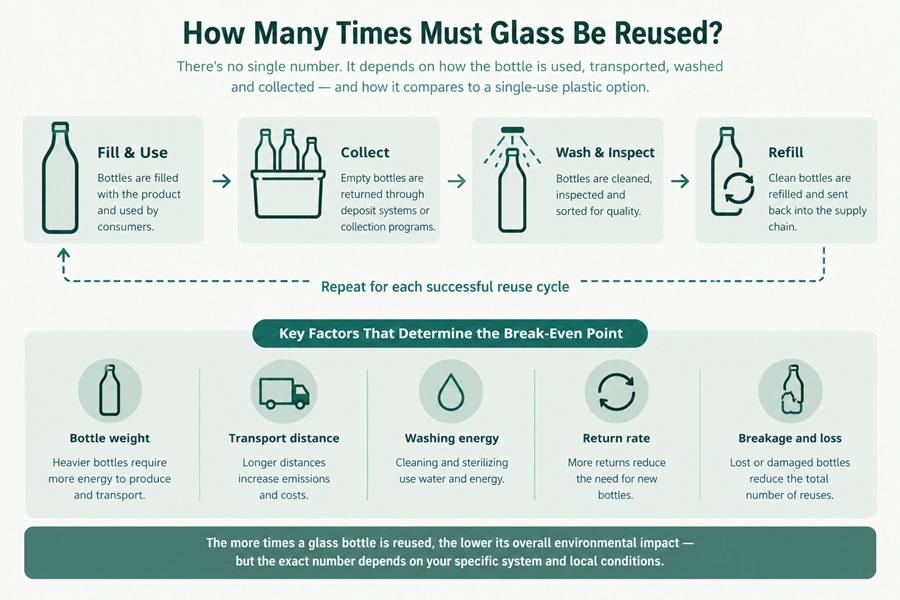
Refilling lets one bottle serve many purchases. Its manufacturing footprint is shared across those uses, while washing, inspection and return transport add impacts each time.
There is no universal number of refills that makes glass better than plastic. A heavy bottle returned a long distance for washing faces a different calculation from a standardized bottle circulating between a nearby dairy and its customers.
Return rates are crucial. A bottle designed for dozens of trips provides little benefit if customers keep it after its first filling. Breakage, losses, washing efficiency and the energy supply also affect performance.
Our reusable packaging guide explains how refill and return systems work. When comparing a particular scheme, look for evidence about actual trips per container and return distances, rather than its maximum advertised lifespan.
Reusing a jar at home is a separate, simpler opportunity. A clean jar may work well for dry-food or household storage. Do not assume it is suitable for pressure canning, freezing or oven use just because it survived its original filling.
Which costs less
Plastic often costs less in high-volume single-use packaging because manufacturers can make strong, lightweight containers quickly. Lower shipping weight and fewer breakage losses can add to that advantage.
Glass often costs more to manufacture, move and handle. A returnable system also needs collection, inspection and washing. Repeated use can spread the initial container cost across many sales, but only if enough containers come back.
For businesses, compare cost per successfully delivered filling. Include closures, protective packaging, freight, product losses, washing and replacement containers. The cheapest empty bottle may not produce the cheapest overall system.
How to choose for everyday use
| Situation | A practical option | What to check |
| Leftovers and strong-smelling sauces | Durable glass storage container | Lid fit and heating instructions |
| School lunches and outdoor trips | Durable food-contact plastic | Reuse rating, condition and cleaning instructions |
| Local beverage return scheme | Refillable glass | Convenient returns and actual reuse performance |
| Drinks shipped long distances | Lightweight packaging may help | Recycled content, product protection and collection |
| Freezing soup or stock | Freezer-rated container of either material | Expansion space and temperature limits |
| Pantry storage | Suitable containers you already own | Cleanliness, dryness and a secure closure |
Start with what you already have. Replacing functional containers solely to change materials adds another purchase and another manufacturing footprint. Keep using suitable containers while they remain sound, and choose replacements around how you will actually use them.
Are compostable alternatives a better option
Compostable packaging needs its own comparison. It is not an automatic improvement over either glass or conventional plastic, and it rarely replaces every function of a durable storage container or beverage bottle.
Our guide to biodegradable and compostable plastics explains why those labels describe different claims. A product certified for industrial composting should not be assumed to break down in a garden, landfill or waterway.
For food-service items, the practical question is whether an accepting composting facility exists and whether the packaging will reach it. The compostable packaging guide covers that disposal decision in more detail.
Be cautious with other breakdown claims too. Oxo-degradable plastics are designed to fragment through oxidation; fragmentation does not establish complete biodegradation. A package becoming less visible does not prove its waste problem has been solved.
Making the choice that fits the job
Glass works well for repeated kitchen storage and can suit effective local refill systems. Plastic’s lower weight and impact resistance are useful for transport and portable containers. Either can be wasteful when used unnecessarily or discarded after a short life.
Choose around the full job: protect the contents, use the container as intended, keep it in service where practical and check where it can go afterward. A returnable bottle you reliably return has more value than a reusable one that never makes a second trip.
Frequently asked questions
Is glass always more environmentally friendly than plastic
No. Single-use glass often has higher greenhouse gas emissions than a comparable lightweight plastic bottle. Glass can offer advantages in repeated use and material recycling, while plastic creates distinct litter and fragmentation concerns. The outcome depends on the package and its collection system.
Is glass better for storing hot food
Glass rated for the intended temperature can be a useful option. Ordinary jars and drinking glasses should not be treated as heat-safe cookware. Plastic must also be rated for the intended use; a cold-storage tub is not automatically suitable for hot food or reheating.
Can glass be recycled forever
Suitable glass can be remelted repeatedly without the polymer degradation associated with plastics. Actual recovery still involves collection losses, sorting and contamination. “Infinitely recyclable” describes material potential rather than an endless journey guaranteed for every bottle.
How many times should a glass bottle be reused
There is no single break-even number. It depends on bottle weight, the alternative being replaced, washing, return transport, losses and the environmental impact being measured. Use evidence from the particular refill system rather than applying a number from an unrelated study.
Should I throw away my plastic food containers
There is no need to replace all functional food-contact containers at once. Use them according to their instructions and replace damaged items. When you need a new container, choose the material, size and temperature rating that suit its job.
Leave a Reply