
Artificial intelligence, computer vision and robotics are changing some recycling operations. They can help identify materials, monitor quality and automate selected picking tasks. But they do not remove every contaminant, create markets for recovered material or guarantee that a facility will become profitable.
The reality is more complicated.
Yes, automation is improving sorting accuracy and speed. Yes, facilities with newer technology outperform older ones. But automation is capital-intensive, and it doesn’t fix the underlying economic problems that are collapsing the industry. In some cases, it makes them worse.
This is the story of what automation can and cannot do for MRFs — and why better technology alone won’t save a broken business model.
The Case for Automation: Where It Actually Works
Automation excels at specific, repetitive, high-speed tasks. In an MRF, that’s identifying and separating materials.
Optical Sorting Gets Smarter
How it works: An optical sorter uses cameras and near-infrared (NIR) sensors to scan plastic pieces at high speed (hundreds per second). It identifies the plastic type (PET, HDPE, LDPE, etc.) by analyzing how the material reflects light.
Traditional optical sorters were “dumb” — they looked for specific light signatures and either matched or didn’t. If a piece of plastic was dark, degraded, or covered with a label, it often went unrecognized and ended up in residue.
Modern optical sorters with AI: Machine learning algorithms train on thousands of images, learning to identify plastics even when they’re dirty, damaged, or partially obscured. They can distinguish between similar-looking plastics (like clear PET and clear polystyrene) with higher confidence. Supplier performance figures are not directly comparable. Accuracy depends on the material mix, test conditions, line speed, object presentation, target polymer and how false positives and missed items are counted. Do not quote a single accuracy rate without an independent study and a clearly defined test.
Equipment prices depend on the system, capacity, installation, software, integration and service contract. Request a dated vendor quotation or a published project budget before including a specific price.
Payback depends on the amount of additional saleable material, the value of that material, avoided downtime, financing and ongoing maintenance. Operators should calculate it using measured facility data and conservative price assumptions.
Commodity prices are volatile. A lower selling price can quickly reduce the revenue benefit of recovering more material, extending the payback period.
Robotic Picking for Contamination Removal
What it does: Robotic arms with suction cups or grippers pick specific items off conveyor lines — plastic bags, food-soiled containers, hazardous materials — and remove them before they reach sorting equipment.
Robotic picking performance depends on item spacing, object shape, belt speed, grasp success and the target material. Results from one installation should not be generalized to every facility. Human workers remain useful for irregular objects and tasks that require judgment.
Robotic picking can remove selected target items from a conveyor before they reach later sorting stages. Its performance depends on item presentation, belt speed, gripping reliability and the type of contamination.
The cost: Robotic system costs are project-specific. They depend on the number of robots, conveyor modifications, safety systems, software, integration and ongoing service. Avoid presenting an unverified price as a standard market cost.
Potential benefits include fewer equipment stoppages, more consistent quality checks and reduced exposure to some repetitive or hazardous tasks. The actual effect should be measured at each facility.
The catch: Robotic picking can’t replace human sorters entirely. The system needs to be trained on the specific contamination profile of each facility’s input stream. Regional variation (different contamination patterns in different areas) requires different models. And the system still misses contamination — it’s accurate but not perfect.
Real-Time Monitoring and Optimization
What it does: IoT sensors on equipment track throughput, conveyor speeds, sorter accuracy, equipment temperature, and power consumption. AI algorithms analyze this data in real time and automatically adjust equipment parameters to optimize sorting efficiency.
Example: If a sorter is running slower than optimal (maybe the lens needs cleaning, or material throughput isn’t aligned), the system flags it. If a baler is running at suboptimal compression pressure, the system recommends adjustment. A dashboard shows operators real-time metrics and predictive alerts (this equipment will likely fail in X days).
Predictive maintenance can flag unusual vibration, temperature or operating patterns before equipment fails. Its value depends on sensor quality, maintenance response and whether alerts identify problems early enough to prevent downtime.
Sensor and software costs depend on the number of monitored assets, integration needs, data services and support arrangements.
ESG Reporting and Supply Chain Transparency
What it does: Digital tracking systems record the material origin, sorting process, contamination rates, commodity destination, and end-market buyer. This data generates transparency reports that municipalities and brands can use for ESG (Environmental, Social, Governance) reporting.
Why it matters: municipalities and buyers increasingly want traceability about where recovered material goes. A digital system can record tonnage, quality checks and downstream destinations, but a report should distinguish material sorted from material actually reprocessed.
The commercial value: Municipalities and brands paying for this transparency will negotiate higher processing fees or longer contracts to secure it. The facility gets more stable, predictable revenue.
Digital traceability costs depend on the platform, data integration, audit scope and reporting requirements.
The commercial value is indirect. Verified data can help municipalities and buyers assess material quality and destination, but a fee premium should not be assumed without a signed contract.
The Limits of Technology: What Automation Cannot Fix
Here’s where the story gets real. Automation is powerful, but it operates within constraints that technology alone can’t overcome.
Contamination at the Source Cannot Be Engineered Away
A facility can install advanced sorting and still receive a highly contaminated input stream. The level of contamination varies by collection program and should be measured locally. Why? Because the most damaging contaminants are invisible or structural:
Food residue inside containers — a robot can’t see inside a sealed yogurt container to detect spoiled milk. Only when the container breaks during sorting does the food spill out. By then it’s too late.
Plastic bags and film can wrap around shafts and rollers, forcing a line stoppage while staff remove the material. The duration and financial impact depend on the equipment and incident.
Non-recyclable plastics mixed with recyclables — a robot can be trained to identify #3 or #6 plastic and remove it, but only if it’s on the surface. A piece of #6 plastic buried in a bale of #1 plastic won’t be caught.
Incompatible materials bonded together — two different plastic types glued together (a laminate, for example) can’t be separated mechanically. The robot either separates them (damaging both) or leaves them mixed (making the batch unmarketable).
Automation improves sorting efficiency, but it can’t overcome the fundamental problem: garbage in, garbage out. Better sorting of contaminated input still produces contaminated output.
Commodity Prices Don’t Care About Sorting Accuracy
Even a highly accurate sorting system earns revenue only when recovered materials meet buyer specifications and have a market. Lower commodity prices can reduce revenue despite improved sorting.
A facility can improve sorting performance and still face falling revenue if commodity prices decline sharply.
For example, a facility that recovers more saleable material may still face financial pressure if market prices fall sharply. Higher recovery can improve resilience, but it cannot remove exposure to commodity markets.
Automation moves the margin, but doesn’t eliminate volatility. The business model is still vulnerable to commodity price swings.
Operating Costs Don’t Scale with Automation
- A facility with advanced automation still needs:
- The same real estate (land and building)
- Similar utility costs (conveyors run whether sorting is manual or automated)
- Equipment maintenance (replacing parts, software updates)
- Residue disposal (same tonnage of contaminated material still needs landfill/incineration)
- Debt service (paid back equally whether you’re using old equipment or new equipment)
Automation can reduce some repetitive manual tasks, but it also creates demand for technicians, software support and maintenance. Total staffing and labor savings depend on the facility’s design and operating model.
Significant, yes. But not transformative. It reduces the operating cost baseline, which helps during downturns — but it doesn’t solve the fundamental problem of low-margin commodity revenue.
Capital Cost Is a New Problem
New-build capital costs and debt service vary substantially by project. A valid payback analysis should use the actual project budget, financing terms, throughput, operating hours, contracts and expected commodity revenue.
A facility with older equipment may have lower remaining debt but higher maintenance needs. A newer facility may improve sorting performance while carrying larger capital and financing costs.
If commodity prices fall, a newer facility may face pressure from its financing costs even when its sorting performance is strong.
Counterintuitive reality: Newer, more automated facilities don’t always have better economics than older ones. They have better sorting efficiency, but worse balance sheets.
Automation Doesn’t Create Markets
If an MRF improves sorting accuracy and produces higher-quality bales, there still has to be a buyer willing to pay a premium for that quality. Many markets don’t exist:
High-purity mixed plastics have limited end uses
Certain plastic types (#4, #5) have weak demand
Contaminated paper fiber has no buyers above a certain contamination threshold
Film and flexible packaging can’t be mechanically recycled at scale (no established market exists for it)
Automation can produce perfectly sorted material, but if the market doesn’t want it, the bales sit or get downcycled to lower value, or end up as residue anyway.
Example: AI-Driven Sorting in Portsmouth, Virginia
A working example is the Portsmouth, Virginia, facility run by AMP Robotics through its affiliate Commonwealth Sortation LLC. It serves the Southeastern Public Service Authority (SPSA), the regional waste authority for eight communities and about 1.2 million residents. It is not a conventional curbside single-stream MRF. It sorts mixed municipal solid waste (bagged trash), so it shows the same technologies applied to a harder sorting problem.
How the plant works
According to AMP, the system uses cameras, robotics and pneumatic jets to detect and remove recyclables and organics from bagged trash. After a pilot line of about 150 tons per day, for which AMP reported more than 90 percent uptime, the plant was expanded to 108,000 tons of waste per year and completed formal acceptance testing against the contract’s recycling and diversion requirements.
What the contract requires
Under the 20-year agreement, at least half of the waste SPSA delivers must be diverted from landfill: about 20 percent as recyclables such as plastics and metals, and 30 percent as organics converted to biochar. The region’s recycling rate before the project was reported at about 7 percent. Local media put the agreement’s value at roughly $450 million. A second sortation facility and an organics system are planned, supported by $70 million in project debt financing announced in September 2026. AMP expects the second facility to come online in late 2027 and says the full system is designed to handle up to 540,000 tons per year.
What this example shows, and what it does not
It supports the article’s argument that automation works best inside a long-term contract. The 20-year term, guaranteed diversion targets and project financing are what make the capital investment bankable, not the sorting technology alone. It is also run by a technology company with access to project finance, which fits the earlier point about well-capitalized operators.
It does not show that automation fixes the underlying economics. Most of the performance figures come from AMP and SPSA announcements rather than independent studies, and the public record does not give the plant’s operating margins, residue rates or the prices received for recovered material. Commodity-price exposure, bale quality and end-market demand still apply. Readers should treat Portsmouth as a documented case of AI-based sorting operating at scale under one specific contract, not as proof that the model transfers to every facility.
Who Benefits Most From Automation? (Spoiler: Large Operators)
Automation doesn’t democratize the industry — it consolidates it.
Larger operators may have advantages in financing, technical staffing, purchasing and routing material between facilities. Independent operators can face a harder investment decision, although outcomes depend on local contracts and markets.
Large waste management companies (Republic Services, Waste Management, GFL Environmental) can:
- Finance large capital investments through corporate treasury
- Spread automation costs across multiple facilities
- Negotiate higher contract prices with municipalities by offering transparency and ESG reporting
- Route material between facilities to optimize market timing
- Absorb losses at individual facilities because other divisions subsidize them
An independent operator can’t compete on any of these dimensions.
Result: Further consolidation
Automation can favor operators with access to capital, technical staff and multiple facilities, but the article should not claim a quantified decline in independent MRFs without a reliable industry census. Large operators investing in automation will capture market share from smaller competitors who can’t afford the capital costs.
Automation may influence the competitive position of MRF operators, but industry structure will also depend on ownership, local contracts, regulation, access to capital and the availability of skilled maintenance staff.
Large operators may be able to spread investment and technical support across several facilities.
Regional partnerships and cooperatives may help smaller facilities share expertise or purchasing power.
Independent facilities may remain viable where local contracts, material supply and end markets support the operation.
This consolidation has implications: less local competition, higher bargaining power for large operators, less flexibility for municipalities. It may also mean less redundancy — if a regional facility closes, there’s no backup.
The Automation Investment Decision: When It Makes Sense
For a facility considering automation investment, the math comes down to:
Do this if:
- Your measured recovery or output quality is below the level your facility can reasonably achieve (identify the gap through a material audit).
- You have stable input volume (at least 3–5 year visibility)
- You have long-term processing contracts that support higher pricing (automation costs need fee premium to justify)
- Commodity prices are stable or rising (you need favorable market conditions to absorb payback period)
- You can finance the capital cost without jeopardizing solvency (most facilities can’t)
Don’t do this if:
- Your facility already meets its operational targets (test whether further automation would deliver enough additional value to justify its cost).
- Your input stream is highly variable (commodity prices or volume swings make payback period uncertain)
- You lack long-term revenue stability (month-to-month contracts)
- Your facility is already struggling financially (automation won’t save an insolvent operation)
- You’re dependent on commodity sales with no contracted revenue (too much risk)
The decision should be based on a facility-specific business case. Operators should compare the expected improvement in saleable output and downtime with capital costs, maintenance, financing, staffing, contract terms and the reliability of end markets.
Automation makes sense for large operators with multiple facilities, stable contracts, and financial reserves to absorb payback periods. For everyone else, it’s a luxury they can’t afford.
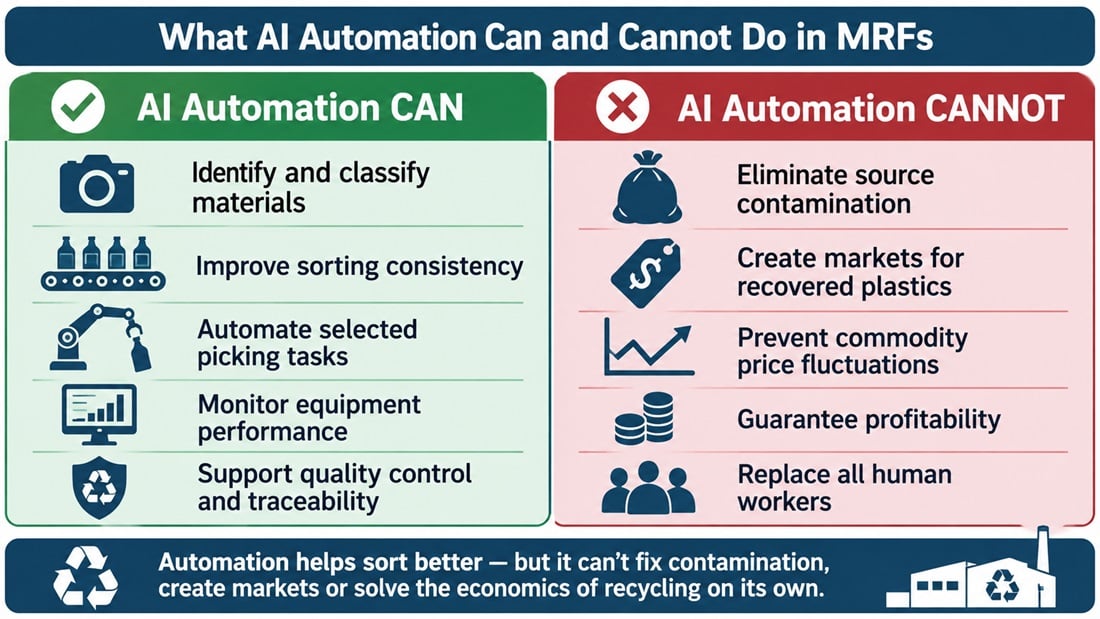
What Automation Can and Cannot Solve
Automation CAN:
- May improve target-material identification and quality control; measured recovery gains depend on the facility and input stream.
- Can reduce selected manual tasks, depending on line design and staffing requirements.
- Decrease equipment downtime (predictive maintenance, fewer jams)
- Enable transparency and ESG reporting (better contracts)
- Support higher-quality output bales (command small premiums)
Automation CANNOT:
- Reduce input contamination (problem is upstream, at the consumer level)
- Create markets for unmarketable materials
- Overcome commodity price volatility
- Reduce fixed costs below a floor (debt service, land, utilities, residue disposal)
- Make single-stream recycling economically efficient
- Solve the business model problem (low-margin, volatile revenue)
The Uncomfortable Truth About Technology
Technology is necessary but not sufficient.
Better sorting machinery is necessary for the recycling system to function — without it, contamination rates would be even worse. But better machinery alone doesn’t solve the industry’s profitability crisis or create sustainable economics.
The mistake the industry makes is betting that “better automation” is the solution. It’s not. The solutions are:
- Policy change — EPR funding, landfill taxes, carbon pricing, material design standards
- System design change — deposit systems, multi-bin collection, standardized packaging
- Market structure change — integrated supply chains, vertical consolidation, long-term contracts
Automation supports these solutions, but it doesn’t replace them.
Even a facility with advanced sorting, robotic picking and real-time monitoring can remain economically unviable if its inputs are contaminated, recovered materials have weak markets and fixed costs are too high.
The future of recycling depends less on better robots and more on making recycling a worth doing from a business and environmental perspective.
What’s Next?
You’ve now explored how automation improves sorting, why it still can’t save bad economics, and who benefits most from the technology shift. The final piece is understanding the materials themselves: which plastics are actually recyclable in today’s MRFs, and which ones are designed to fail.
Read Plastic Types & Recyclability in MRFs to learn what your plastic waste actually becomes — and why some materials shouldn’t be called “recyclable” at all.
Recent developments and what they mean for MRFs
A particularly relevant development appeared in October 2026. A study by researchers at the U.S. National Institute of Standards and Technology and the University of Maryland reviewed AI and robotic sorting in MRFs and consulted industry stakeholders. It describes a shift toward using AI as a standalone detection, quality-control and monitoring tool, rather than assuming every AI system needs a robot arm. The researchers identify practical barriers including speed, reliability, gripper performance, data availability and economic viability. This is a more realistic picture than vendor claims of near-perfect automated sorting.
The investment case should also be viewed against wider infrastructure needs. The U.S. EPA’s 2024 assessment estimated $36.5–$43.4 billion to modernize recycling infrastructure across collection and processing. That scale of need underlines why automation decisions should be evaluated alongside collection quality, contracts, maintenance capacity and end-market demand.
Sources and further reading
- NIST summary of the 2026 MRF AI and robotics study
- EPA recycling infrastructure assessment
- Peer-reviewed 2026 study indexed by PubMed
- AMP release: Portsmouth capacity expansion and acceptance testing (April 2026)
- WTKR: SPSA 20-year contract and diversion requirements
- AMP release: Portsmouth pilot line, 150 tons per day and 90 percent uptime
- AMP release: $70 million project financing for Portsmouth (September 2026)
Related guides on PlasticSolutionsReview
How material recovery facilities work | MRF contamination | MRF economics | plastic types and recyclability
Editorial note: Recovery rates, contamination levels, commodity prices and facility costs vary by location, date, material grade and contract. Where no comparable public dataset exists, this article avoids presenting a universal figure.
Leave a Reply