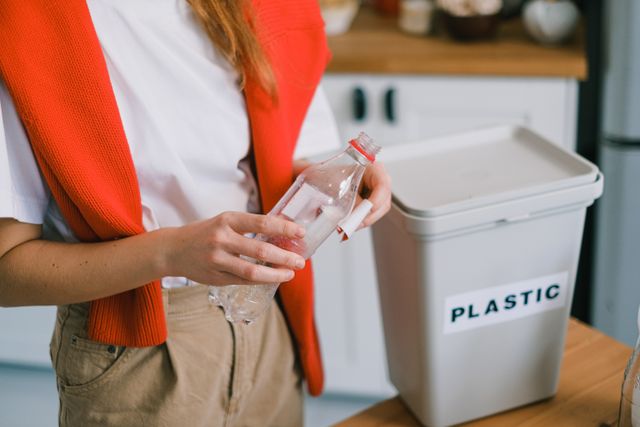
Picture three items landing in the same recycling bin: a water bottle, a milk jug and a yogurt tub. They all look like everyday packaging waste. But once they leave your hands, their journeys can look very different.
The water bottle is almost always PET (#1). The milk jug is HDPE (#2). The yogurt tub is usually polypropylene, or PP (#5). All three are recyclable, yet some are far easier to recover and turn into something new than others.
The reason isn’t just whether a plastic can be melted down again. It comes down to collection, sorting, contamination, material quality, and whether anyone actually wants to buy the recycled result. This guide walks through how PET, HDPE and PP behave in real recycling systems, why some products fall through the cracks, and what the recovered material becomes.
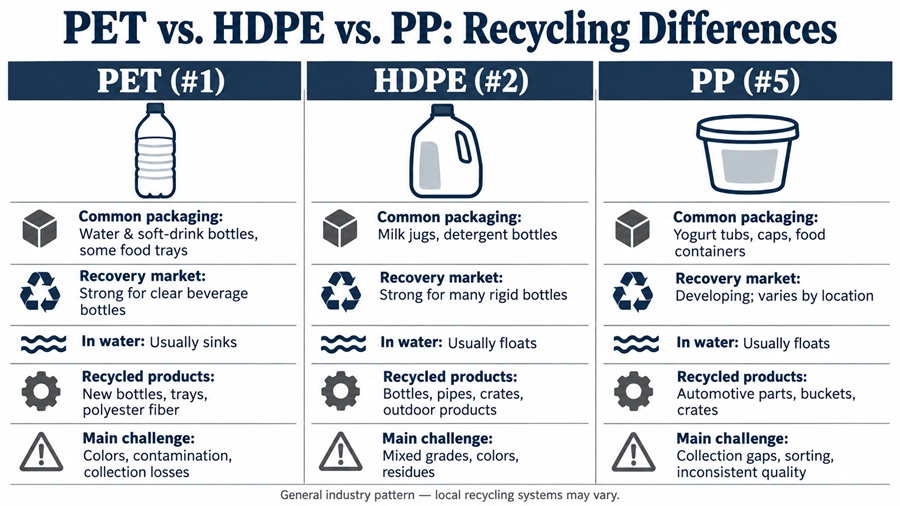
PET, HDPE and PP at a Glance
| Recycling factor | PET (#1) | HDPE (#2) | PP (#5) |
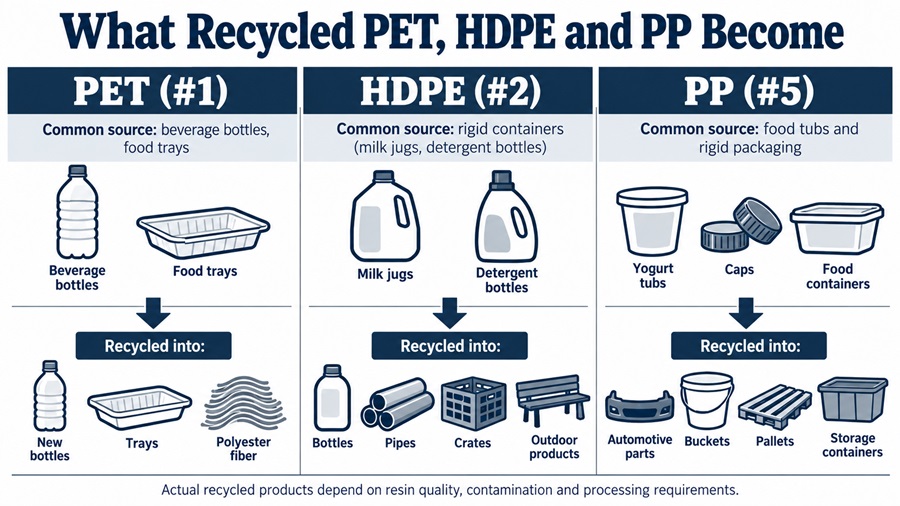
| Common packaging | Beverage bottles, food trays | Milk jugs, detergent bottles | Yogurt tubs, caps, food containers |
| Recovery markets | Strong for clear beverage bottles | Strong for many rigid bottles | Developing; varies by location |
| In water | Usually sinks | Usually floats | Usually floats |
| Recycled material | rPET | rHDPE | rPP |
| Common recycled products | New bottles, trays, polyester fiber | Bottles, pipes, crates, outdoor products | Automotive parts, buckets, crates |
| Main obstacle | Contamination, colors, collection losses | Mixed grades, colors, residues | Collection gaps, sorting, inconsistent quality |
| Food-contact recycling | Established for suitable processes | Possible with suitable processes | Possible, but more application-specific |
Treat this as a general pattern, not a universal ranking. Local infrastructure, packaging design and end-market demand can change the picture a lot.
If you want to go deeper on the materials themselves, we have separate guides to PET plastic, HDPE plastic and polypropylene (PP).
PET Recycling: Why Clear Bottles Have the Edge
PET’s big advantage is that clear beverage bottles make a consistent, easy-to-recognize waste stream. Water and soft-drink bottles are made to similar specifications, so recyclers can turn them into material that manufacturers are happy to use again.
Clarity matters because it keeps options open. Recycled clear PET can go into transparent bottles, food packaging or colored products. Colored PET has fewer paths, since pigments can’t simply be washed out. And when recyclers go to sell their output, a cleaner, more uniform batch simply has more potential buyers.
Bottle-to-Bottle vs. Bottle-to-Fiber
PET can be recycled in a closed loop: a used beverage bottle becomes a new beverage bottle, as long as the recycled material meets quality and food-contact requirements.
The other common route is polyester fiber for clothing, carpet or insulation. Both routes recover material, but they end differently. A new PET bottle can re-enter an established bottle collection system. A polyester jacket, by contrast, rarely has an equivalent recycling network waiting for it at end of life.
Neither route is automatically better in every situation, but bottle-to-bottle offers a clearer path to recovering the same material again and again.
Why Some PET Packaging Is Harder
Not every PET container benefits from that bottle infrastructure. Thermoformed food trays, colored bottles and multilayer packaging cause problems that a plain clear bottle doesn’t:
- Large shrink sleeves can confuse optical sorters.
- Adhesives can contaminate washed flakes.
- Some barrier materials degrade the quality of the finished resin.
- PET can lose molecular weight during processing if moisture and heat aren’t carefully controlled, so reprocessors sometimes need extra treatment to restore the properties demanding applications require.
That’s why a PET bottle and a PET food tray can have very different recovery outcomes, even though both carry the #1 code.
HDPE Recycling: Color and Past Use Matter
HDPE has a well-established market for many rigid containers, especially milk jugs, household-product bottles and industrial packaging. But two HDPE containers can be worth very different amounts to a recycler.
A natural, translucent milk jug gives recyclers flexibility, because the material can be processed into a wide range of colors. A heavily pigmented detergent bottle is more limited: dark HDPE generally ends up in dark finished products. That’s why recyclers separate natural HDPE from mixed-color HDPE.
What Recycled HDPE Becomes
rHDPE goes into new bottles, bins, crates, drainage products, outdoor furniture and certain pipe products. The end use sets the quality bar. A storage crate can tolerate an appearance and performance profile that a bottle or pressure-rated pipe cannot. Manufacturers weigh melt flow, impact resistance, contamination and durability before choosing recycled content, and demanding applications may need extra testing, blending or modification.
The Problem With Mixed HDPE
A detergent bottle, an industrial drum and a plastic pipe can all be HDPE, yet each may have different molecular-weight distributions, additives, pigments and processing behavior. Blend them without control and you get recycled material that performs inconsistently.
Previous use matters too. Containers that once held chemicals need careful evaluation, because residues can linger in the plastic. So good HDPE recycling takes more than spotting the #2 code. It takes feedstock that matches what the recycled product needs.
PP Recycling: Why Polypropylene Is Harder to Recover
Polypropylene shows up everywhere: rigid food packaging, closures, car parts, household goods and flexible packaging. The issue isn’t that PP can’t be recycled. It’s that gathering enough suitable PP, separating its many grades and producing consistent recycled resin is difficult. A yogurt tub, a bottle cap and a car bumper may all be polypropylene, but they aren’t interchangeable feedstock.
Collection and Sorting Are the Big Hurdles
Most recycling systems were built around commonly collected bottles, mainly PET and HDPE. PP comes in a much wider range of formats: tubs, trays, caps, films and small rigid parts.
Some materials recovery facilities accept rigid PP containers, while others have limited ability to identify and capture them. Films and flexible packaging usually need separate collection. Small PP items can also slip through mechanical screens into the wrong fraction. The result: a technically recyclable PP item may never reach a polypropylene reprocessor.
Why Recycled PP Quality Varies
PP products are made with different grades and additives. Some are tuned for stiffness, others for impact resistance or easy molding, and mixing them makes consistent melt flow and mechanical performance harder to deliver. Food residue, odors, pigments and leftover additives add more complications, and repeated heating can degrade the polymer and change its properties.
Recyclers tackle this with better sorting, washing, filtration, stabilization, blending and application-specific quality control. Even so, not every recycled PP batch suits every new product.
What Recycled PP Becomes
Recycled PP goes into automotive components, buckets, storage containers, pallets, crates and other molded products. Higher-end uses require tighter control over resin properties and contamination.
Food-contact use is possible under the right regulatory conditions, but don’t assume recycled PP is food-grade just because the original package held food. For some stubborn PP waste streams, alternative technologies may come into play. Our plastic pyrolysis guide covers one such route and its limitations.
PET vs. HDPE vs. PP: Which Is Easiest to Recycle?
There’s no single answer for every country or product. Where beverage-bottle collection is well established, clear PET usually has the advantage, since it flows into dedicated recovery systems and can return to bottle manufacturing. Natural HDPE bottles benefit from mature markets and steady demand for recycled resin. PP is tougher because collection coverage, sorting equipment and feedstock consistency vary so much.
Comparing the barriers makes the differences clearer:
| Issue | PET | HDPE | PP |
| Clean, identifiable bottle streams | Major advantage | Major advantage | Less common |
| Sensitivity to mixed colors | High for clear applications | Significant for natural resin | Depends on end use |
| Mixed product grades | A concern | A concern | Especially challenging |
| Food-contact recovery | Established for suitable streams | Available under specific conditions | More limited, application-specific |
| Collection strength | Strong for bottles in many markets | Strong for many bottles | More variable |
| Room to improve | Better capture and packaging design | Cleaner, grade-specific streams | Broader collection, higher-purity sorting |
The key distinction is technical versus practical recyclability. A polymer can pass a lab recycling test and still be hard to recycle commercially if collection is costly or buyers can’t use the output. The strongest systems line up three things: suitable waste, reliable processing and real demand for the recovered material.
Why These Plastics Must Be Separated
You can toss PET, HDPE and PP into the same household bin, but high-quality recycling generally needs them in separate streams.
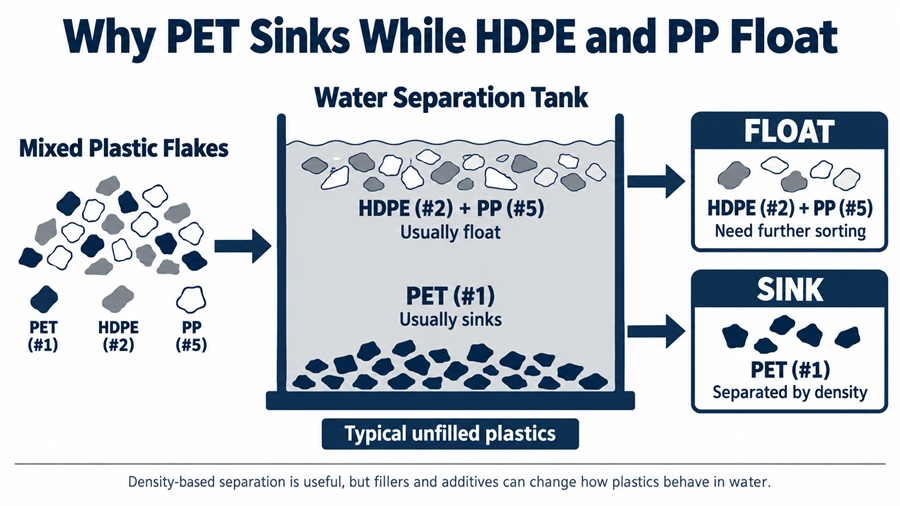
The first tool is density. PET is typically denser than water, while plain, unfilled HDPE and PP are lighter. In a water tank, PET flakes sink and HDPE and PP flakes float, which neatly separates PET from many polyolefin parts, including bottle caps.
But HDPE and PP both float, so density can’t tell them apart. Facilities add other methods, such as near-infrared optical sorting, to identify polymer types. And since fillers and additives can shift a plastic’s density, sink-float separation isn’t foolproof.
What Happens When They Get Mixed
PET and polyolefins like HDPE and PP are generally incompatible in conventional melt recycling unless specialized measures are used. Poorly controlled blends can separate into distinct phases, causing defects and weaker mechanical performance. Even HDPE and PP, though related, can cause trouble when mixed in the wrong proportions. Small amounts of contamination are especially damaging where strength, appearance or processing consistency matters.
That’s why sorting quality often decides what recycled plastic is worth. For a step-by-step look at collection, washing, extrusion and pelletizing, see our guide to mechanical recycling.
Can Recycled PET, HDPE and PP Go Into Food Packaging?
Yes, but the polymer alone doesn’t settle it. Used plastic can carry residues from earlier contents, chemicals absorbed during use, or contamination picked up during collection. Those must be controlled so the recycled packaging meets food-contact safety rules.
PET has well-developed recycling and decontamination technology for beverage bottles. Recycled HDPE and PP can also serve in certain food-contact applications when the feedstock, process and intended use meet the relevant requirements. The U.S. Food and Drug Administration says recycling processes must be evaluated for contaminants and other chemical safety concerns, and it maintains a list of processes where it has issued favorable opinions for particular food-contact uses.
Suitability is application-specific. Approval for one type of packaging or condition of use doesn’t carry over to every food or temperature. And neither a recycling symbol nor a previous life as food packaging proves that recycled plastic is safe for food contact.
How Packaging Design Affects Recycling
A package made from a widely recyclable polymer can still cause problems. Take a clear PET bottle wrapped in an opaque full-body label: if optical sorters can’t read the plastic underneath, the bottle may be rejected or sent down the wrong line. Adhesives, liners and coatings can likewise interfere with reprocessing. The trouble isn’t always the main plastic. It’s the whole package.
Four design choices make the biggest difference:
- Color and pigments. Clear or natural packaging gives recyclers more flexibility, and some pigments hurt optical sorting.
- Labels and adhesives. They should suit the intended recycling process or wash off under suitable conditions.
- Multilayer materials. Permanently combining incompatible polymers makes conventional mechanical recycling difficult.
- Closures and components. Caps, seals, pumps and liners are often a different material, so their compatibility and how easily they separate affect the outcome.
Designers can check these choices early using established guidance such as RECOUP’s Recyclability by Design. Better design won’t fix everything, but it prevents avoidable losses at sorting and reprocessing.
Why Technology Alone Won’t Fix It
Recycling is often framed as an engineering challenge, and technology does help. Better optical sorters, improved washing and more consistent filtration all raise the quality of recovered material.
But economics matters just as much. A facility needs enough volume to run efficiently, and collecting scattered containers is expensive where waste services are thin. Recyclers also need buyers who will pay prices that cover collection and processing. When virgin plastic gets cheaper, recycled material faces tougher competition, especially in applications with no recycled-content requirement.
Chemical and other advanced recycling may offer extra options for certain waste streams, but they come with their own technical, energy, cost and environmental trade-offs. We cover those in our chemical recycling and advanced recycling guides. For PET, HDPE and PP, improving existing collection and material-specific recycling remains essential.
Which Plastic Is Better for Recycling?
If you mean which has the most established route, clear PET beverage bottles and natural HDPE containers lead in many markets. PP recycling is commercially viable too, but it depends heavily on product format, local collection and quality requirements.
That doesn’t mean brands should swap every PP package for PET or HDPE. The right plastic depends on what the product needs: function, material use, shelf life, safety and end-of-life options. A package that uses more material or causes more product waste isn’t greener just because its resin has a better recycling market.
The better question is whether a product can do its job efficiently and fit into a recovery system that actually exists.
Frequently Asked Questions
Is PET easier to recycle than HDPE? Not universally. Clear PET bottles and natural HDPE containers both have established systems in many markets. PET benefits from bottle-to-bottle demand, while HDPE has a broad range of uses. Local collection and feedstock quality decide what’s practical.
Can PET and PP be recycled together? They can be collected together where local programs accept both, but high-quality recycling generally requires separating them before reprocessing. Mixing the polymers weakens the recycled material.
Can HDPE be recycled multiple times? Yes. HDPE can go through several cycles, though heat, oxidation, contamination and repeated processing affect its properties. No fixed number of cycles applies to every HDPE product.
Why is polypropylene recycling less common? Collection gaps, varied packaging formats, sorting difficulties and inconsistent feedstock all make it harder to produce commercially useful recycled PP.
Are plastics numbered 1, 2 and 5 always recyclable? No. The numbers identify PET, HDPE and PP. They don’t guarantee that your local program accepts a particular package or that it will end up recycled.
The Bottom Line
PET, HDPE and PP are all recyclable, but their opportunities aren’t equal. PET benefits from established beverage-bottle recovery. HDPE offers broad reuse potential, especially when natural and colored material are kept apart. PP has useful applications but faces more variable collection and quality.
For all three, the same rule holds: recycling works best when products are designed for recovery, collected efficiently, sorted accurately and turned into materials manufacturers actually need. Improving those conditions matters far more than printing another recycling symbol on a package.
Leave a Reply